Bank of Italy Raises 2026 Growth Forecast to 0.9 Percent as Inflation Is Seen at 3.2 Percent
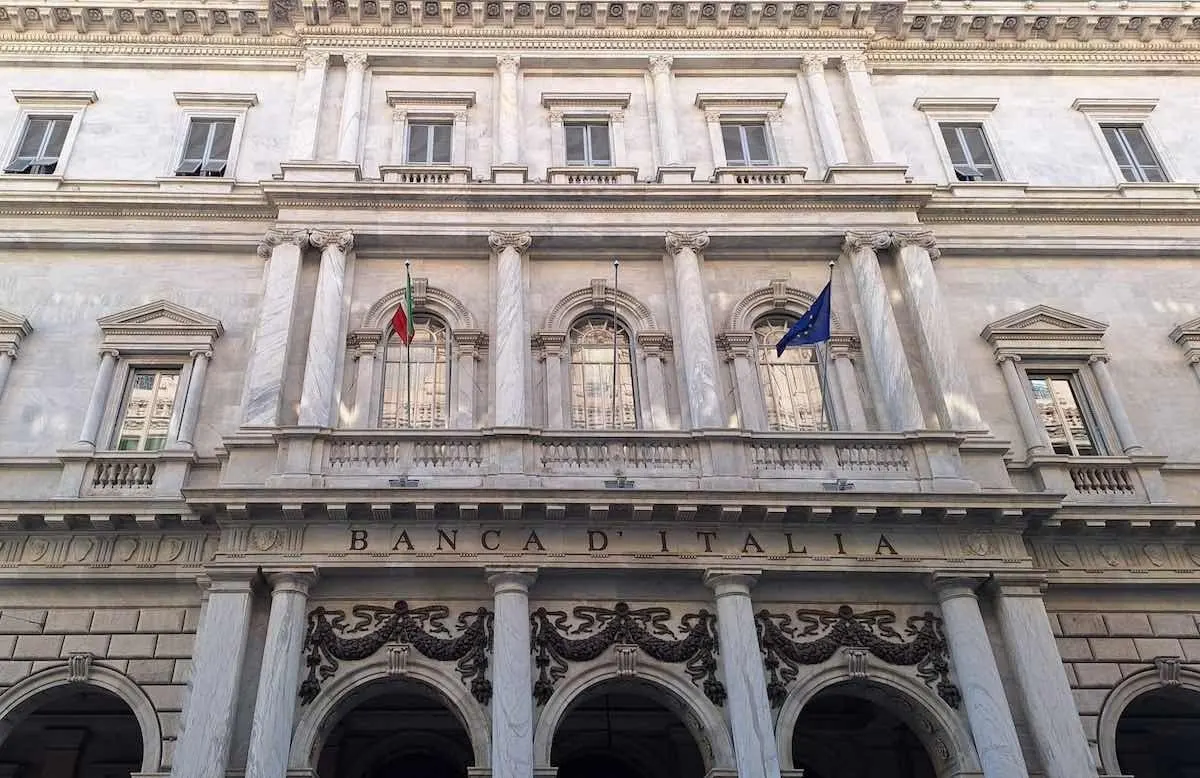
Banca d’Italia raised its forecast for Italian economic growth this year to 0.9 percent from 0.5 percent in June, in projections published alongside its Economic Bulletin on 16 October. The central bank put most of the upgrade down to “a less severe impact of the Middle East crisis” in the first half than it had assumed, together with favourable trends in investment linked to the digital and energy transition and, over the summer, in tourism. It now sees growth of 0.7 percent in 2027, up from 0.4 percent, and 0.8 percent in 2028, down from 0.9 percent. The bank notes that these projections were not prepared as part of a Eurosystem coordinated exercise, unlike those of June.
Why 0.9 Percent and Not 1 Percent
The 0.9 percent figure is built on quarterly data adjusted for seasonal and calendar effects. Without the calendar adjustment, the bank’s own table puts growth at 1.0 percent in 2026, 0.7 percent in 2027 and 0.6 percent in 2028, so 0.9 percent and 1 percent describe the same forecast on two bases. The gap is the calendar effect: it adds 0.1 point to 2026, nothing to 2027 and takes 0.2 point off 2028, on our calculation. On the adjusted basis the new path compounds to cumulative growth of 2.4 percent over the three years, against 1.8 percent in the June set, a gain of 0.6 point.
Most of this year’s number is already banked. Istat figures published on 5 October show GDP grew 0.2 percent in the second quarter and 1.0 percent on a year earlier, with a calendar-adjusted carry-over of 0.8 percent for 2026: the annual rate would reach 0.8 percent even if output stayed flat for the rest of the year. Set against the 0.9 percent forecast, that leaves 0.1 point for the second half to add, on our reading. It fits the bank’s estimate that activity slowed slightly over the summer on the uncertainty tied to international tensions and higher energy costs.
The domestic mix weakens next year, with consumption recovering to 1.2 percent only in 2028. Household consumption is forecast to grow 1.0 percent this year and 0.2 percent in 2027 as higher inflation erodes real incomes, while fixed investment grows 3.3 percent in 2026 and 2.3 percent in 2027 before slowing to 0.6 percent in 2028. Planned government spending on defence and energy security will help support activity over the next two years; in 2028 the bank expects higher interest rates to more than offset that boost. Italy’s 2026 forecast now matches the 0.9 percent that the September ECB staff projections, cited in the bulletin, set for the euro area as a whole.
Italy GDP projections, October against June
| Year | October | June | Revision (pts) |
|---|---|---|---|
| 2026 | 0.9% | 0.5% | +0.4 |
| 2027 | 0.7% | 0.4% | +0.3 |
| 2028 | 0.8% | 0.9% | -0.1 |
| 2026 to 2028, cumulative | 2.4% | 1.8% | +0.6 |
Banca d’Italia, Macroeconomic projections for the Italian economy, 16 October 2026. Annual changes on data adjusted for seasonal and calendar effects; without the calendar adjustment the October path is 1.0 percent, 0.7 percent and 0.6 percent. The cumulative row is our calculation.
Inflation Seen Peaking This Quarter
The price outlook moved the other way. The bank expects harmonised consumer price inflation to average 3.2 percent this year, twice the 1.6 percent of 2025, peaking in the fourth quarter before easing to 2.4 percent in 2027 and 1.7 percent in 2028. The 2027 figure is 0.4 point higher than in June because of energy prices, while 2028 is 0.2 point lower on base effects from an assumed fall in energy prices. Inflation excluding food and energy stays between 1.9 and 2.1 percent across the horizon, and the bank expects wage growth to remain moderate in late 2026.
The September data show where the strain sits. The national consumer price index rose 4.2 percent on a year earlier, up from 3.3 percent in August and confirming the flash estimate, and the harmonised index also rose 4.2 percent, above its 4.1 percent flash. Regulated energy prices were 25.8 percent higher and non-regulated energy 22.5 percent higher, while core inflation, which excludes energy and unprocessed food, was 1.6 percent, so the headline rate ran 2.6 points above core, on our calculation. The cost falls unevenly: in the third quarter, harmonised inflation was 4.4 percent for households with lower spending capacity and 2.9 percent for those with higher spending, a gap of 1.5 points on our calculation.
The climb has been steeper than in the wider euro area. Eurostat’s harmonised series has Italian inflation at 1.0 percent in January, 0.7 point under the euro area’s 1.7 percent; by September it was 4.2 percent against 3.8 percent, 0.4 point above, on our calculation. Italy’s monthly rates from January to September average 2.6 percent, on our calculation, well short of the bank’s 3.2 percent for the year as a whole, which leaves the higher readings to the final quarter. That is consistent with the bank’s call for a fourth-quarter peak. Its baseline assumes oil at 114 dollars a barrel and gas at 76 euros per megawatt hour on average in the fourth quarter, with the annual oil average falling from 98.7 dollars a barrel in 2026 to 78.2 dollars in 2028, a decline of 20.8 percent on our calculation.
Italy inflation and jobless projections
| Indicator | 2026 | 2027 | 2028 |
|---|---|---|---|
| Inflation (HICP), October | 3.2% | 2.4% | 1.7% |
| Inflation (HICP), June | 3.1% | 2.0% | 1.9% |
| Core, excluding energy and food, October | 1.9% | 2.1% | 2.0% |
| Unemployment rate, October | 5.8% | 6.0% | 6.0% |
| Unemployment rate, June | 5.4% | 5.5% | 5.5% |
Same projection set as above; annual averages. The unemployment rate was 6.1 percent in 2025.
Energy Eats Into the Trade Surplus
Italy ran a trade surplus of 1,773 million euros in August, the statistics office reported on 16 October, made up of a 2,100 million euro surplus with countries outside the EU and a 327 million euro deficit with EU partners. On a seasonally adjusted basis exports fell 1.5 percent from July and imports 1.6 percent, while over the latest 3 months exports were 0.7 percent higher than in the previous 3.
Excluding energy the surplus was 6,925 million euros, which puts the energy deficit at 5,152 million euros, 2.9 times the overall surplus, on our calculation. Against August 2025 as first published, when the surplus was 2,050 million euros and the non-energy surplus 5,481 million euros, the non-energy surplus grew by 1,444 million euros, or 26.3 percent, while the energy deficit widened by 1,721 million euros, or 50.2 percent. Import prices rose 7.3 percent on a year earlier, and 10.3 percent for goods from outside the euro area.
The same mechanism runs through the bank’s numbers. The bulletin says the current account surplus fell close to zero as the energy balance deteriorated, and the projections lower the 2026 current account surplus to 0.1 percent of GDP from 0.5 percent in June. The country’s net international investment position remains positive.
Italy’s August trade balance, million euros
| Balance | August 2026 | August 2025 | Change |
|---|---|---|---|
| Total | 1,773 | 2,050 | -277 |
| Excluding energy | 6,925 | 5,481 | +1,444 |
| Energy | -5,152 | -3,431 | -1,721 |
Istat. August 2025 as first published on 16 October 2025. The energy balance and the change column are our calculation; the energy balance is the total balance minus the balance excluding energy.
Why it matters: The forecast changes the mix of Italy’s prospects more than their direction. Growth this year is better than the bank expected in June and now level with the euro area forecast, but the gain rests mainly on a smaller first-half impact from the Middle East crisis, helped by investment and tourism, while consumption slows to 0.2 percent in 2027 and the jobless rate is projected at 6.0 percent that year, 0.5 point above the June path. Energy is the common thread: the energy trade deficit widened 50.2 percent in August, the bulletin ties the near-zero current account to the energy balance, and the bank attributes the 0.4 point rise in its 2027 inflation forecast to energy prices. On the public finances, the bulletin notes that the planning document approved on 2 October has net borrowing falling to 2.9 percent of GDP this year and rising to 3.4 percent in 2027, with debt rising to 138.5 percent of GDP. The bulletin also notes that the ECB has raised its deposit facility rate to 2.5 percent.
Outlook: The bank also set out three alternative scenarios. On our calculation from its scenario table, the severe case puts cumulative growth over 2026 to 2028 at 1.8 points below the baseline, which would mean output shrinking 0.3 percent in 2027, while inflation runs 3.3 points higher in total and reaches 4.9 percent in 2027. In the milder scenario, growth is 0.4 point higher over the three years and inflation 0.6 point lower. The next readings come from the statistics office, with consumer prices due on 30 October and foreign trade on 13 November.
Sources: Banca d’Italia, Istat, Eurostat, The Edge.