
Economic Report · Macroeconomic & Market Outlook
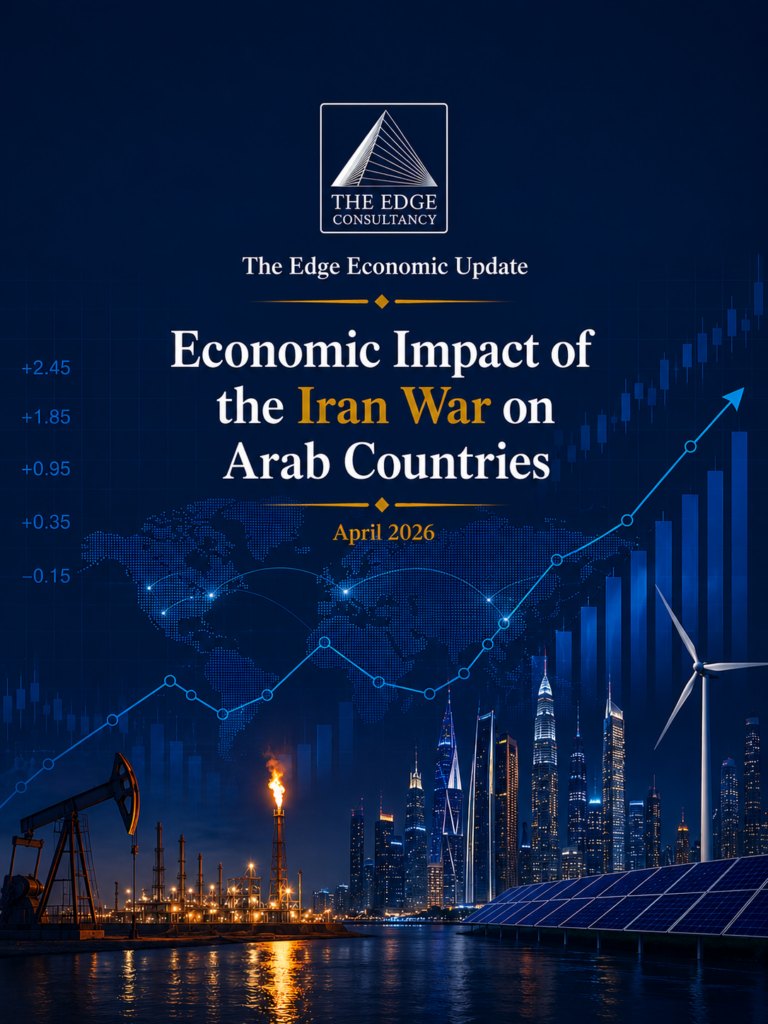
Economic Impact of the Iran War on Arab Countries
23 April 2026 · By The Edge Research Team
Report summary
This report provides a structured assessment of the macroeconomic impact of recent geopolitical tensions on Arab economies, with a focus on inflation dynamics, growth trajectories, and cross-country divergence. The central conclusion is clear: the current geopolitical shock is not a conventional oil cycle, but a multi-channel economic disruption affecting trade flows, energy supply chains, financial conditions, and investor confidence simultaneously. The transmission mechanisms include higher shipping and insurance costs, supply chain disruptions, capital outflows, and increased uncertainty across global markets. Even under a contained scenario, global conditions are tightening. Recent projections indicate global growth moderating to approximately 3.1% in 2026, while global inflation remains elevated near 4.4%, reflecting persistent supply-side pressures and geopolitical risk premiums. Across the broader MENA region, growth is estimated to slow sharply, with regional expansion declining toward ~1.8% in 2026, representing a significant downgrade from earlier expectations. Within the Arab world, the impact is highly uneven, leading to clear divergence in both inflation and growth outcomes. On inflation, the data shows a wide dispersion. Egypt records the highest projected inflation at 13.2%, followed by Tunisia at 6.5% and Mauritania at 4.1%, reflecting strong exposure to currency pressures and imported inflation. In contrast, Gulf economies maintain relatively contained inflation, generally within the 2.3% to 2.8% range, supported by currency stability, fiscal buffers, and policy intervention. However, upward revisions across several economies, including Bahrain (+1.6pp), Qatar (+1.3pp), and Kuwait (+0.6pp), indicate increasing sensitivity to global inflationary pressures.
Cite as: The Edge for Economic Consultancy, “Economic Impact of the Iran War on Arab Countries”, 23 April 2026. https://edgeconsultancykw.com/reports/economic-impact-of-the-iran-war-on-arab-countries-april-2026/ · Editorial Standards
Twin Shocks: Energy Prices, AI Leverage and Global Financial Stability
One of the two shocks in this report has already happened; the other is a vulnerability building on balance sheets.…
13 November 2026
Beyond the Barrel: The UAE's Non-Oil Economy Holds Firm in a Tested Half-Year
The United Arab Emirates came through the first half of 2026 with its economy still growing. Real gross domestic product reached 961.9 billion dirhams…
24 October 2026
Running on Buffers: The IMF's October 2026 Outlook and the Second Opinion on the Gulf's War Year
The world economy keeps absorbing blows it was not built for, and the International Monetary Fund has now put a number on the endurance.…
13 October 2026