China Targets 440 Million Tonnes of Domestic Oil and Gas Output by 2030 and 200 Million Tonnes of LNG Receiving Capacity
China published its Oil and Natural Gas Development 15th Five Year Plan on 17 August, jointly issued by the National Development and Reform Commission and the National Energy Administration under document number 1055 of 2026. The document itself is dated 3 July. It sets a 2030 target of 440 million tonnes of oil equivalent for domestic oil and gas output, alongside an LNG receiving capacity target of 200 million tonnes a year.
The output target is more modest than it appears. The plan states no baseline. Building one from the National Bureau of Statistics communique for 2025, crude output was 216.09 million tonnes and natural gas output 262.06 billion cubic metres. Converting the gas at the plan’s own factor of 1,255 cubic metres to one tonne of oil equivalent gives 208.8 million tonnes, for a 2025 total of about 424.9 million tonnes of oil equivalent. Reaching 440 million by 2030 is therefore an increase of roughly 3.6 percent over five years, about 0.7 percent a year. That is a plan to hold domestic output close to where it already is. It is growth, but slight.
| The plan’s 2030 targets, and a derived 2025 baseline | Figure |
|---|---|
| Domestic oil and gas output, 2030 target | 440 million tonnes of oil equivalent |
| New long distance trunk pipeline, 2030 target | 20,000 km added |
| Total long distance trunk network, 2030 target | 220,000 km |
| Gas storage as a share of national consumption, 2030 target | above 13 percent |
| LNG terminal receiving capacity, 2030 target | 200 million tonnes a year |
| Onshore pipeline gas import capacity, 2030 target | 114 billion cubic metres a year |
| CCS and CCUS carbon dioxide injection, 2030 target | 10 million tonnes a year |
| 2025 equivalent output, derived by The Edge from NBS data, not a plan figure | about 424.9 million tonnes |
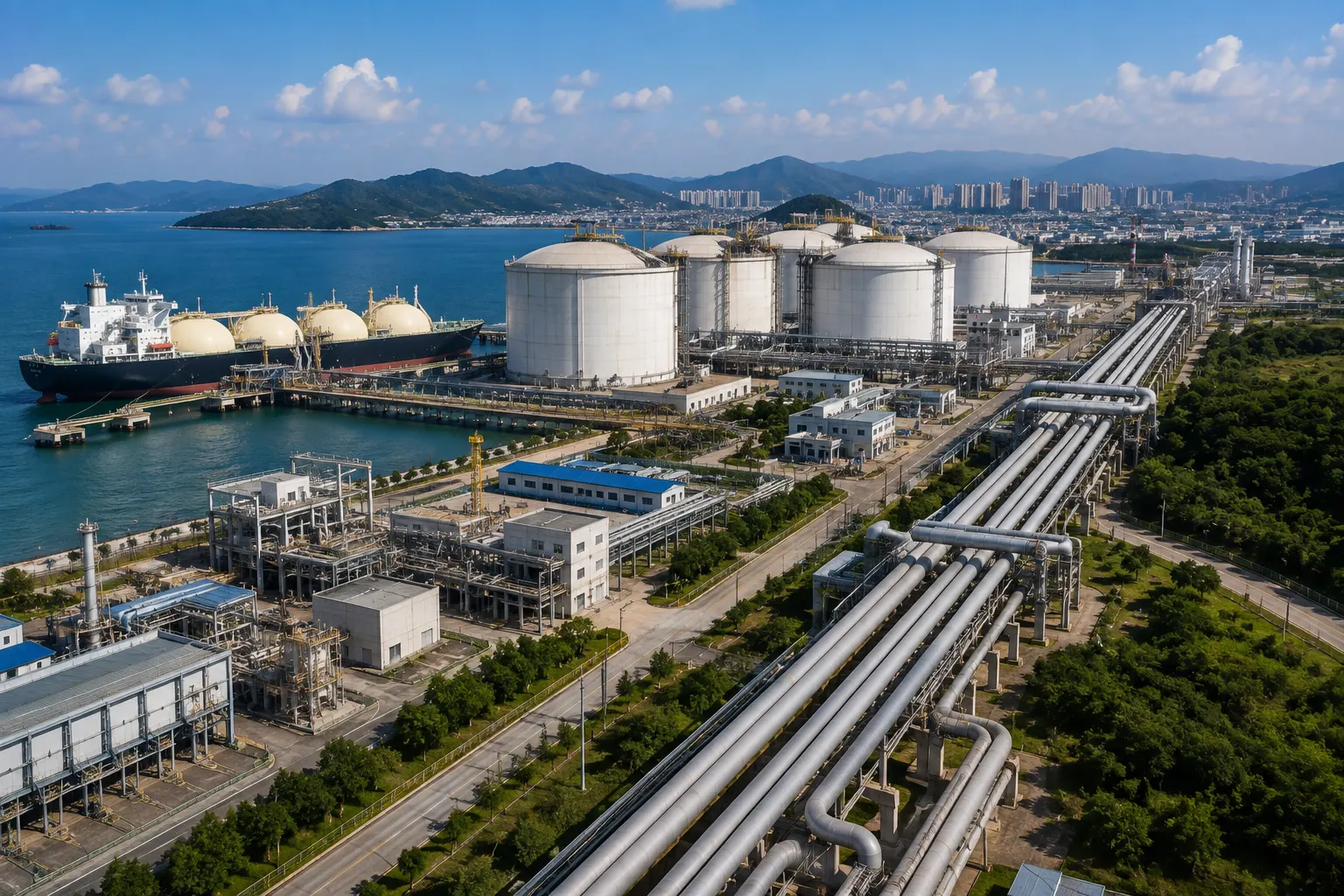
The import capacity targets have the widest read-across. The plan sets LNG terminal receiving and unloading capacity at 200 million tonnes a year by 2030 and onshore pipeline gas import capacity at 114 billion cubic metres a year. These are capacity targets for terminals and pipelines. They are not import volumes and they are not demand forecasts, and the plan publishes neither. What they establish is the infrastructure China intends to have in place by 2030.
How the LNG capacity is to be built is specified. The plan directs that receiving terminals be developed mainly by expanding existing facilities, with the siting of new projects assessed prudently. Only one new terminal is named, in western Guangdong.
Two definitions worth stating precisely. The gas figure of above 13 percent of national consumption refers to storage capacity, underground and LNG, not to geological reserves. The 10 million tonne carbon figure is annual injection under CCS and CCUS combined, not capture.
What the plan says about oil demand. Its own language commits to driving oil consumption to peak, and it keeps refining capacity under a strict reduction based replacement rule while maintaining moderate surplus refining and petrochemical capacity. It retains the levy and rebate arrangement on value added tax at the point of gas import. The pipeline annex is weighted toward overland import corridors, including new capacity on the eastern route from Russia and two further west to east trunk lines.
Why it matters: A country that plans 200 million tonnes a year of LNG receiving capacity and 114 billion cubic metres a year of pipeline import capacity, while committing to peak its own oil consumption and holding domestic output close to flat, is materially expanding its gas import optionality. Capacity permits volume, it does not establish it, and the plan forecasts neither imports nor demand. For Gulf producers those two capacity figures are the most useful numbers in the document, and the pipeline annex is the other half of the picture, because it shows the scale and configuration of the overland import capacity that would compete with seaborne supply.
Outlook: The plan covers 2026 to 2030. It sets an oil reserve replacement ratio of at least one, aims higher for gas, and targets offshore output at the 100 million tonne of oil equivalent class. No implementation timetable for individual targets is published and the plan carries no annual milestones, so the annual NBS output figures provide one external checkpoint against the 440 million tonne endpoint.
Sources: National Development and Reform Commission and National Energy Administration, Oil and Natural Gas Development 15th Five Year Plan, document 1055 of 2026, signed 3 July 2026 and published 17 August 2026 · National Bureau of Statistics of China, Statistical Communique on National Economic and Social Development 2025, published 28 February 2026. The 2025 oil equivalent baseline and the implied growth rate to 2030 calculated by The Edge Research Team using the conversion factor stated in the plan.