Egypt Executed 212,000 Housing Units in 2024/25 With 245.3 Billion Pounds of Investment as Private Builders Overtook the State
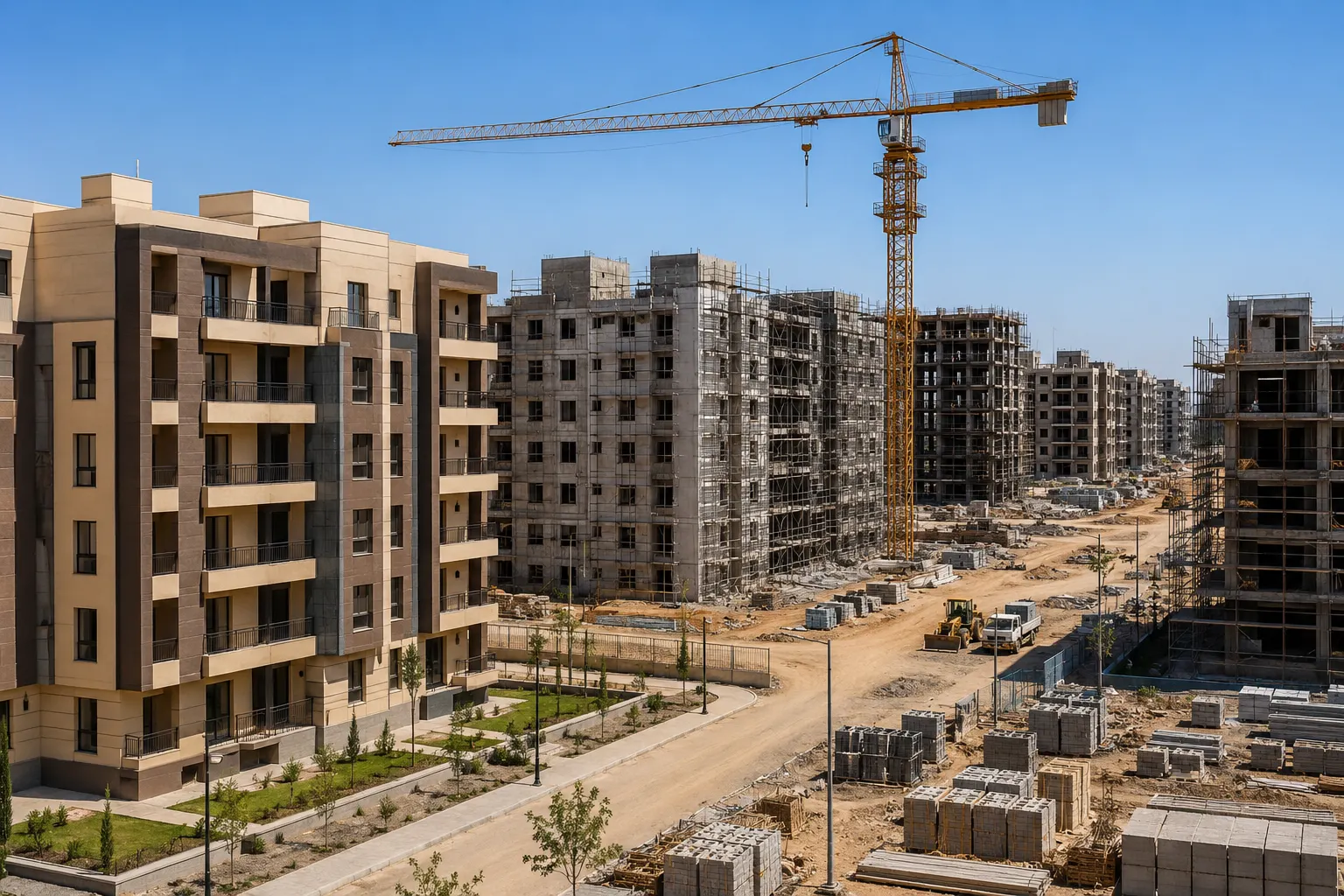
Egypt completed 212,000 housing units in the year to June 2025 with investment of 245.3 billion pounds, the Central Agency for Public Mobilization and Statistics reported on 17 August. That compares with 158,900 units and 152 billion pounds the year before, an increase of 33.4 percent in units and 61.4 percent in investment.
Investment grew at almost twice the rate of construction, and that gap is the first thing to read. Dividing investment by units gives an average of about 1.16 million pounds per unit in 2024/25 against about 0.96 million the year before, a rise of 21.0 percent. The bulletin reports totals rather than a cost index. The increase could reflect construction cost pressure, a shift in the composition of completed units, or both, and the release contains no decomposition that would separate them.
| Housing units executed in Egypt | 2023/24 | 2024/25 | Change |
|---|---|---|---|
| Total units | 158,900 | 212,000 | +33.4% |
| Total investment | EGP 152bn | EGP 245.3bn | +61.4% |
| Average investment per unit | about EGP 0.96m | about EGP 1.16m | +21.0% |
| Government, public and public business sector | 82,700 | about 104,800 | +26.7% |
| Private sector | 76,200 | 107,200 | +40.7% |
The private sector passed the state, reversing the previous year. Private builders executed 107,200 units, 50.6 percent of the total, against 76,200 the year before. The government, public and public business sectors together took 49.4 percent. Subtracting the private figure from the total gives about 104,800 units on that side, against 82,700 the year before. Both sides grew, but the private sector grew at 40.7 percent against 26.7 percent, and the ranking flipped: in 2023/24 the state side accounted for 52.0 percent of units and the private side 48.0 percent.
The two sides are not building the same thing, and the split is close to complete. Economic housing was the largest category overall at 86,500 units, 40.8 percent of the total, and the state side executed 68,500 of them, which is 79.2 percent of all economic housing. Luxury housing totalled 49,300 units, and the private sector executed 35,800 of them, 72.6 percent. Middle housing totalled 57,000 units, split 43,200 private and 13,800 state. Low cost housing totalled a rounded 5,100 units and the private sector figure alone is 5,128, which is consistent with essentially the whole of that category sitting on the private side, though the rounding does not allow an exact state residual to be calculated.
| Units by build quality, 2024/25 | Total | By the state side | By the private sector |
|---|---|---|---|
| Economic | 86,500 | 68,500 | 18,000 |
| Middle | 57,000 | 13,800 | 43,200 |
| Luxury | 49,300 | 13,500 | 35,800 |
| Above middle | 14,100 | 9,031 | 5,100 |
| Low cost | 5,100 | not separately reported | 5,128 |
Shares of the total: economic 40.8 percent, middle 26.9 percent, luxury 23.2 percent, above middle 6.7 percent, low cost 2.4 percent.
Construction is heavily concentrated in two governorates. On the state side Cairo took 47,600 units, 45.4 percent, and Giza 20,700, 19.8 percent, so the two account for about 65 percent of state built units. On the private side Cairo took 31,700 units, 29.6 percent, and Giza 24,600, 22.9 percent, about 53 percent between them. Combining both sides, Cairo accounts for roughly 79,300 units and Giza roughly 45,300, which is close to 59 percent of all units executed in the year. At the other end the bulletin records 20 units in North and South Sinai on the state side and 7 units in Gharbia on the private side.
The social housing programme in context. The bulletin reports 694,700 units executed to date under the social housing project, of which 67,900 were executed in 2024/25. Within that year’s figure, housing directorates executed 1,400 units, 2 percent, with investment of 693.1 million pounds, and the remainder falls to other implementing bodies. The 67,900 units represent about 32 percent of the year’s total output and about 65 percent of the state side’s units.
Why it matters: A year in which reported completions rise by a third and investment by three fifths is a strong year for housing output, and the composition shows where the growth came from. The private sector supplied the majority of units for the first time in this two year comparison, and it supplied them mainly in the middle and luxury categories, while the state side remained the supplier of economic housing at close to eighty percent of that category. That points to a clear difference in output mix between the two sides. The figure to keep is the average investment per unit, up 21.0 percent, because the bulletin does not separate cost pressure from category mix and both are present in the data.
Outlook: The bulletin is annual and covers the fiscal year to June. The measurable tests in the next edition are whether the private sector holds its majority share, whether the state side’s concentration in economic housing persists, and whether average investment per unit continues to rise faster than the unit count, which could reflect construction cost pressure, a shift toward higher value housing, or both.
Sources: Central Agency for Public Mobilization and Statistics, Housing Bulletin in Egypt for 2024/2025, published 17 August 2026. Average investment per unit, growth rates by sector, category shares between the state and private sides, governorate concentration and the social housing shares calculated by The Edge Research Team from the published figures.