BRICS New Delhi Declaration Pushes Cross-Border Payments, Local Currencies and Energy Security
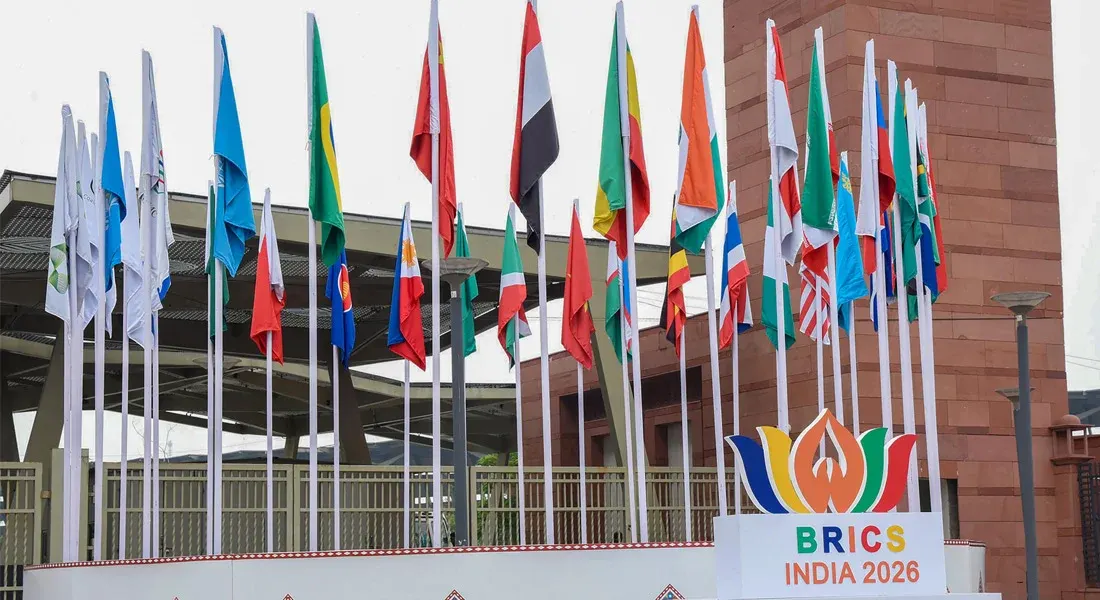
BRICS leaders adopted their New Delhi Declaration on Saturday with an economic agenda built around more efficient cross border payments, greater use of local currencies, resilient trade and energy flows, critical mineral supply chains and deeper cooperation on artificial intelligence.
The declaration was adopted on the first day of the 18th BRICS Summit, held in New Delhi on 12 and 13 September under the theme Building for Resilience, Innovation, Cooperation and Sustainability, as the grouping marks two decades of institutional cooperation.
India says BRICS accounts for nearly one fourth of global trade. UN Trade and Development says intra BRICS merchandise exports have expanded more than thirteenfold since 2003 to 1.17 trillion dollars in 2024. Yet they still accounted for only about 20 percent of South South trade, pointing to substantial room for deeper commercial integration.
The useful part of the declaration, on our reading, is therefore not another statement about the size of the grouping. It is where the members are trying to convert that scale into working economic infrastructure.
Payments move toward interoperability, not a common currency
The declaration acknowledges work by the BRICS Payment Task Force on practical cross border payment mechanisms, including interoperability between national payment and messaging channels, alongside discussions on settling more trade and investment in BRICS local currencies.
The language is deliberately flexible. Leaders said national priorities differ and there is no one size fits all approach, while calling for payments that are faster, lower cost, more accessible, efficient, transparent and safe.
The text therefore stops well short of creating a single BRICS payment system or a common currency. It concentrates instead on making existing national systems work more readily across borders.
That distinction matters. A common currency would require a degree of monetary and fiscal integration that the grouping does not have. Linking payment infrastructure and increasing local currency settlement is a narrower task and, potentially, a more achievable one.
India had already pushed that approach at the BRICS Business Forum on Friday. Commerce and Industry Minister Piyush Goyal called on member and partner countries to link payment systems and promote trade in each other’s currencies. He said India’s Unified Payments Interface handles more than 250 billion transactions a year and is accepted in 11 countries.
On our reading, the practical test is therefore not whether BRICS displaces the dollar. It is whether businesses can settle a larger share of intra BRICS commerce at lower cost and with less friction between national payment networks.
Energy security sits beside the transition
Energy receives unusually explicit treatment in the declaration.
Leaders described energy security as a foundation of economic development and national security and called for stable energy markets, uninterrupted flows from diverse sources, stronger value chains and protection of critical energy infrastructure, including infrastructure that crosses borders.
They also said fossil fuels will continue to play an important role in the global energy mix, particularly for emerging and developing economies, while reaffirming the need for a just, orderly, equitable and inclusive energy transition.
That combination is significant. Rather than treating energy security and the transition as competing objectives, the declaration puts conventional supply, new technologies and system resilience inside the same framework.
The agenda then moves beyond oil and gas. BRICS recognises a wide mix of energy sources and technologies, including renewables, nuclear power, hydropower, hydrogen, fossil fuels and energy storage.
The declaration also highlights artificial intelligence and advanced data analytics for system planning, grid management, renewable integration and cyber resilient energy infrastructure. It welcomes the BRICS Guiding Principles on Smart Grids and Energy Storage and references the Digital Centre of Excellence for Smart Grids and Energy Storage, which India launched under the BRICS Energy Research Cooperation Platform in June.
Critical minerals form another part of the same resilience agenda. The declaration calls for reliable, diversified and resilient supply chains while affirming resource rich countries’ sovereign rights over their minerals and recognising their importance to both energy security and zero and low emission technologies.
The result is not an either or formulation between hydrocarbons and transition technologies. It is an energy security framework that puts conventional supply and the minerals, grids, storage and digital systems needed for the next energy system inside the same policy architecture.
Trade policy contains its own tension
The declaration expresses concern over unjustified unilateral protectionist measures inconsistent with World Trade Organization rules and reiterates support for a stable, predictable trading environment and more resilient supply chains.
Yet the BRICS Business Forum also exposed the work still required inside the grouping itself.
Goyal called for members to open their markets, simplify regulatory procedures and diversify supply chains. He also cited the finding that non tariff measures impose higher export costs than tariffs for 88 percent of countries.
That figure is supported by UN Trade and Development’s May global trade update, which found that technical regulations, health and safety requirements, certification procedures and other non tariff measures now exceed tariff related export costs for 88 percent of countries.
India’s Commerce Secretary Rajesh Agrawal separately pointed to trade among BRICS countries rising from about 84 billion dollars in 2003 to nearly 1.2 trillion dollars in 2024 and called for stronger integration under the Strategy for BRICS Economic Partnership 2030.
That is the more substantive trade question, on our reading. Opposing barriers imposed from outside the grouping is easier than removing frictions among economies with very different regulatory systems, industrial policies and market access regimes.
The scale of the opportunity is large, but so is the integration still missing.
Critical minerals, food and artificial intelligence broaden the resilience agenda
The declaration also keeps work alive on a proposed BRICS Grain Exchange. Leaders backed continued elaboration of the initiative and further discussions on how it would operate, with the possibility of later expanding beyond grain to other agricultural products and commodities.
The wording matters. The Grain Exchange remains an initiative under development, not an operational BRICS marketplace.
On technology, leaders described artificial intelligence as an important opportunity for economic growth and sustainable development but coupled that with requirements around safety, security, inclusiveness, reliability and accessibility.
They committed to implementing the BRICS Leaders’ Statement on the Global Governance of Artificial Intelligence and backed cooperation on artificial intelligence science and innovation, trustworthy systems and their energy efficiency.
These initiatives differ substantially in maturity. Payment interoperability already has a dedicated task force. The Digital Centre for smart grids and storage is operational. The Grain Exchange remains under discussion. Critical mineral cooperation is principally a supply chain objective, while artificial intelligence governance remains a broad coordination framework.
They should not be presented as if all are equally developed or immediately executable.
Why it matters: The New Delhi Declaration moves the BRICS economic argument away from the more dramatic question of whether the grouping can construct alternatives to Western led institutions and toward a more practical one: whether it can make trade, payments, energy flows and supply chains work more efficiently across a large and economically diverse group. Cross border payment interoperability is particularly important because it can develop incrementally without requiring monetary union, and the same is true of local currency settlement, regulatory cooperation and supply chain links. Those are smaller steps than creating a new financial architecture, but they are also more executable. The energy provisions are equally significant, because BRICS is explicitly combining energy security, continued fossil fuel use, critical minerals, digital grids, storage and the transition rather than treating them as competing agendas. For a grouping containing major energy producers, consumers and emerging economies, that may prove the more durable common position.
Outlook: The measures to watch are implementation rather than further declarations. For payments, the next evidence will be specific connections between national systems and measurable growth in local currency settlement. For trade, it will be whether the Strategy for BRICS Economic Partnership 2030 translates into fewer regulatory barriers and stronger two way market access among the members themselves. For food, the question is whether the Grain Exchange moves from further study to an operating model. For critical minerals and energy, the test will be whether the new cooperative mechanisms produce investment, technology transfer or functioning supply chain projects. The summit continues through 13 September, but the economic benchmark has now been set, and the test from here is how much of its resilience agenda becomes infrastructure rather than language.
Sources: Prime Minister’s Office of India, Press Information Bureau of India, Ministry of Power of India, UN Trade and Development.