Jordan’s Re-exports Rose 44 Percent and Supplied Most of Its Export Growth
Jordan’s total exports grew by more than 14 percent in the first half of 2026, Industry, Trade and Supply Minister Yarub Qudah told a meeting of the Jordanian Businessmen Association on 16 September. The composition is the finding. National exports, meaning locally produced goods, rose 6.2 percent. Re-exports rose 44 percent, seven times as fast, on our calculation.
Where the growth comes from
Total exports are national exports plus re-exports, so the three growth rates fix the weights between them. On growth of just over 14 percent, re-exports supply roughly two thirds of the increase from about a fifth of the base, on our calculation. The minister gave no levels, and total growth was given as a floor rather than a figure, so the split cannot be fixed more tightly than that. A 44 percent rise in goods that pass through the kingdom rather than originate in it is a statement about Jordan as a transit and logistics route, not about Jordanian industry. The minister makes the same point from the other direction, saying the re-export growth reinforces the kingdom’s role as a regional trade and logistics hub.
Export gains were spread across more than 12 industrial sectors, which the minister frames as diversification that reduces exposure to any single product or market.
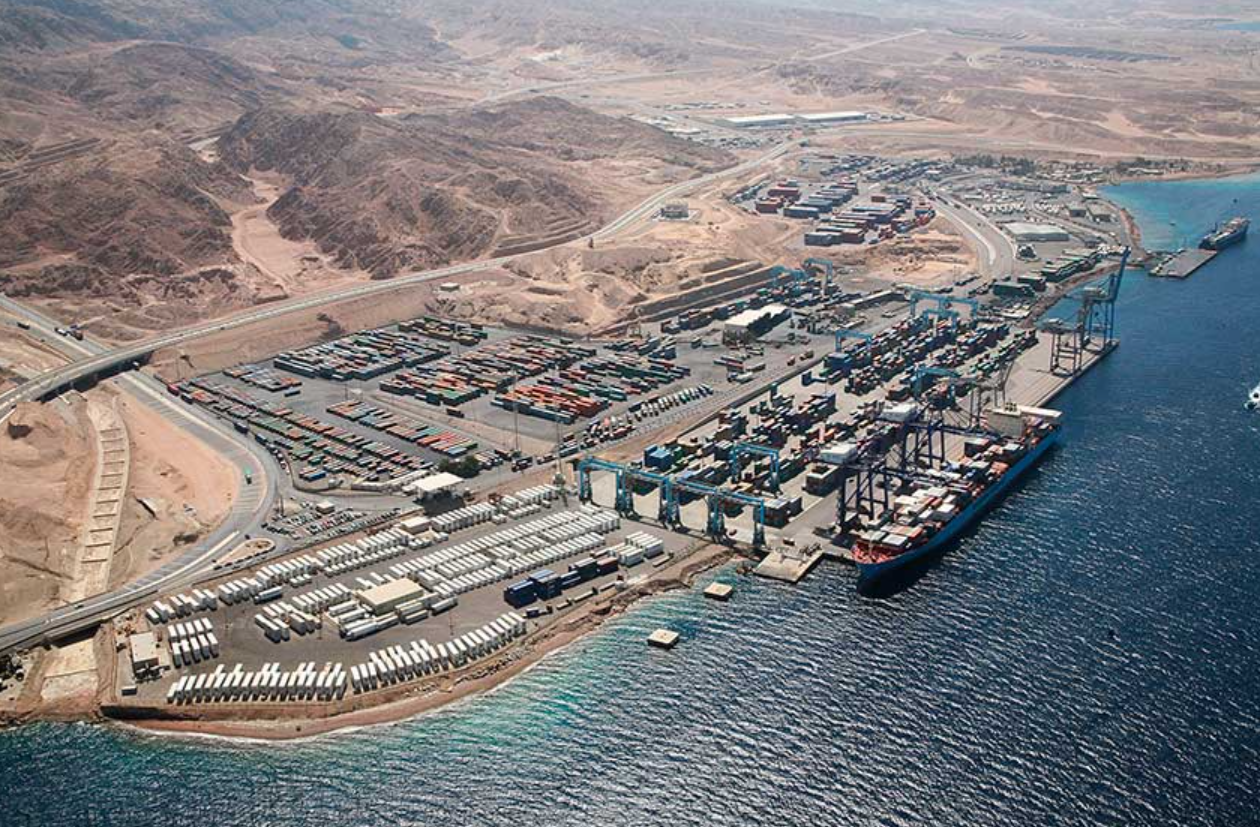
Aqaba Port handled more than 5 percent more containers than in the same period of 2025, the minister said, over what he described as the first nine months of the year. It is the only volume measure in his figures, and a nine month count does not divide into a half year of export value, so the two sit side by side rather than in a ratio.
| Measure | Period | Change |
|---|---|---|
| Total exports | First half 2026 | More than 14% |
| National exports | First half 2026 | 6.2% |
| Re-exports | First half 2026 | 44% |
| Total exports | 2025 against 2024 | Around 11.5% |
Figures as given by the Minister of Industry, Trade and Supply and reported by Petra on 16 September 2026. The minister gave percentage changes and no levels; the hedged wording on the total and the 2025 comparison is his.
The comparison with last year is looser than it looks. Total export growth of more than 14 percent in the first half follows around 11.5 percent for the whole of 2025, but the minister gave a floor for one and an approximation for the other, and a half year against a full year, so the size of the acceleration cannot be computed from what he said.
The pipeline behind the trade push
The government plans projects worth around 10 billion dollars with the private sector over the next three to four years, covering water, energy, transport, infrastructure and public services. Named among them are the National Water Carrier and a gas pipeline linking the Risha field to the rest of the kingdom, which the minister says should raise natural gas self-sufficiency to around 80 percent by 2028, and Airport City.
On trade agreements, two preferential deals are expected to be signed before the end of the year, with Rwanda for East and Central African markets and with Uzbekistan as a route into Central Asia. Talks have opened with the Eurasian Economic Union. These sit alongside existing free trade agreements with the United States, the European Union, the United Kingdom, Arab countries and Canada.
Why it matters: Jordan’s export growth is running through two channels and they are not contributing equally. Nationally produced exports rose 6.2 percent; re-exports rose 44 percent and supply roughly two thirds of the increase from about a fifth of the base, on our calculation. That concentration is the finding. Goods that pass through the kingdom can be redirected by a route change in a way that factory output cannot, so the composition of this growth matters as much as its rate.
Outlook: Two preferential agreements are due before the end of the year and the Eurasian talks carry no date. The 80 percent gas self-sufficiency target is set for 2028 and depends on the Risha pipeline and continued exploration around the field. The minister gave percentage changes and no levels in dinars, so the composition of the rise cannot be broken down further from what was published.
Sources: Petra, Ministry of Industry, Trade and Supply.