Oman Turns to an OMR 90 Million Nine-Month Budget Surplus as Gas Revenue Jumps 61%

The Takeaway: Oman’s state budget recorded a surplus of OMR 90 million through September, with public revenue up 16% on the year as oil and gas receipts both grew. Public debt came down to OMR 14.1 billion, and banks kept credit growth in double digits. The surplus rests on an oil price well above the budget’s assumption, and spending rose too.
Net gas revenue jumped 61% to OMR 2,088 million from January to September, the Ministry of Finance’s third-quarter fiscal performance bulletin shows, lifting Oman’s budget into surplus.
Public revenue rose 16% on the year to OMR 9,828 million, which the ministry attributed mainly to higher oil and non-oil revenue. Spending grew more slowly, up 9%, with every spending line higher than a year earlier.
That left a surplus of OMR 90 million, against a deficit of OMR 433 million over the same months of 2025.
Gas revenue jumps 61% as oil revenue rises 7%
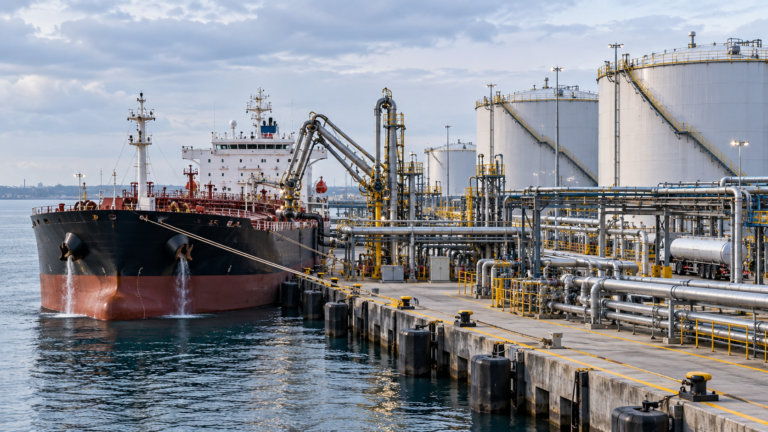
Net oil revenue rose 7%, which the bulletin traces to a higher realized oil price. That price averaged $81 a barrel, against $72 a year earlier.
Net gas revenue grew far faster, on higher returns on liquefied natural gas sales and higher prices for Oman LNG’s spot sales, the ministry said. Its share of total revenue climbed to 21.2% from 15.3%.
Oil and gas together supplied 72.6% of all revenue, against 70.8% in the same months of 2025. Current revenue grew a slower 7%.
The 2026 budget was calculated on an average oil price of $60 a barrel, with a planned full-year deficit of OMR 530 million. By the end of September, revenue had reached 85.9% of the full-year estimate.
Spending stood at 81.3% of the budgeted total. Gas revenue had already passed its full-year estimate, at 106%, while oil revenue had reached 88% of its estimate.
Oman state budget, January to September, and the full-year 2026 budget (in OMR millions)
| Item | 2026 | 2025 | 2026 budget |
|---|---|---|---|
| Total revenue | 9,828 | 8,481 | 11,447 |
| Net oil revenue | 5,046 | 4,710 | 5,752 |
| Net gas revenue | 2,088 | 1,296 | 1,961 |
| Current revenue | 2,614 | 2,449 | 3,607 |
| Capital revenue and recoveries | 80 | 26 | 127 |
| Total spending | 9,738 | 8,914 | 11,977 |
| Current spending | 6,621 | 6,227 | 8,771 |
| Development spending | 1,224 | 1,103 | 1,300 |
| Contributions and other | 1,723 | 1,584 | 1,906 |
| Payments under settlement | 170 | 0 | 0 |
| Balance | 90 | -433 | -530 |
The 2026 and 2025 columns are the ministry’s preliminary data; the budget column is the full-year 2026 estimate. Development spending covers civil ministries and units and economic transformation projects.
Third quarter alone yields a surplus of OMR 107 million
The bulletin’s figures are cumulative from January. Subtracting the second-quarter bulletin’s totals, set out here on 23 August, The Edge calculates that July to September brought revenue of OMR 3,226 million and spending of OMR 3,119 million.
That is a quarterly surplus of OMR 107 million, after a deficit of OMR 17 million over the first half.
Third-quarter revenue was 22.1% higher than in the same quarter of 2025, and spending 10.8% higher.
Gas did most of the work. Net gas revenue for the quarter came to OMR 924 million, more than double the OMR 412 million of July to September 2025.
Oil added far less. Third-quarter oil revenue, at OMR 1,714 million, was 1.3% above a year earlier. Current revenue for the quarter rose 9.2%.
The realized oil price averaged $74 a barrel in the first half and $81 over nine months, so the third-quarter average was higher than both.
Output rose the same way, from 1.074 million barrels a day in the first half to 1.102 million over nine months.
Development spending reaches 94% of the year’s allocation
Development spending by civil ministries and units and on economic transformation projects rose 11% on the year. It reached 94% of the 2026 allocation, up from 61% at the end of June, a pace the ministry ascribed to faster work on projects under way.
Support for the social protection system came to OMR 486 million, and for the electricity sector OMR 441 million.
Oil product subsidies took OMR 280 million, and OMR 225 million went to a provision for debt repayment.
The ministry paid more than OMR 1,434 million in dues to private sector firms for claims with complete documentation. It is committed to settling such claims within five working days on average.
Public debt stood at OMR 14.1 billion at the end of September, more than OMR 600 million lower than a year earlier. At the end of June it was OMR 14.16 billion.
The International Monetary Fund’s end of mission statement, set out here on 9 November, put government debt at 30.4% of GDP at the end of June.
Bank credit grows 13.2% as private lending gathers pace
Outstanding credit at Oman’s banks rose 13.2% on the year to OMR 39.1 billion at the end of September, the Central Bank of Oman’s monthly statistical bulletin shows. Annual growth eased from 13.8% in August.
Private sector credit grew 11.7% to OMR 31.5 billion. Its annual growth rate picked up from 11.4% in August, even as growth in total credit slowed.
Total deposits rose 13.3%, a shade faster than credit. Private sector deposits grew 11.6% to OMR 24.8 billion.
Broad money rose 14.3% on the year. Within it, narrow money, the cash and rial deposits spendable on demand, grew 25.1%, and quasi-money, which includes time, savings and foreign currency deposits, 9.7%.
Based on the bulletin’s levels, The Edge calculates that total credit has grown 10.5% since the end of 2025, with deposits close behind. Credit equaled 104.2% of deposits at the end of September.
At conventional banks, private sector credit grew 12.0% to OMR 24.1 billion. Deposits there rose a faster 14.2%.
Islamic banks and windows made up 19.5% of banking system assets. Their financing grew 12.8% to OMR 8.2 billion.
Deposits at Islamic banks and windows rose 12.1%, also to OMR 8.2 billion.
On the month, credit rose OMR 264.9 million while deposits slipped OMR 101.4 million. Broad money eased OMR 108.3 million.
The weighted average rate on rial deposits at conventional banks fell to 2.245% from 2.568% a year earlier. Their weighted average lending rate edged up to 5.474% from 5.452%.
The average repo rate, the cost of the central bank’s liquidity injections into banks, fell to 4.367% from 4.892%, in line with the US Federal Reserve. The overnight interbank lending rate eased to 3.774% from 3.815% a year earlier.
Central Bank of Oman banking and monetary indicators (in OMR millions)
| Item | Sep 2026 | Aug 2026 | Dec 2025 |
|---|---|---|---|
| Total credit | 39,071 | 38,806 | 35,350 |
| Total deposits | 37,480 | 37,582 | 33,964 |
| Broad money (M2) | 29,414 | 29,523 | 26,384 |
| Narrow money (M1) | 9,488 | 9,432 | 7,457 |
| Foreign assets | 7,616 | 7,684 | 7,476 |
Credit and deposits are the banks’ totals in the bulletin’s indicators table; money supply includes Islamic banks and windows. Foreign assets are the central bank’s foreign assets and bullion. Values are rounded to whole numbers from the bank’s figures, which are printed to one decimal.
In The Edge’s reading, a nine-month surplus built at an oil price $21 above the budget’s assumption leaves room to finish the year ahead of plan, provided prices stay clear of that assumption.
What to watch: the central bank’s next Monthly Statistical Bulletin, listed in its publication calendar for 10 December.
Method: figures are from the Ministry of Finance of Oman’s fiscal performance bulletins for the third quarter of 2026 (preliminary data) and the second quarter of 2026, the ministry’s 2026 budget statement of 1 January 2026, and the Central Bank of Oman’s Monthly Statistical Bulletins for September and August 2026; third-quarter figures, shares and comparisons not attributed to a source are The Edge’s calculations.
Sources: Ministry of Finance of Oman, Central Bank of Oman, International Monetary Fund, The Edge.