
Saudi Arabia and the UAE Sign MoU on Grid Interconnection, Electricity Trade and Rail Link

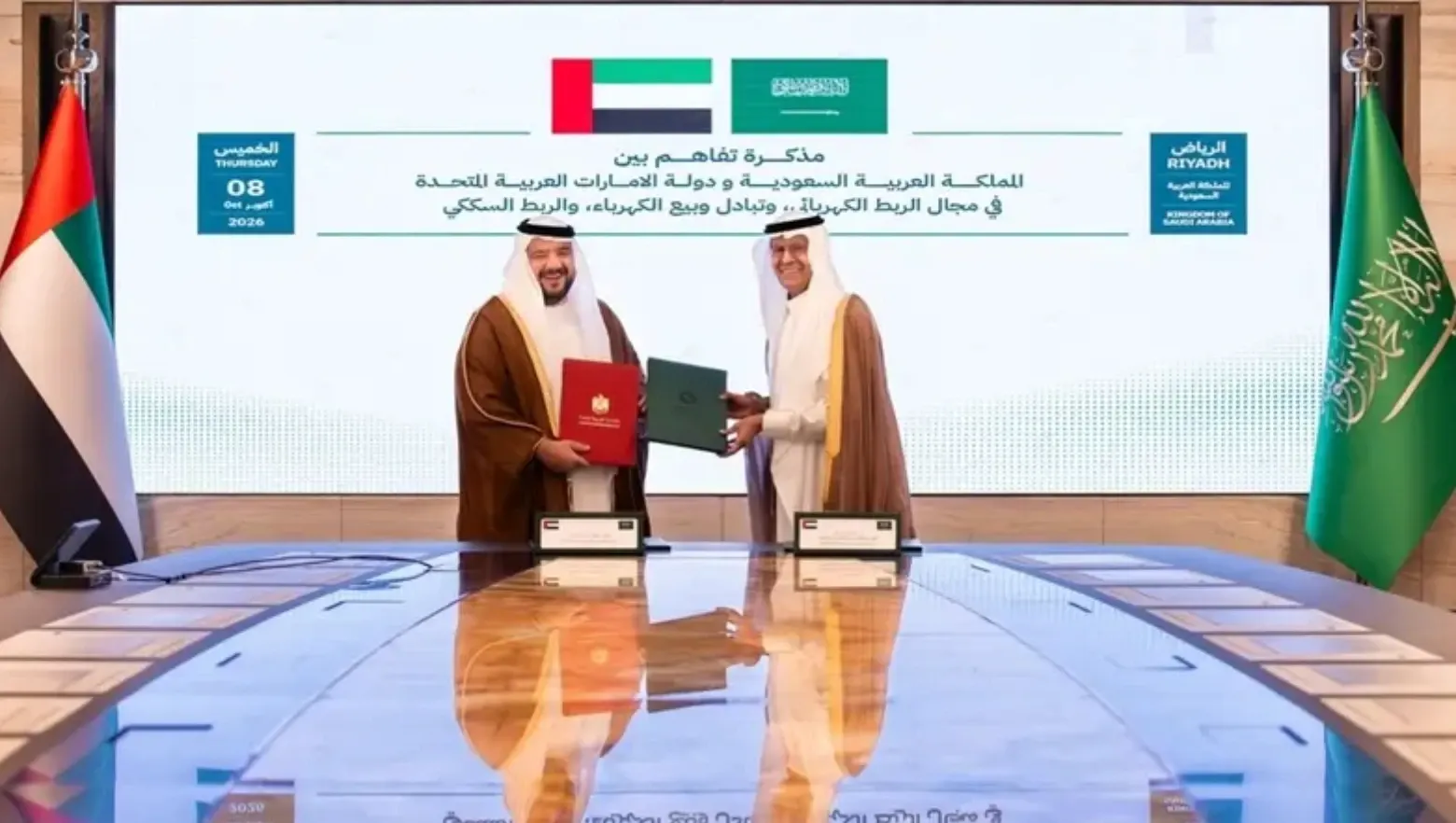
Saudi Arabia and the UAE signed a memorandum of understanding in Riyadh on Thursday to cooperate on connecting their power grids, exchanging and selling electricity, and linking their railways for two-way freight. Prince Abdulaziz bin Salman, Minister of Energy and Minister of Industry and Mineral Resources, signed for Saudi Arabia, and Mohamed Hassan Alsuwaidi, the UAE’s Minister of Investment, for the UAE, the Saudi Press Agency reported.
What the memorandum covers
Under the memorandum, the 2 countries will agree general principles for grid interconnection and for the exchange and sale of electricity, carry out technical, economic and environmental studies, and coordinate with other Gulf Cooperation Council states on expanding the GCC interconnection grid under the GCC General Agreement for Grid Interconnection. A second track sets principles for a rail link carrying goods and freight in both directions, aimed at logistics integration and more efficient supply chains.
The 2 official agencies framed it differently. The Saudi account led with electricity, while WAM, the UAE news agency, led with rail and cross-border trade. Neither published a capacity, a cost or a timetable, which fits a framework agreement that starts with studies.
The grid it builds on
The GCC interconnection grid
| Item | Figure |
|---|---|
| Transmission capacity with the UAE, current | 2,400 MW |
| Transmission capacity with the UAE, after expansion | 3,500 MW |
| New line, Salwa to Al Sila | 96 km |
| Overhead lines across the network | Approximately 913 km |
Source: GCC Interconnection Authority, network and projects pages; the expansion is listed among its projects under construction.
The GCC grid has linked Bahrain, Saudi Arabia, Qatar and Kuwait since 2009, and the UAE since 20 April 2011, according to the GCC Interconnection Authority. It runs at 400 kilovolts and 50 hertz, while Saudi Arabia’s grid runs at 60 hertz and connects through a back-to-back high-voltage direct current station that converts between the 2 frequencies. The expansion of the link with the UAE would add 1,100 megawatts, a 45.8 percent increase in transmission capacity, on our calculation. Oman connects to the grid through the UAE network, with a capacity of 400 megawatts.
On the rail side, the UAE’s Etihad Rail operates a 900 kilometre network running from Ghuwaifat to Fujairah.
Why it matters: For both countries, the memorandum puts the sale of electricity, as well as its exchange, on a bilateral footing, and places freight rail on the same agenda. Saudi Arabia’s 60 hertz grid already exchanges power with the 50 hertz GCC network through a back-to-back converter station, so the studies the memorandum calls for start from an existing connection. On our reading, pairing power and rail in one framework also ties energy trade to the logistics links that carry goods between the 2 countries.
Outlook: The memorandum’s next steps are the technical, economic and environmental studies and agreement on general principles for the grid and the rail link, alongside coordination with the other GCC states. On the grid side, the authority separately lists among its projects under construction an expansion that would lift transmission capacity with the UAE to 3,500 megawatts.
Sources: Saudi Press Agency, WAM, GCC Interconnection Authority, Etihad Rail, The Edge.