Georgieva Calls AI a ‘Slow-Moving Tsunami’ as UAE Matches 92 Percent of Advanced-Economy Score
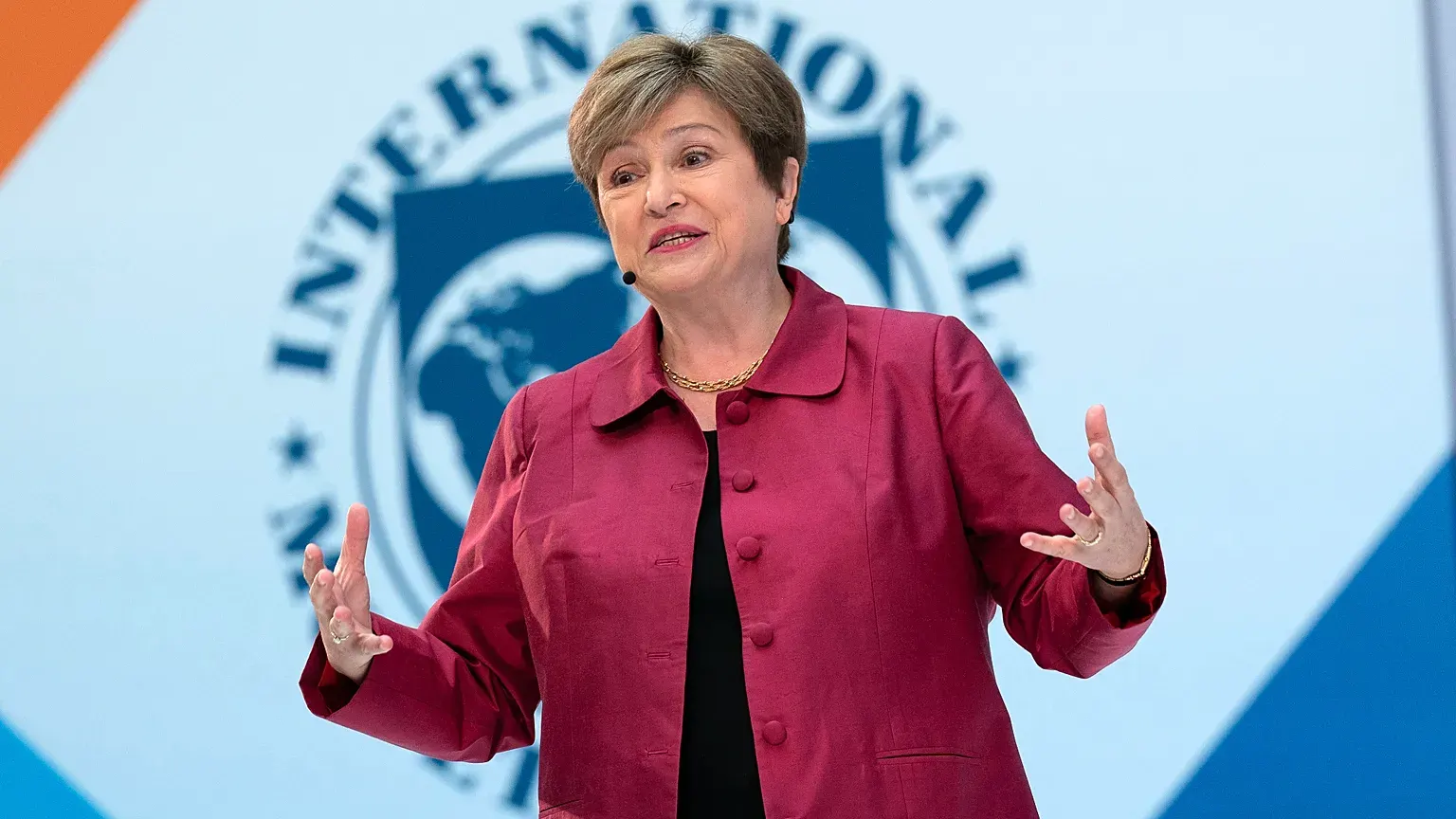
International Monetary Fund Managing Director Kristalina Georgieva described artificial intelligence as “a slow-moving tsunami, but tsunami none the less” at her first appearance at the fund and World Bank annual meetings in Bangkok on 12 October, Bloomberg reported, warning of its threat to the labour market and to taxation and urging policymakers to rethink education. On the fund’s AI Preparedness Index, whose latest data year is 2023, the UAE’s score of 0.628 is equal to 92.0 percent of the 0.683 the fund gives advanced economies as a group, and Saudi Arabia’s 0.577 to 84.5 percent, on our calculation.
The Fund Puts Up to 60 Percent of Advanced-Economy Jobs in the Path
Georgieva used the same image 3 weeks earlier. Addressing an informal meeting of economic and financial affairs ministers in Dublin on 21 September, she said AI “could hit the labor market like a tsunami”, affecting up to 60 percent of jobs in advanced economies. In the same remarks she said the fund estimates AI could eventually lift global annual potential growth by some 0.1 to 0.8 percentage points, and that Europe should aim for the upper half of that range.
Georgieva set out the same figure in a January 2024 blog, which estimated that almost 40 percent of global employment is exposed to AI, with an estimated 60 percent of jobs exposed in advanced economies, 40 percent in emerging markets and 26 percent in low-income countries. Georgieva’s January 2026 blog kept the global figure at nearly 40 percent. Exposure is not the same as loss: the 2024 blog put roughly half of the exposed jobs in advanced economies on the side that may gain from AI through higher productivity, and the other half where AI may take over key tasks, which could lower labour demand, wages and hiring.
On our calculation from those estimates, the exposed share in advanced economies is 1.5 times the emerging market share and 2.3 times the low-income share. The emerging market group scores 0.465 and the low-income group 0.322, scores equal to 68.1 percent and 47.2 percent of the advanced-economy score. Set against exposure of 66.7 percent and 43.3 percent of the advanced level, the gap in index scores runs close to the exposure gap: the advanced economies carry the most exposure and the highest score, and the low-income group the least of both.
The Most Exposed Groups Are Also the Most Prepared
| Group | Jobs exposed to AI | Preparedness score 2023 | Score as share of advanced score |
|---|---|---|---|
| Advanced economies | 60% | 0.683 | 100.0% |
| Emerging markets | 40% | 0.465 | 68.1% |
| Low-income countries | 26% | 0.322 | 47.2% |
Exposure shares are fund estimates published in January 2024. Preparedness scores are the AI Preparedness Index group values for 2023, the latest data year; the share column is our calculation, the ratio of each group’s score to the advanced-economy score on unrounded values. Exposure groups follow the January 2024 estimates and preparedness groups the fund’s analytical groups, which may differ at the margin.
The Gulf States Average 116.5 Percent of the Emerging Market Score
The index combines 4 components: digital infrastructure, human capital and labour market policies, innovation and economic integration, and regulation and ethics. The fund says the index is an indicative guide that points policymakers to areas for improvement, and is not meant for ranking economies. Both the UAE and Saudi Arabia score above Thailand, this year’s host, at 0.536. Against the emerging market group, the UAE scores 35.1 percent higher and Saudi Arabia 24.1 percent higher, on our calculation.
The 6 Gulf states have a simple average of 0.542, a score equal to 116.5 percent of the emerging market score and 79.3 percent of the advanced-economy score, on our calculation. All 6 score above the 0.40 the fund gives its Middle East and Central Asia region. Qatar and Oman score 0.535 and 0.533, with Bahrain at 0.515 and Kuwait at 0.461. The UAE’s distance to the advanced-economy score is 0.055 points; Singapore, at 0.801, scores 0.172 points above the UAE, on our calculation.
The UAE and Saudi Arabia at 92.0 and 84.5 Percent of the Advanced-Economy Score
| Economy | Preparedness score 2023 | Share of advanced-economy score |
|---|---|---|
| UAE | 0.628 | 92.0% |
| Saudi Arabia | 0.577 | 84.5% |
| Qatar | 0.535 | 78.3% |
| Oman | 0.533 | 78.0% |
| Bahrain | 0.515 | 75.4% |
| Jordan | 0.483 | 70.7% |
| Kuwait | 0.461 | 67.5% |
| Egypt | 0.394 | 57.7% |
| Thailand, host | 0.536 | 78.4% |
AI Preparedness Index, 2023 data. Shares are our calculation, the ratio of each economy’s score to the advanced-economy score of 0.683, on unrounded values. The Middle East and Central Asia regional score is 0.40.
Saudi Arabia Scores 8.4 Percent Above Advanced Economies on the Component Closest to Jobs
The component that maps most directly onto Georgieva’s labour warning is human capital and labour market policies, which the fund built from measures such as years of schooling, job-market mobility and the share of the population covered by social safety nets. Saudi Arabia’s weighted value on it is 0.177, 8.4 percent above the advanced-economy value of 0.163 and level with Denmark’s 0.177 at 3 decimal places, on our calculation. Oman also does well here, at 0.158, or 97.0 percent of the advanced-economy value.
On innovation and economic integration, the UAE’s value of 0.151 is 96.6 percent of the advanced-economy value, and on digital infrastructure its 0.152 is 86.6 percent of the advanced level. Bahrain’s 0.142 on innovation and integration is 91.2 percent of the advanced-economy figure.
The Index’s Weighted Components: the UAE and Saudi Arabia Against Advanced Economies
| Weighted component | UAE | Saudi Arabia | Advanced economies |
|---|---|---|---|
| Digital infrastructure | 0.152 | 0.144 | 0.175 |
| Innovation and economic integration | 0.151 | 0.117 | 0.156 |
| Human capital and labour market policies | 0.154 | 0.177 | 0.163 |
Weighted components of the AI Preparedness Index, 2023 data. The fund describes the index both as the sum of its 4 dimensions and as their simple average, so each published component is a quarter-weighted value on a scale of 0 to 0.25, on our reading, and the 4 add up to the index score. The fourth component, regulation and ethics, is 0.171 for the UAE and is not shown for the others.
Skills, Wages and Taxation
The labour shift is already visible in job adverts. Georgieva’s January 2026 blog found that 1 in 10 postings in advanced economies and 1 in 20 in emerging markets require at least 1 new skill, so the rate in advanced economies is twice the emerging market rate, on our calculation. IT accounts for more than half of that demand. Postings that include a new skill tend to pay roughly 3 percent more, and postings with 4 or more new skills can pay up to 15 percent more in the United Kingdom and 8.5 percent more in the United States.
The local picture cuts both ways. Regions with higher adoption of new skills saw employment rise 1.3 percent for each 1 percentage point increase in the share of postings requiring them over the past decade. AI skills behave differently: in regions with high demand for them, employment in AI-vulnerable occupations was 3.6 percent lower after 5 years than in regions with less demand. In Dublin, Georgieva said the gains go to high-skilled and low-skilled workers, leaving the middle of the job market thinner.
Bloomberg’s account of the Bangkok remarks puts taxation beside jobs, and in Dublin she told finance ministers that as AI reshapes the income distribution between labour and capital, they need to rethink and revamp taxation.
Why it matters: Of the 3 country groups, advanced economies carry the largest share of exposed jobs and also score highest on the index, while the wage and employment evidence shows the gains going to workers who add new skills. For the Gulf, the UAE and Saudi Arabia start well above the emerging market group, and Saudi Arabia’s human capital and labour market component, the part of the index most tied to how workers absorb the shift, sits above the advanced-economy value.
Outlook: The fund’s World Economic Outlook and Global Financial Stability Report are both due on 13 October, and Georgieva previewed the stability report in Dublin as treating an AI-driven market correction as one of the risks the fund takes most seriously. The Middle East and Central Asia regional outlook is listed as coming soon. The preparedness scores rest on 2023 data, the only year the fund’s index covers, and stand as its latest reading of where the UAE and Saudi Arabia sit against the advanced-economy score.
Sources: IMF, Bloomberg, The Edge.