Bank of England Raises Bank Rate to 4% in an 8 to 1 Vote, Its First Increase Since 2023
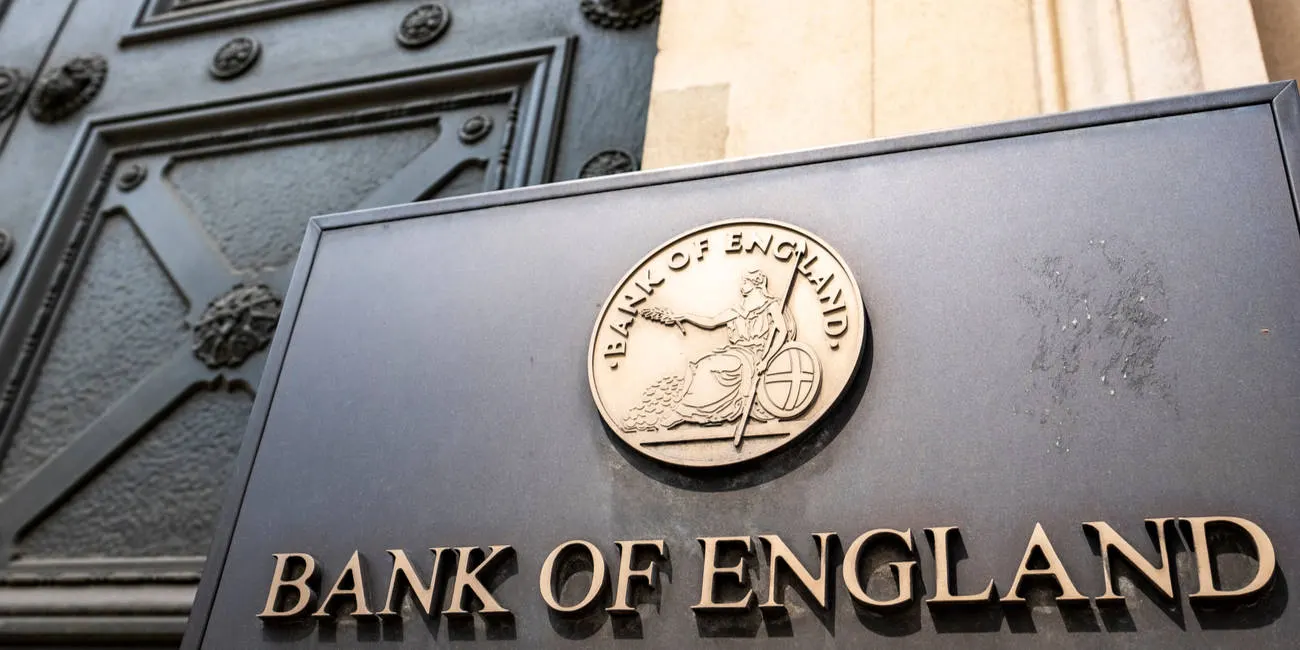
The Bank of England raised Bank Rate to 4%, its first increase since 2023, and the only Monetary Policy Committee member to dissent wanted a larger rise.
For UK borrowers and businesses, the decision ends a period at 3.75% that began in December 2025 and turns policy towards tightening. CPI inflation, 3.5% in September, should reach an estimated 5% by mid-2027, the Bank said. It is then projected to return to the 2% target in the third quarter of 2028. In The Edge’s reading, the vote understates the appetite for more: 4 of the 8 quarter-point voters called a further increase likely or arguable.
The Committee turns to an increase after the September split
Eight members voted for the quarter point: Andrew Bailey, the Chair, with Sarah Breeden, Swati Dhingra, Megan Greene, Clare Lombardelli, Huw Pill, Dave Ramsden and Alan Taylor. Catherine L Mann voted against, preferring a half point to 4.25%.
In September the Committee voted 6 to 3 to leave the rate unchanged, with Greene, Mann and Pill seeking an increase. All 9 members now voted for higher rates.
Bank Rate had stood at 3.75% since 18 December 2025, according to the Bank’s rate history. The last increase before this one took effect on 3 August 2023, at 5.25%. Then came 6 cuts worth 1.5 percentage points, starting in August 2024.
The Bank’s case rests on energy. In the 15 UK working days to 27 October, front-month Brent crude futures averaged $108 a barrel, the minutes said.
UK front-month gas futures averaged 216 pence a therm. Against the July report, oil was 38% higher and gas 81% higher.
Limited evidence of knock-on effects on other prices and wages did not settle the matter. The Committee judged that the inflationary pressure in the pipeline was now sufficient to warrant an increase, with activity data generally stronger than expected.
The guidance stays conditional. “Monetary policy is not on a pre-set path,” the Committee said, adding that it will watch underlying pay, pricing behaviour and slack and adjust Bank Rate as necessary to bring CPI inflation back to the 2% target in the medium term.
Inflation is projected to peak in 2027 and reach target in 2028
September’s 3.5% was up from 3.1% in August, as set out on The Edge in October. The rate has risen 0.9 percentage point since June, when it stood at 2.6%.
Core CPI rose to 2.8% from 2.6%. Services inflation reached 3.7%, from 3.4%. Goods inflation rose to 3.2% from 2.7%, the Office for National Statistics reported.
Direct energy effects contributed an estimated 1 percentage point to September’s rate, most of it from fuels, the minutes said. The Ofgem price cap rose to £1,723 in the fourth quarter, 16.7% above its level in the second quarter.
Food is the exception so far. Food and non-alcoholic beverage inflation was 1.3% in September, and Bank staff expect it to climb to a little under 3% in the first quarter of 2027 as costs pass through.
November central projection, with July in brackets (in %)
| Measure | 2026 Q4 | 2027 Q4 | 2028 Q4 |
|---|---|---|---|
| CPI inflation | 3.8 (3.2) | 4.0 (2.1) | 2.0 (1.9) |
| GDP growth | 2.2 (1.2) | 1.0 (1.4) | 1.4 (1.7) |
| Unemployment | 4.8 (5.1) | 5.0 (5.3) | 5.1 (5.2) |
| Bank Rate | 3.9 (3.9) | 4.9 (4.2) | 4.9 (4.1) |
Monetary Policy Report November 2026, Table 3.B; CPI inflation and GDP growth are four-quarter rates, unemployment is the ILO rate and Bank Rate is the path implied by forward market rates, on which the projections are conditioned.
The CPI inflation projection for the fourth quarter of 2027 is 1.9 percentage points above July’s. Inflation stays well above target through 2027 and the first half of 2028, then dips slightly below it by the end of the forecast as spare capacity weighs.
At 4%, Bank Rate sits 0.5 percentage point above September’s headline inflation. It is 1.2 percentage points above core inflation and 0.3 percentage point above services inflation. These are backward comparisons, not a forward real rate.
Two scenarios bracket the central case. The adverse one assumes oil an estimated 30% and gas a little over 50% above the central path, the Bank said. Inflation then reaches 5.5% at the end of 2027.
CPI inflation across the projection and scenarios (four-quarter rates, in %)
| Case | 2027 Q4 | 2028 Q4 | 2029 Q4 |
|---|---|---|---|
| Central | 4.0 | 2.0 | 1.8 |
| Adverse | 5.5 | 3.0 | 2.2 |
| Weaker demand | 3.6 | 1.2 | 1.2 |
Monetary Policy Report November 2026, Table 3.B; all three cases are conditioned on the same market curve for Bank Rate.
In the weaker demand case, spending falters, no second-round effects emerge and inflation falls to 1.2% by the end of 2028. Each case would call for a different policy response, the minutes said.
Growth has surprised on the upside, and unemployment is projected to edge higher
GDP grew 0.5% in the second quarter, and Bank staff expect it to have picked up to 0.7% in the third. Momentum came from the impact of global growth on UK exports, and some lift from the deployment of artificial intelligence.
The Bank now projects four-quarter growth of 2.2% at the end of 2026, a full percentage point above July. It sees growth slowing to 1.0% by the end of 2027 as energy costs squeeze real incomes. Output stands an estimated 1% below potential at the end of this year, the Bank said.
The unemployment rate fell to 4.7% in the three months to August, as set out on The Edge in October. The projection lifts it to 5.1% by the end of 2028, with no widespread shakeout in jobs.
Private sector regular pay growth was 3% in August. Greene put underlying wage growth at an estimated 3.5%, above target-consistent levels, and Ramsden noted that private sector wage growth has stopped declining.
Budget 2026 enters the projections. Its measures are expected to lower CPI inflation by 0.25 percentage point by the second quarter of 2027, with a small effect on activity, the minutes said.
Markets already price a higher path, and the gilt stock keeps shrinking
The forward curve behind the projections stood an estimated 60 basis points above its July level, on average over the next 3 years, the Bank said. Against its level before the conflict, the gap was an estimated 120 basis points. The curve implies Bank Rate of 4.9% at the end of 2027, 0.9 percentage point above the new rate. The Bank notes that the curve captures both expectations for Bank Rate and risk premia.
Benchmark two-year mortgage rates rose by nearly 50 basis points from early September, the minutes said. Business lending growth stayed strong, while new mortgage approvals have been falling.
The Bank’s latest Market Participants Survey put the median expected rate at 4% in November and 4.25% in February, below the market curve. For the central projection, the Bank’s illustrative policy rules sit close to that curve in the near term and somewhat lower further out.
Members differ on what follows. Bailey and Lombardelli each saw a case for a further increase unless inflation pressures soften. Greene said additional hikes would likely be required, and Pill said a single quarter point was unlikely to be enough.
Others were more cautious. Breeden judged current financial conditions restrictive enough for now, though further tightening would be needed the longer energy prices stay high. Dhingra said keeping the rate higher for longer would need clear evidence of recovering pricing power and purchasing power, alongside signs of mutually reinforcing wage and price pressures.
Taylor described the move as an insurance increase for now, not the start of a cycle, and said the next move could go up, down or sideways.
Mann, the dissenter, argued for a larger move on credibility grounds. She noted that inflation has run above target for 5 years, averaging 4.7%.
On quantitative tightening, the minutes pointed to the arrangements announced after the September meeting. The Bank’s stock of gilts for monetary policy purposes stood at £362 billion on 4 November.
That is £6 billion below the £368 billion left to unwind under the plan set out in September. The plan reserved £120 billion of gilts to back banknotes.
Elsewhere in Europe this week, Sveriges Riksbank decided on 4 November to raise its policy rate to 2%, and Norges Bank left its rate at 4.5% on 5 November, as set out on The Edge.
What to watch: The ONS publishes October consumer price inflation on 18 November at 07:00 GMT. The Committee announces its next decision on 17 December, with the minutes of the meeting ending 16 December published the same day.
Figures are from the Bank of England’s Monetary Policy Summary and minutes of the meeting ending on 4 November 2026 and its Monetary Policy Report November 2026, both published on 5 November 2026, its September 2026 Monetary Policy Summary and minutes and its Bank Rate history, and the Office for National Statistics’ release “Consumer price inflation, UK: September 2026” of 21 October 2026. Differences and comparisons not attributed to a source are The Edge’s calculations.
Sources: Bank of England, Office for National Statistics, The Edge.