Burnham Sets Three Tests for an EU Deal That Could Add Up to 0.4% to UK GDP

The Takeaway: Prime Minister Andy Burnham said on Monday that “the hard Brexit we were given is not good enough for Britain”, and that a deal “that could add up to 0.4% to GDP” is at stake at Friday’s UK-EU Summit in Brussels. He set tests for the proposed deal and said it would mean presenting legislation to Parliament next week, with no step across the government’s red lines before a General Election. On The Edge’s calculation from official GDP data, that gain would be worth about GBP 12.5 billion a year at current prices.
Burnham set out “a repositioning of British foreign policy” at the Lord Mayor’s Banquet in London on 16 November, with Europe the last of three resets he named.
Burnham puts a number on the cost of Brexit
“To be frank, we have lost more than we have gained in the last 10 years,” the Prime Minister said, according to the transcript published by Downing Street on Monday night. Some sectors, such as financial services and tech, “have adapted well and are thriving”, while others have suffered.
“Taken as a whole, the OBR says Brexit has meant a 4% hit to the British economy,” Burnham said. “Others put it higher at up to 8% of GDP.”
The Office for Budget Responsibility’s own wording is narrower. Its Brexit analysis page, updated with information from its March 2026 Economic and fiscal outlook, assumes that the Trade and Cooperation Agreement, the post-Brexit UK-EU trade treaty in effect since 1 January 2021, “will reduce long-run productivity by 4 per cent relative to remaining in the EU”.
The forecaster estimates that around two-fifths of that impact had already occurred by the time the agreement came into force, through uncertainty weighing on investment. It also assumes UK exports and imports will both be around 15% lower in the long run than if the country had stayed in the EU.
The 4% is therefore a long-run shortfall in productivity against a counterfactual, not a loss measured in a single year’s output.
Three tests for Friday’s deal
“Britain is not in a position to turn its back on a potential deal that could add up to 0.4% to GDP,” Burnham said. “That is what is at stake at Friday’s UK-EU Summit in Brussels,” the Prime Minister added, paying tribute to Keir Starmer for laying the groundwork. The transcript gives no time frame for the gain.
Any deal must first be consistent with the government’s manifesto and red lines. Second, it has to improve the Brexit deal “to bring it closer to what people thought they were getting in 2016”.
The third is what he calls the Makerfield Test, named after the Makerfield constituency he represents, which voted by a clear majority to leave the EU. A deal passes it by “producing real improvements in people’s everyday lives in areas of the country that have felt neglected for too long”.
The speech listed what that means: help with the cost of living and the price of the weekly shop, less red tape and a lower cost of doing business, progress on bringing down electricity bills, and more cooperation on illegal immigration and small boat crossings. The head of M&S Food believes the deal will help with the weekly shop, Burnham said.
“If the deal delivers all of this, and I believe it can, it will easily pass the Makerfield Test and I will agree it,” he said.
Burnham had set out the same aim to European Commission President Ursula von der Leyen on 12 November at the European Political Community summit, a gathering of European leaders. Downing Street’s readout said he wanted a deal that cuts costs for consumers and businesses, and that the status quo was not working for either side.
Legislation next week, wider options left to the next Parliament
A deal “will mean presenting legislation to Parliament next week”, the Prime Minister said. “And we will do nothing that crosses our red lines this side of a General Election.”
After the summit, London will open a discussion with EU partners on options for the long-term relationship. The government will present those options and its assessment of them “to inform decisions in the next Parliament”.
At home, the Plan for Britain, due next month as a 10-year roadmap, “will pave the way for the biggest transfer of power out of Westminster and Whitehall ever seen”, the Prime Minister said.
What 0.4% of GDP is worth in pounds
On The Edge’s calculation, UK nominal GDP summed to GBP 3,136.1 billion over the four quarters to September 2026, adding the Office for National Statistics’ quarterly figures at current prices published on 12 November. On that base, a 0.4% gain would be worth about GBP 12.5 billion a year.
The 4% shortfall he attributed to the OBR would equal about GBP 125.4 billion on the same base.
The figures in the speech, scaled to UK output (share of GDP in %; GBP billions)
| Figure cited by the Prime Minister | Share of GDP | GBP bn |
|---|---|---|
| Potential gain from the UK-EU deal | 0.4 | 12.5 |
| Brexit hit, as he cited the OBR | 4.0 | 125.4 |
| Highest outside estimate he cited | 8.0 | 250.9 |
Pound values apply each share to nominal GDP of GBP 3,136.1 billion, the sum of the four quarters to 2026 Q3 (ONS, current prices, seasonally adjusted). They are scale illustrations at current prices, not forecasts; the OBR’s 4% is a long-run productivity effect, and the speech gives no time frame for the 0.4%.
In The Edge’s reading, the speech confines any deal agreed now within the government’s red lines and leaves larger change to the next Parliament: on his own figures, the gain on the table is a tenth of the cost he attributes to Brexit.
G20 next year, G7 in 2028
Britain takes the G20 Presidency next year, followed by the G7 Presidency in 2028, the Prime Minister said. London plans to use the G20 for growth and economic security and to seek a new consensus on AI, working towards a “Manchester Compact on AI” at next November’s Leaders’ Summit.
Burnham described the Commonwealth as 2.7 billion people with a combined GDP of around $16 trillion. It accounts for up to 80% of the mining of some critical minerals, he said.
Britain will not pay reparations but will offer Commonwealth members, many of whom have wanted to talk about the legacy of slavery, a structured dialogue over 2027, and will start new work on debt and development finance for the G20 agenda.
On Ukraine, the Prime Minister pointed to this Thursday’s meeting in Berlin of the Coalition of the Willing, the countries backing Ukraine’s security, the sanctions announced last Thursday, as set out here on 12 November, and the talks that began in Abu Dhabi last week, which London backs.
He said the war involving Iran “drives the prices of energy through the roof for ordinary people”, and that London is supporting mediators working for an agreement that ends it, reopens the Strait of Hormuz and prevents Iran developing a nuclear weapon. The speech called the United States “our largest single trading partner and our key ally in defence”.
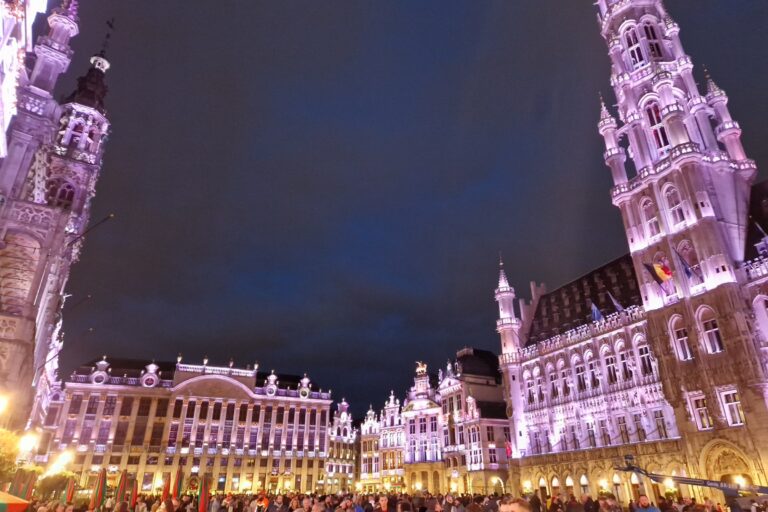
What to watch: The Coalition of the Willing meets in Berlin on Thursday, 19 November, and the UK-EU Summit takes place in Brussels on Friday, 20 November. Burnham said a deal would mean presenting legislation to Parliament next week, and the Plan for Britain is due next month.
Method: quotations and positions are from the transcript of the Prime Minister’s speech at the Lord Mayor’s Banquet of 16 November 2026, published by the Prime Minister’s Office, 10 Downing Street, and from its readout of 12 November 2026; the OBR assumption is from its Brexit analysis page, last updated 20 July 2026; GDP is from the Office for National Statistics’ first quarterly estimate of 12 November 2026, at current prices; pound values, sums and ratios not attributed to a source are The Edge’s calculations.
Sources: Prime Minister’s Office, 10 Downing Street, Office for Budget Responsibility, Office for National Statistics, The Edge.