Trump’s Proposed $250 Banknote Faces Legal and Historical Barriers
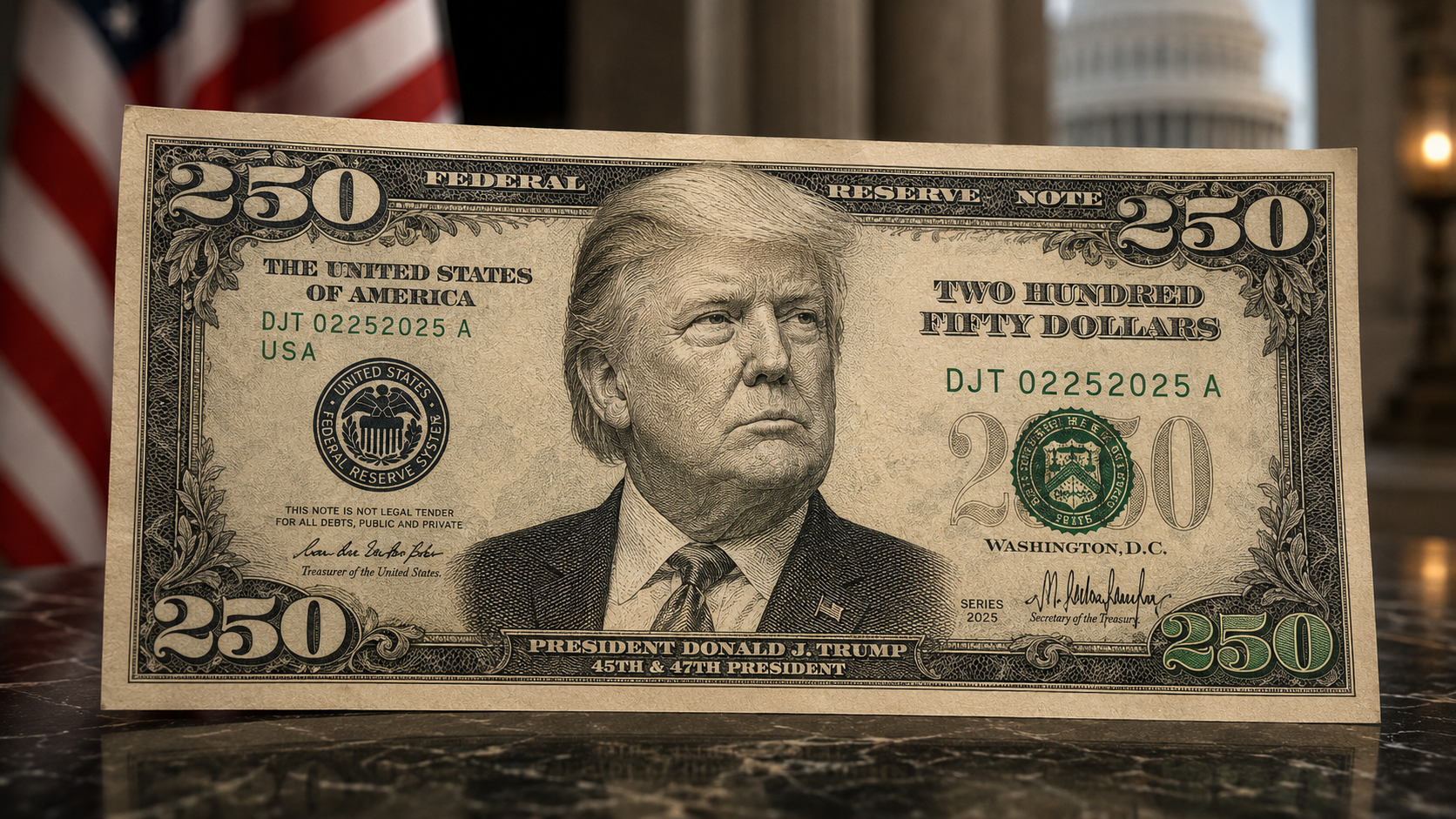
The proposal to issue a $250 US banknote carrying Donald Trump’s portrait has revived a rare debate over currency law, political symbolism and institutional neutrality. While the proposed denomination is linked to the 250th anniversary of US independence in 2026, the issue goes far beyond a commemorative design.
At the center of the debate is a basic legal restriction: living individuals are not permitted to appear on United States currency or securities. That means any Trump $250 banknote would require Congress to create a legal exception before it could be issued.
No Official $250 Banknote Exists Today
There is currently no official $250 US banknote in circulation. The United States’ modern paper currency system is built around familiar denominations, with the $100 bill serving as the highest widely circulated note.
The proposed $250 denomination is therefore symbolic rather than functional. It is tied to the semiquincentennial, the 250th anniversary of US independence, rather than a clearly demonstrated need for a new high-value note in everyday transactions.
This symbolism is exactly why the proposal has attracted attention. Currency design is not only a technical matter. It reflects national identity, institutional continuity and public trust.
The Legal Barrier: 31 U.S.C. § 5114(b)
The central legal obstacle is found in 31 U.S.C. § 5114(b). The law states that only the portrait of a deceased individual may appear on United States currency and securities.
Because Donald Trump is alive, a banknote featuring his portrait cannot be issued under the current legal framework. Congress would need to amend the law or create a specific exception before the Treasury or the Bureau of Engraving and Printing could move forward with any official note.
This makes the proposal a legislative question, not merely a design question. Even if a concept image or mock-up exists, it has no legal standing as currency unless Congress authorizes the change.
H.R. 1761 and the Congressional Path
The proposal is linked to H.R. 1761, introduced by Rep. Joe Wilson. The bill seeks to authorize a $250 note featuring Donald Trump and would require Congress to address the existing prohibition on living individuals appearing on US currency.
This legislative path is politically significant. Currency design has historically been treated as a national institutional matter, not a campaign or partisan branding exercise. Introducing a living political figure onto paper money would therefore raise questions about precedent, neutrality and the role of Congress in shaping monetary symbols.
Even if the proposal advanced, implementation would not be immediate. New banknotes require design, anti-counterfeiting review, production planning and coordination across Treasury-related institutions. The legal question is only the first barrier.
The 1866 Restriction and the Spencer Clark Controversy
The prohibition on living people appearing on US currency traces back to the Civil War era. The rule followed controversy over Treasury official Spencer M. Clark, whose image appeared on a 5-cent fractional currency note.
The episode created concern that officials could use federal currency as a platform for self-promotion. In response, Congress moved to prevent living individuals from appearing on US bonds, securities, notes, fractional currency and related instruments.
That historical background matters because it explains the institutional logic behind the current law. The restriction was designed to protect the neutrality of public money and prevent currency from becoming a tool of personal political image building.
The Lincoln Precedent
Supporters of the proposal may point to Abraham Lincoln as a rare historical precedent. Lincoln’s portrait appeared on the 1861 $10 Demand Note while he was alive and serving as president.
However, that example occurred before the later legal restriction took effect. It is therefore a historical precedent, but not a modern legal precedent under the current framework.
This distinction is important. Lincoln’s appearance on currency does not automatically justify or permit a modern banknote featuring a living president or former president. The legal environment changed after the Civil War era controversies.
Why the Debate Matters
The $250 proposal is not only about whether a new denomination should be created. It is about whether US currency should remain a neutral national instrument or become a platform for current political identity.
For markets and institutions, symbolism matters. Currency is one of the most visible expressions of state credibility. It is used daily by citizens, businesses, investors and foreign holders of dollar assets. Its design carries implications for trust, continuity and institutional independence.
The US dollar also plays a global role as the world’s dominant reserve currency. While a commemorative banknote would not directly alter monetary policy or the dollar’s reserve status, the symbolism of placing a living political figure on currency would likely attract international scrutiny.
Institutional Implications
If approved, a Trump $250 banknote would represent one of the most significant breaks with modern US currency tradition in more than a century.
The move would also raise broader questions. Should currency commemorate historical figures only after their public legacy has been tested over time? Should living political leaders be excluded to protect institutional neutrality? Should major reserve currency design remain insulated from current political cycles?
These questions are not technical. They are institutional.
Outlook
The proposed Trump $250 banknote remains a political and legal proposal, not an approved currency issue. Under current law, a living person’s portrait cannot appear on US currency. That means the proposal cannot become reality without congressional action.
The main takeaway is that the debate is bigger than a new banknote. It tests whether US currency remains a neutral national instrument or becomes a platform for current political identity.
For institutions and markets, the symbolism matters. Currency design reflects trust, continuity and state credibility. Any move to place a living political figure on a banknote would attract scrutiny far beyond the technical process of printing money.
Source note: Data used in this article is based on 31 U.S.C. § 5114(b), H.R. 1761, US currency history and current market reporting.