Kuwait Public Debt Instruments More Than Quadruple to 3.7 Billion Dinars as Deposits Outpace Credit
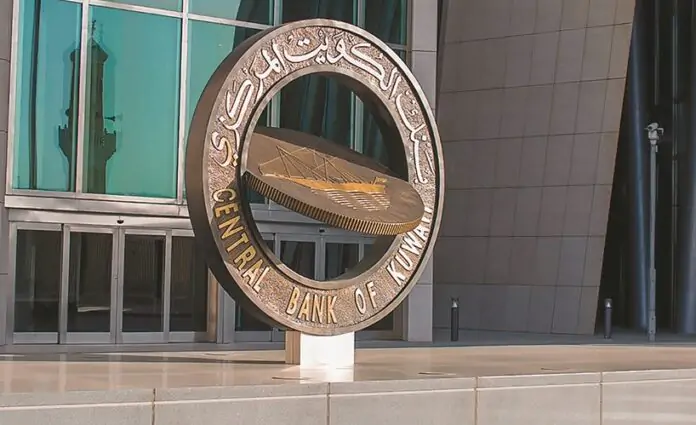
Kuwait’s outstanding public debt instruments and related Tawarruq reached 3.7 billion dinars at the end of July 2026, more than four times the 900 million dinars outstanding in July 2025, according to Central Bank of Kuwait data. Over the same year, resident deposits with local banks grew faster than resident credit, and government and public institution accounts drove most of that deposit growth. Utilized cash credit to residents stood 4.8 percent higher than a year earlier even after a small monthly dip, while broad money supply grew more slowly than either.
Public Debt Issuance Extends Its Rebuild
The domestic public debt program was close to dormant for years before its current rebuild. The Central Bank of Kuwait’s public debt instruments table shows the balance falling from 950 million dinars in mid-2021 to 50 million dinars by August 2024, where it sat unchanged through May 2025. The rebuild began in June 2025, when the Central Bank of Kuwait, acting on behalf of the Ministry of Finance, issued a 500 million dinar 1-year instrument at a yield of 4.375 percent, taking the balance to 550 million dinars. A further 350 million dinars issued in July 2025, with no maturities, brought the balance to 900 million dinars.
The balance has climbed most months since, reaching 2.25 billion dinars by January 2026, 3.05 billion dinars in April, 3.3 billion dinars in June and 3.7 billion dinars in July, holding flat rather than falling in months without new issuance.
June’s increase came from 4 auctions on 24 June: 150 million dinars at 2 years and a yield of 2.750 percent, 250 million dinars at 3 years and 2.700 percent, 100 million dinars at 5 years and 3.250 percent, and 50 million dinars at 7 years and 3.125 percent, for gross issuance of 550 million dinars. That same month, the 500 million dinar 1-year instrument issued in June 2025 matured, so the balance rose by only 50 million dinars on a net basis even though gross issuance was 550 million dinars.
July’s 400 million dinar increase came from 2 auctions with no maturities: 150 million dinars at 3 years and a yield of 2.500 percent on 22 July, and 250 million dinars at 5 years and 3.250 percent on 29 July. The entire 3.7 billion dinar balance is held by local banks, with none held by the Central Bank of Kuwait itself.
Across 2026 through July, the program has priced instruments at 2, 3, 5 and 7 years. Neither the 1-year nor the 10-year tenor has been used for new issuance in any month of 2026 through July.
This balance covers only the Central Bank of Kuwait’s own series for Treasury bills and bonds and related Tawarruq, and should not be read as Kuwait’s entire sovereign debt stock. The current program operates under Decree-Law No. 60 of 2025 on financing and liquidity, issued 26 March 2025, which the Ministry of Finance states sets a public debt ceiling of 30 billion dinars, or the equivalent in major convertible foreign currencies, and permits instruments with maturities of up to 50 years.
| Period | Outstanding balance |
|---|---|
| May 2025 | 50 million dinars |
| July 2025 | 900 million dinars |
| January 2026 | 2.25 billion dinars |
| April 2026 | 3.05 billion dinars |
| June 2026 | 3.3 billion dinars |
| July 2026 | 3.7 billion dinars |
Source: Central Bank of Kuwait, Table 08, Public Debt Instruments, and the Central Bank of Kuwait’s Public Debt Issuance announcements of 24 June, 22 July and 29 July 2026.
Money Supply and Bank Balance Sheets
Broad money supply, M2, stood at 42.843 billion dinars at the end of July, up 0.2 percent from 42.742 billion dinars in June and 1.9 percent from 42.059 billion dinars in July 2025, on our calculation. Within that total, M1 fell 1.0 percent from June to 10.903 billion dinars but was still 4.0 percent higher than a year earlier, while quasi money rose 0.7 percent from June to 31.940 billion dinars.
Net foreign assets held by the Central Bank of Kuwait and local banks fell for a third straight month, down 1.5 percent from June to 25.948 billion dinars in July and 2.6 percent lower than in July 2025. Claims on the private sector, a broader balance sheet measure than the credit facilities figures reported by sector below, rose 0.3 percent from June to 51.985 billion dinars, up 5.3 percent from a year earlier. Claims on government, which include the public debt instruments and Tawarruq described above, rose 12.4 percent from June and 276.7 percent from July 2025, an annual increase of 3.389 billion dinars on our calculation. The 2.8 billion dinar annual increase in public debt instruments alone accounts for about 83 percent of that rise in claims on government, on our calculation.
| Measure | July 2026 | June 2026 | July 2025 |
|---|---|---|---|
| Money supply, M2 | 42.843bn | 42.742bn | 42.059bn |
| Claims on private sector | 51.985bn | 51.822bn | 49.367bn |
| Claims on government | 4.613bn | 4.103bn | 1.225bn |
| Net foreign assets | 25.948bn | 26.344bn | 26.633bn |
Source: Central Bank of Kuwait, Tables 01 and 02, Monetary Survey and Money Supply. Month on month and year on year changes are on our calculation from Central Bank of Kuwait levels.
Resident Credit Still Growing, Despite a Monthly Dip
Utilized cash credit facilities extended by local banks to residents totaled 54.651 billion dinars at the end of July, down 0.2 percent from June but up 4.8 percent, or 2.482 billion dinars, from July 2025, on our calculation. This series, which the Central Bank of Kuwait reports by economic sector, is narrower than the claims on private sector figure above, which also includes bank investments and certificates of deposit.
Personal facilities, the largest category, rose 4.5 percent from a year earlier to 20.596 billion dinars, adding about 888 million dinars over 12 months, which our calculation puts at roughly 36 percent of the entire annual increase in resident credit. Within personal facilities, installment loans, which the Central Bank of Kuwait defines as long term loans of up to 15 years financing home purchase, construction or renovation, rose 5.6 percent from July 2025 to 17.932 billion dinars. Real estate facilities rose 4.3 percent from a year earlier to 11.043 billion dinars despite easing 0.4 percent from June.
Trade facilities fell 10.8 percent from July 2025 to 3.456 billion dinars, the only sector in the table to post a year on year decline. Crude oil and gas facilities grew fastest, up 22.8 percent from a year earlier to 2.266 billion dinars, followed by industry, up 11.5 percent to 2.569 billion dinars, and construction, up 6.7 percent to 2.822 billion dinars.
Despite the sharp rise in government instruments held by banks, resident credit was still 2.482 billion dinars higher than a year earlier, on our calculation. The July data do not point to broad crowding out of private credit so far.
| Sector | July 2025 | July 2026 | Year on year change |
|---|---|---|---|
| Personal facilities | 19.708bn | 20.596bn | +4.5% |
| Real estate | 10.584bn | 11.043bn | +4.3% |
| Trade | 3.876bn | 3.456bn | -10.8% |
| Construction | 2.645bn | 2.822bn | +6.7% |
| Industry | 2.304bn | 2.569bn | +11.5% |
| Crude oil and gas | 1.845bn | 2.266bn | +22.8% |
| Total resident credit | 52.169bn | 54.651bn | +4.8% |
Source: Central Bank of Kuwait, Table 13-1, Sectoral Distribution of Balances of Utilized Cash Portion of Credit Facilities by Residents. Changes are on our calculation. Total resident credit also includes loans to banks, non-bank financial institutions, purchase of securities, agriculture and fishing, public services and other services, which the Central Bank of Kuwait reports individually but are not broken out as separate rows here.
Deposit Growth Is Concentrated in the Public Sector
Total resident deposits with local banks reached 56.478 billion dinars at the end of July, up 9.8 percent, or 5.051 billion dinars, from 51.428 billion dinars in July 2025, on our calculation. Almost all of that annual increase came from government and public institution accounts rather than private sector deposits. Private sector deposits, the largest single component, rose just 1.7 percent from a year earlier to 41.132 billion dinars. Government deposits rose 33.5 percent to 5.846 billion dinars, while public institution deposits rose 43.6 percent to 9.501 billion dinars.
Combined, government and public institution deposits reached 15.346 billion dinars, up from 10.995 billion dinars a year earlier, on our calculation. That 4.352 billion dinar combined increase accounts for about 86 percent of the entire 5.051 billion dinar annual increase in total resident deposits, on our calculation. This composition also helps explain why total deposits grew faster than M2, since M2 is built mainly from private sector money holdings.
Average interest rates on 12-month Kuwaiti dinar time deposits with local banks stood at 3.598 percent in July, unchanged from June but down 50.8 basis points from 4.106 percent in July 2025, according to the Central Bank of Kuwait’s own survey of customer deposit rates.
| Category | July 2026 | July 2025 | Year on year change |
|---|---|---|---|
| Private sector deposits | 41.132bn | 40.433bn | +1.7% |
| Government deposits | 5.846bn | 4.378bn | +33.5% |
| Public institution deposits | 9.501bn | 6.617bn | +43.6% |
| Total resident deposits | 56.478bn | 51.428bn | +9.8% |
Source: Central Bank of Kuwait, Table 15-1, Residents Deposits by Type. Changes are on our calculation.
Why it matters: Kuwait is rebuilding a domestic sovereign debt market after years of very limited issuance, giving local banks a growing stock of dinar denominated government paper and starting to build out a domestic yield curve across several tenors. That rebuild has not so far come at the expense of private credit, which remained 4.8 percent higher than a year earlier across most sectors. The banking system’s deposit growth is concentrated in government and public institution accounts rather than private sector balances, which is the channel funding both the sovereign program and continued private lending from the same expanding deposit base. If public sector deposit inflows were to slow while government borrowing kept rising, the balance between funding the sovereign program and funding private credit would become more consequential than it has been so far.
Outlook: The public debt program has not used the 1-year or 10-year tenor in 2026. Whether the Central Bank of Kuwait and Ministry of Finance test those tenors, and whether the pace of roughly 400 to 550 million dinars in gross new issuance seen in recent months continues on a similarly small net basis or accelerates, will show in the August release. Issuance has already continued beyond the July data covered here: on 19 August 2026, the Central Bank of Kuwait announced a further 100 million dinar 5-year issue at a yield of 3.375 percent, ahead of the Central Bank of Kuwait’s regular monthly release schedule for August.
What the deposit surge actually is
Three ratios computed from the Central Bank of Kuwait’s own published series, none of them printed in the release, show what the July numbers describe.
The first is where the deposit growth came from. Total resident deposits rose 5.050 billion dinars over the year. Government and public institution deposits together rose from 10.995 billion dinars to 15.346 billion, an increase of 4.352 billion. That is 86.2 percent of the entire year’s deposit growth, on our calculation, leaving 688 million dinars, or 13.8 percent, from the private sector and everything else combined. The headline 9.8 percent deposit growth is very largely a public sector deposit.
The second is the resulting liquidity position. Claims on the private sector stood at 51.985 billion dinars against resident deposits of 56.478 billion, a ratio of 92.0 percent. A year earlier the same two series stood at 49.368 billion and 51.428 billion, a ratio of 96.0 percent, on our calculation. The banking system is close to 4 percentage points more deposit-funded than it was in July 2025, not because lending slowed, but because deposits grew roughly twice as fast as credit.
The third is the changing shape of the deposit base. Private sector deposits were 78.6 percent of resident deposits in July 2025 and are 72.8 percent now, on our calculation, a fall of 5.8 percentage points in twelve months. The deposit base is measurably more concentrated in state hands than it was a year ago.
Those three readings also resolve an apparent contradiction in the same release. Resident deposits grew 9.8 percent over the year while broad money supply grew 1.9 percent. The two are not in conflict: government deposits are not counted in the standard money aggregates, so a deposit build that is 86.2 percent public sector by construction barely registers in M2. The money supply figure is not understating the deposit growth. It is measuring a different thing.
Set against the balance sheet, the debt rebuild is still small but no longer marginal. Public debt instruments and related Tawarruq at 3.7 billion dinars are 8.6 percent of M2, against 2.1 percent a year earlier, on our calculation.
Why it matters
For Kuwait, the July data describe a banking system taking in state money faster than it lends, and a sovereign that has resumed borrowing domestically after a period in which the domestic debt stock had fallen to 50 million dinars. Both are balance sheet facts rather than statements about the fiscal position, and The Edge does not infer one from the other.
The practical consequence sits with the banks. A loan to deposit ratio falling from 96.0 percent to 92.0 percent while credit is still growing 5.3 percent year on year means the constraint on lending in July was not funding. Where a system is more deposit-funded and more of those deposits are public, the composition of the funding base matters more than its size, because public deposits behave differently from retail ones.
Outlook
Three things to watch in the August release. Whether government and public institution deposits keep rising at 33.5 and 43.6 percent year on year, since a single year at those rates is a level shift rather than a trend. Whether net foreign assets extend what is now a third consecutive monthly fall, at 25.948 billion dinars in July and 2.6 percent below a year earlier. And whether the issuance pace holds, given that the 19 August 5-year issue at 3.375 percent already falls outside the July data covered here.
Sources: Central Bank of Kuwait, Dynamic Statistical Releases, Monthly, data for July 2026, Tables 01, 02, 08, 13-1, 15-1 and 20; Central Bank of Kuwait Public Debt Issuance announcements of 24 June, 22 July, 29 July and 19 August 2026; Ministry of Finance, Kuwait, Decree-Law No. 60 of 2025.