Banque du Liban Raises Monthly Dollar Withdrawal Cap 20% to $1,200 Under Circular 158
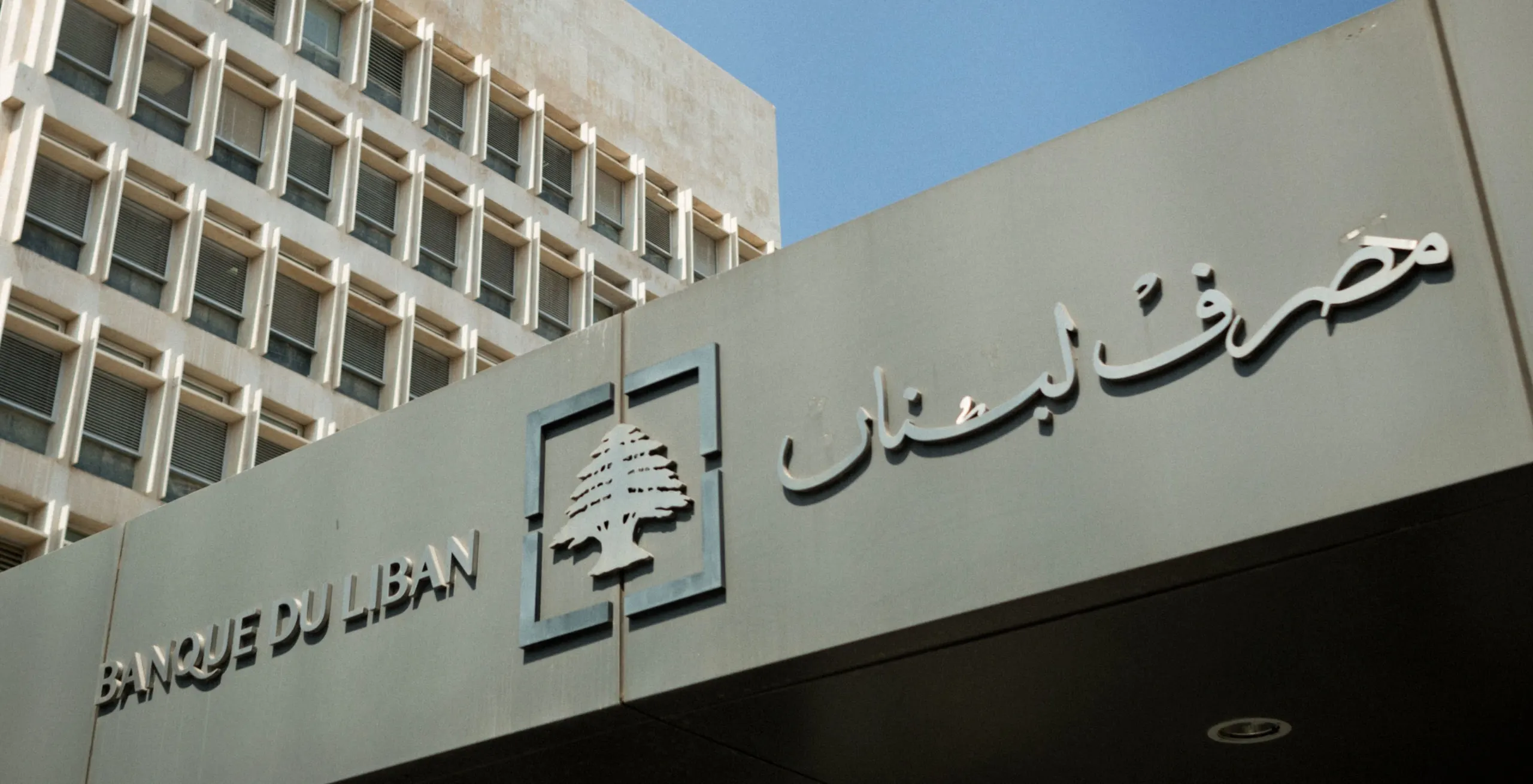
Banque du Liban will raise the monthly dollar withdrawal ceilings under its two deposit repayment circulars by 20% from 1 December, all of it as card payments at point-of-sale terminals.
For depositors with savings still locked in Lebanese banks, the monthly cash maximum stays at $800 under Circular 158 and $400 under Circular 166. Only the card portion for point-of-sale (POS) terminals rises, doubling to $400 and $200. In The Edge’s reading, what this adds to monthly payouts turns on how many depositors still draw and how much of the card portion they spend.
The central bank set out the change in Intermediate Circulars 780 and 781, dated 3 November, which Lebanon’s National News Agency published the same day. Under Circular 158, the monthly ceiling rises to $1,200 from $1,000. Under Circular 166, it rises to $600 from $500.
The POS amount can be used only by bank card at point-of-sale terminals, and the central bank may change it in line with its monetary policy. The rest of each monthly sum can be taken in banknotes, transferred abroad, spent by bank card in Lebanon or abroad, or placed in a new account, which the circulars call a Fresh Account.
Circular 158 is Basic Decision 13335 of 8 June 2021, on the gradual repayment of foreign currency deposits, and payments under it began on 1 July 2021. Circular 166, Basic Decision 13611 of 2 February 2024, covers foreign currency deposits constituted before 30 June 2023.
The yearly maximum rises to $14,400 under Circular 158
The yearly maximum a depositor can draw from all banks rises to $14,400 under Circular 158, from $12,000. Under Circular 166 it rises to $7,200, from $6,000.
For the current cycle, which ends on 30 June 2027 and began with five months at the old amounts, the circulars set the yearly ceilings at $13,400 and $6,700.
The overall ceiling on what a depositor can receive under Circular 158 rises to $55,600, from $54,200. Under Circular 166 it rises to $15,900, from $15,200.
Withdrawal ceilings under the two circulars (in $)
| Ceiling | Since Dec 2025 | From Dec 2026 |
|---|---|---|
| Circular 158, monthly | 1,000 | 1,200 |
| of which by POS card | 200 | 400 |
| Circular 158, yearly | 12,000 | 14,400 |
| Circular 166, monthly | 500 | 600 |
| of which by POS card | 100 | 200 |
| Circular 166, yearly | 6,000 | 7,200 |
POS card amounts can be spent only at point-of-sale terminals; the rest of each monthly amount can be taken in cash, transferred abroad, spent by card or placed in a new account. The December 2025 ceilings were set by Intermediate Circulars 746 and 747 of 28 November 2025 and renewed for a year from 1 July 2026; the December 2026 ceilings by Intermediate Circulars 780 and 781 of 3 November 2026. Yearly ceilings are the maximums from all banks.
The new ceilings are 2.4 times their March 2025 levels
In February 2025 the central bank raised the monthly ceiling under Circular 158 to $500 and under Circular 166 to $250, from 1 March 2025. It took that decision after consulting the president, the speaker of parliament, the prime minister and the finance minister.
In June 2025 it extended both circulars, which had been due to end on 30 June 2025. It also raised the monthly cash ceilings to $800 and $400, for a renewable year running from 1 July 2025.
In November 2025 it lifted the ceilings to $1,000 and $500 from 1 December 2025. The added amounts, $200 and $100, could be spent only by card at point-of-sale terminals. One of the grounds the circulars gave was to encourage the use of bank cards and reduce the use of cash.
In June 2026 it renewed both circulars for a year from 1 July 2026 without changing the monthly amounts. In September it added religious associations and endowments to the sole proprietorships and licensed associations that the November 2025 amendment had already admitted.
As The Edge set out on 1 November, the September amendments were issued on the same day as a circular on reviving the business of banks operating in Lebanon.
The central bank ties the payments to a future deposit law
The new circulars rest on a decision of the central bank’s Central Council of 8 October. They cite a contraction in economic activity and a sharp rise in the prices of basic goods, and the effect of both on household purchasing power.
They were issued pending approval of the draft law on financial regularisation and deposit recovery by the competent constitutional authorities. The circulars state that amounts already repaid under the central bank’s circulars must be counted when any cash payments under that expected law are calculated, to ensure equal treatment of depositors and avoid any double counting.
The circulars had returned $6.1bn to depositors by March 2026
By the end of March 2026, 578,770 depositors had benefited from the two circulars, the central bank said in a statement on 11 May. Of those, 266,166, or 46%, had recovered their full deposits in the dedicated sub-account.
That left 312,604 beneficiaries, 54% of the total, still short of their full balance at that date. Applications had reached 610,624 by the date of the statement.
Every beneficiary since 1 July 2021 whose deposits were $40,200 or less had recovered the full amount by the end of April 2026, according to the statement.
Banks and the central bank together had paid depositors $6.109bn by the end of March 2026. That is $10,555 per beneficiary on average.
The central bank covered $4.183bn of the total, or 68.46%. The banks paid the other $1.926bn.
The two circulars to end-March 2026
| Measure | Value |
|---|---|
| Beneficiaries | 578,770 |
| Fully repaid | 266,166 |
| Applications | 610,624 |
| Paid out, $ millions | 6,109 |
| Central bank, $ millions | 4,183 |
| Banks, $ millions | 1,926 |
Applications are counted to the date of the 11 May 2026 statement; all other rows run to the end of March 2026.
The scheme runs on a yearly cycle from July to June. In November 2024 the central bank let a depositor who had finished drawing under one circular move to the other without waiting for the cycle to end.
That change followed a June 2024 renewal that widened access, letting depositors choose either circular and draw under Circular 166 even after benefiting from Circular 158.
The central bank pays most of each month’s bill
Monthly payments under the two circulars came to $240.4m in March 2026, down from $242.2m in February. The banks’ share of the March payment was an estimated $28.36m, the central bank said, or 11.8% of the total.
The central bank paid the other 88.2%, or $212m. The statement puts the cash the circulars provide at more than $2.5bn a year; at the March pace, the run rate is $2.88bn.
The payments are funded from the commercial banks’ mandatory placements kept at the central bank. The central bank describes those placements as belonging, in law and in fact, to the depositors themselves.
The central bank’s own data on its foreign assets give a sense of scale. Its liquid foreign assets excluding gold stood at $11.42bn at the end of July 2026, the latest month in the series.
That is $471m, or 4.0%, below the level of January 2026. It is still 12.7% above the end of December 2024.
In The Edge’s reading, and as an illustration of scale only, setting a year of payments against a stock of assets, the $2.5bn floor that the statement gives equals 21.9% of the July liquid stock, although part of that sum is paid by the banks themselves. On the same basis, the central bank’s $212m share of the March payment equalled 1.8% of its liquid foreign assets at the end of that month.
Gold makes up most of the rest of the central bank’s foreign assets. It was worth $37.45bn at the end of July, out of total foreign assets of $49.10bn. That is a share of 76.3%.
Banque du Liban liquid foreign assets excluding gold (in $ millions)
| Month end | Assets |
|---|---|
| Dec 2024 | 10,134.7 |
| Jun 2025 | 11,325.8 |
| Dec 2025 | 11,840.2 |
| Jan 2026 | 11,891.9 |
| Mar 2026 | 11,479.2 |
| Jun 2026 | 11,443.0 |
| Jul 2026 | 11,420.9 |
End-of-period figures from the central bank’s foreign assets and liabilities series; July 2026 is the latest month published.
What to watch: 1 December 2026, when the new ceilings take effect under both circulars; 30 June 2027, when the current cycle ends and the terms of both circulars fall due for renewal or amendment.
Figures are from Banque du Liban’s Intermediate Circulars 780 and 781 of 3 November 2026, published by the National News Agency the same day; its Intermediate Circulars 746 and 747 of 28 November 2025, 768 and 769 of 4 June 2026 and 775 and 776 of 14 September 2026; its statements and decisions carried by the same agency on 27 June 2024, 26 November 2024, 19 February 2025, 18 June 2025 and 11 May 2026; and its foreign assets and liabilities series. Percentages and comparisons not attributed to a source are The Edge’s calculations.
Sources: Banque du Liban, National News Agency, The Edge.