Commodities Wrap 3 August: Crude Slides Almost 5 Percent as Cocoa Jumps 9.4 Percent
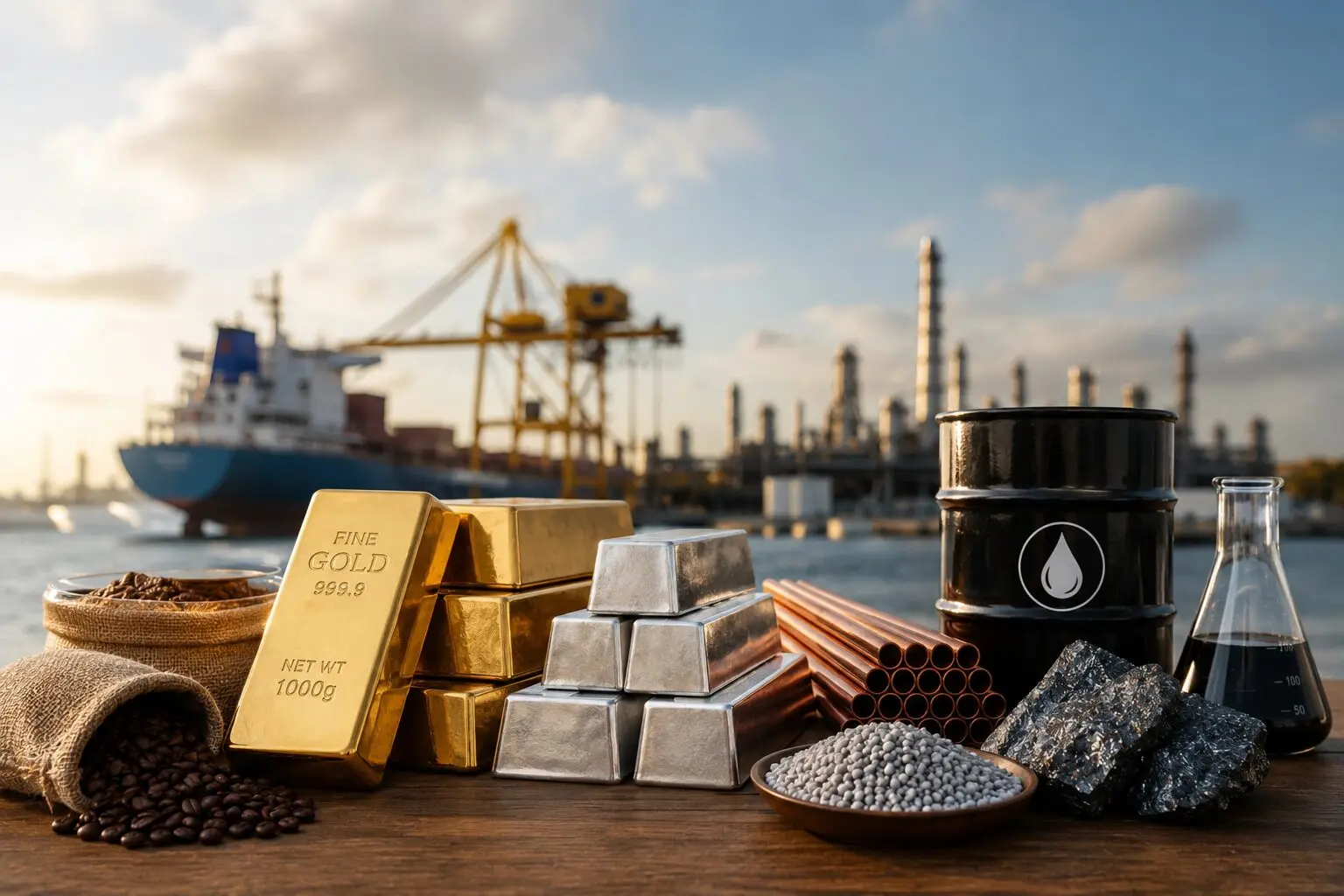
Crude oil fell close to 5 percent across every grade on Monday 3 August while soft commodities pushed sharply higher, leaving the commodity complex split down the middle. Brent traded at 83.78 dollars a barrel, down 4.72 percent, and West Texas Intermediate at 80.06 dollars, down 4.61 dollars or 5.44 percent, per CNBC. The move came alongside a rally in equities and a broad decline in United States Treasury yields, a combination that on our reading points to a session driven by an easing of supply-risk premium rather than by a deterioration in the demand outlook.
The selling in energy was uniform rather than concentrated. Refined products fell further than the crude they are made from: heating oil dropped 5.79 percent to 3.8584 dollars a gallon and RBOB gasoline fell 4.99 percent to 2.959 dollars a gallon, per CNBC. Natural gas was the single exception in the energy table, adding 0.98 percent to 2.774 dollars per million British thermal units. Our reading is that products leading crude lower is consistent with a risk-premium unwind working through the barrel from the top down, since refining margins would ordinarily widen, not narrow, if the driver were stronger end demand.
Precious metals were mixed and base metals firmed. Gold was effectively unchanged at 4,110.9 dollars an ounce, up 3.9 dollars or 0.09 percent, while silver added 1.05 percent to 58.395 dollars and copper rose 1.21 percent to 6.544 dollars a pound, per CNBC. Platinum and palladium both fell, by 1.15 percent to 1,639.7 dollars and 1.24 percent to 1,265.5 dollars respectively. Silver’s outperformance against gold left the gold-to-silver ratio at roughly 70.4 by our calculation, a level that continues to sit well below the multi-year averages of the past decade and that on our reading reflects the industrial component of silver demand rather than any change in the monetary case for gold.
Agriculture produced the session’s largest single move. Cocoa jumped 506 dollars, or 9.38 percent, to 5,903 dollars a tonne, per CNBC. Sugar added 2.39 percent to 15.01 cents a pound. Grains were firm across the board, with corn up 1.94 percent to 473 cents a bushel, wheat up 1.92 percent to 651.5 cents and rough rice up 1.76 percent to 14.205 dollars; soybeans added 0.4 percent to 1,192.25 cents and cotton rose 0.73 percent to 82.39 cents a pound. Coffee was the notable decliner, down 2.89 percent to 305.55 cents a pound.
Across the wider markets, the United States Dollar Index closed at 99.957, up 0.04 percent, while the euro traded at 1.151 dollars and sterling at 1.342 dollars, per CNBC. The dollar was quoted at 157.18 Japanese yen. Treasury yields fell along the whole curve: the two-year finished at 4.241 percent, down about 5 basis points, the ten-year at 4.676 percent, down about 7 basis points, and the thirty-year at 5.226 percent, down about 5 basis points. The CBOE Volatility Index eased 0.81 percent to 15.86 and Bitcoin added about 0.5 percent to 63,631 dollars. United States equities closed higher in the cash session, with the S&P 500 up 1.48 percent to 7,600.50, the Nasdaq Composite up 2.13 percent to 25,913.90 and the Dow Jones Industrial Average up 1.32 percent to 53,178.41, per CNBC.
Why it matters: A 5 percent single-session fall in crude is material for the Gulf’s fiscal arithmetic. Saudi Arabia, Kuwait, the United Arab Emirates and Oman price the bulk of their export revenue off international benchmarks, and a broad decline across the crude grades feeds into the official selling prices that anchor the region’s term barrels. For Kuwait, whose budget framework remains anchored on a conservative reference price, a single session of this size does not change the fiscal picture, and the country’s revenue planning has been built around exactly this kind of volatility. Qatar’s liquefied natural gas contracts are largely oil-indexed on a lagged basis, so the read-through there is slower and smaller than the headline move implies, and Henry Hub’s 0.98 percent gain runs the other way. The fall in Treasury yields is the more immediate positive for the region: with Gulf currencies pegged or managed against the dollar, lower United States yields reduce the cost of dollar-linked borrowing for regional sovereigns, banks and corporates refinancing in the coming weeks. Gold’s stability at just above 4,100 dollars also holds the mark-to-market value of the region’s official gold reserves steady.
Outlook: The immediate question is whether the risk premium that came out of crude on Monday stays out. On our reading, a decline of this size, delivered uniformly across the crude grades and the refined products with no offsetting move in natural gas, is characteristic of a premium unwind rather than a demand signal, and such moves have historically been partially retraced within the following two sessions when the underlying supply position is unchanged. Cocoa’s 9.38 percent surge extends a run that has repeatedly overshot in both directions this year and we would treat a single session as weak evidence of a durable trend. The more consequential number for the week is the United States rates path: a further leg lower in the ten-year would compound the financing relief for Gulf borrowers, while a reversal would put the dollar back in focus for gold. We will carry the next wrap after Tuesday’s close.
Data note: commodity levels are CNBC late-session snapshots on the day’s active contracts, not a single uniform exchange settlement, and the rate, currency and cryptocurrency figures are timestamp-sensitive.
Table Energy, 3 August, ranked by change:
| Instrument | Level | Change |
|---|---|---|
| Natural gas (USD/MMBtu) | 2.774 | +0.027 (+0.98%) |
| Brent crude (USD/bbl) | 83.78 | -4.15 (-4.72%) |
| RBOB gasoline (USD/gal) | 2.959 | -0.155 (-4.99%) |
| WTI crude (USD/bbl) | 80.06 | -4.61 (-5.44%) |
| Heating oil (USD/gal) | 3.8584 | -0.2371 (-5.79%) |
Table Metals, 3 August, ranked by change:
| Instrument | Level | Change |
|---|---|---|
| Copper (USD/lb) | 6.544 | +0.078 (+1.21%) |
| Silver (USD/oz) | 58.395 | +0.609 (+1.05%) |
| Gold (USD/oz) | 4,110.9 | +3.9 (+0.09%) |
| Platinum (USD/oz) | 1,639.7 | -19.0 (-1.15%) |
| Palladium (USD/oz) | 1,265.5 | -15.9 (-1.24%) |
Table Agriculture, 3 August, ranked by change:
| Instrument | Level | Change |
|---|---|---|
| Cocoa (USD/tonne) | 5,903 | +506 (+9.38%) |
| Sugar (cents/lb) | 15.01 | +0.35 (+2.39%) |
| Corn (cents/bushel) | 473 | +9.00 (+1.94%) |
| Wheat (cents/bushel) | 651.5 | +12.25 (+1.92%) |
| Rough rice (USD/cwt) | 14.205 | +0.245 (+1.76%) |
| Cotton (cents/lb) | 82.39 | +0.60 (+0.73%) |
| Soybean (cents/bushel) | 1,192.25 | +4.75 (+0.40%) |
| Coffee (cents/lb) | 305.55 | -9.10 (-2.89%) |
Table Rates, currencies, volatility and crypto, 3 August:
| Instrument | Level | Change |
|---|---|---|
| US 2-year yield | 4.241% | -5.0 bp |
| US 5-year yield | 4.387% | -7.3 bp |
| US 10-year yield | 4.676% | -6.9 bp |
| US 20-year yield | 5.232% | -6.3 bp |
| US 30-year yield | 5.226% | -4.9 bp |
| UK 10-year gilt yield | 4.950% | -0.6 bp |
| German 10-year Bund yield | 3.150% | unchanged |
| EUR/USD | 1.151 | +0.02% |
| GBP/USD | 1.342 | -0.02% |
| USD/JPY | 157.18 | +0.01% |
| US Dollar Index | 99.957 | +0.043 (+0.04%) |
| USD/KWD | 0.3077 | reference |
| VIX | 15.86 | -0.13 (-0.81%) |
| Bitcoin (USD) | 63,631 | +0.48% |
Sources: CNBC.