Egypt Has Signed a Contract for a 500 kV Gulf of Suez Wind Line as Sisi Reviews a 200 MW Plant
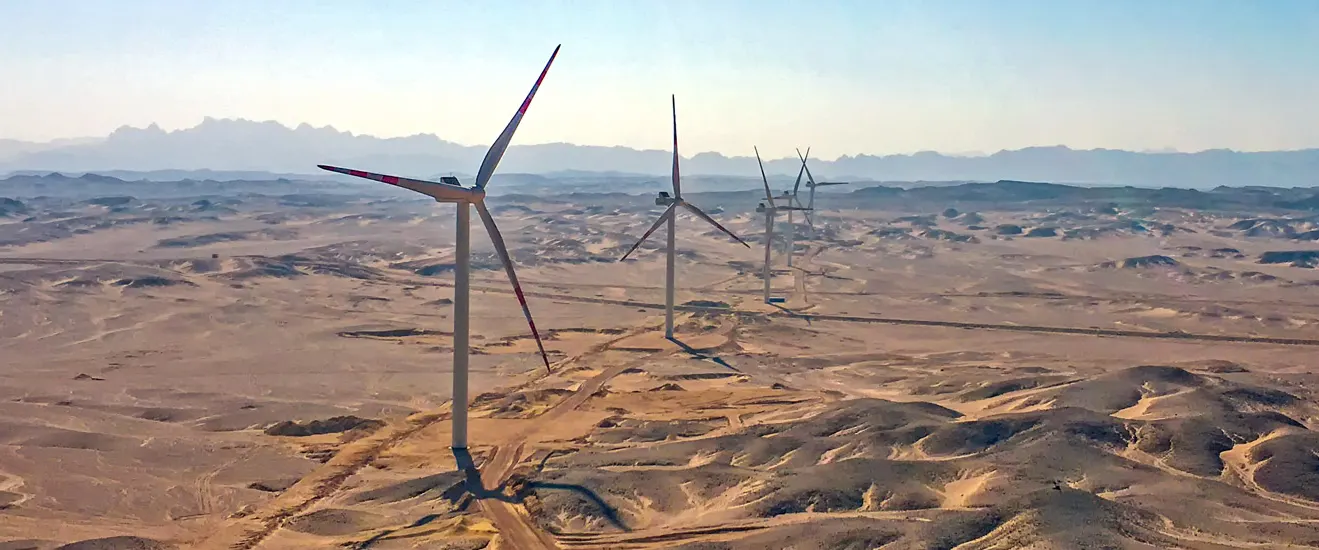
Egypt’s Ministry of Electricity and Renewable Energy has recently signed a contract for a new 500 kilovolt overhead line to carry wind power from the Gulf of Suez to consumption areas across the country, the Egyptian Presidency said on Tuesday. President Abdel Fattah El-Sisi reviewed the implementation status of a 200 megawatt wind plant in the same region. The Presidency said the plant contributes to the goal, set out earlier, of a 45 percent renewables share in the energy mix by 2028, instead of 42 percent by 2030. On its own, the plant would enlarge Egypt’s operating wind fleet by 6.9 percent, on our calculation.
A Line Under Contract for Gulf of Suez Wind
The President met Prime Minister Mostafa Madbouly, Minister of Electricity and Renewable Energy Mahmoud Esmat and Finance Minister Ahmed Kouchouk. Esmat said the new line is part of the work to develop and strengthen the unified national grid.
The 2028 goal itself was set out earlier. The Prime Minister restated 45 percent by 2028 on 22 October, alongside a 2030 goal of 50 percent, according to the Egyptian Cabinet. In May 2024 the New and Renewable Energy Authority’s news page described a 42 percent share for renewables on the national grid by 2030, after an amendment to the 2035 energy strategy set that share for 2030.
The region already hosts other wind projects. In March 2025 the Egyptian Electricity Transmission Company signed an agreement with Siemens Gamesa Renewable Energy for a 500 megawatt wind plant in the Gulf of Suez, the authority’s news page shows. Masdar lists the 252 megawatt West Bakr wind farm in the Gulf of Suez among its projects, in commercial operation since 2021.
What 200 Megawatts Adds
The authority’s quarterly bulletin for July 2026, Issue 31, lists 2,895.7 megawatts of wind in operation: 1,233.2 megawatts public and 1,662.5 megawatts private sector. That makes 57.4 percent of the wind now running privately developed, on our calculation. A 200 megawatt plant would take the fleet to 3,095.7 megawatts, on our sum.
Against Egypt’s total renewable fleet of 9,616.56 megawatts, on our sum of the bulletin’s figures, the plant adds 2.1 percent, on our calculation. A much larger build sits behind it. The bulletin lists 12,069 megawatts of wind in construction and development until 2030, which is 4.2 times the wind in operation, on our calculation.
Egypt’s Wind Fleet and the 200 MW Plant
| Measure | MW | 200 MW as a share |
|---|---|---|
| Wind in operation | 2,895.7 | 6.9% |
| Renewables in operation | 9,616.56 | 2.1% |
| Wind in construction and development to 2030 | 12,069 | 1.7% |
Quarterly bulletin, Issue 31, July 2026. Renewables in operation is our sum of the bulletin’s hydro, wind and solar figures; the share column is our calculation.
Wind’s Share of Output
In the April to June quarter, the last of fiscal 2025/26, wind farms generated 2,873.4 gigawatt hours, on our sum of the bulletin’s monthly figures. That is 28.6 percent of all renewable output, on our calculation. It is also 1.27 times what solar produced, on our calculation. June’s wind output was 44.5 percent above April’s, on our calculation. May was the strongest month at 1,085 gigawatt hours.
Spread across the fleet, the quarter’s output works out at 992.3 megawatt hours per megawatt installed, on our calculation. If the 2,895.7 megawatts ran through all 91 days of April to June, on our count, the capacity factor was 45.4 percent, on our calculation. At the same rate a 200 megawatt plant would have produced 198.5 gigawatt hours in April to June, on our calculation.
The bulletin tracks wind speed at two sites. The Gulf of Zeit averaged 8.6 metres a second in the quarter. That is 24.6 percent faster than Zafarana’s 6.9, on our calculation. Both readings were lower than a year earlier, as the table shows.
Average Wind Speed at Two Sites (m/s)
| Site | Q4 2024/25 | Q4 2025/26 |
|---|---|---|
| Gulf of Zeit | 8.8 | 8.6 |
| Zafarana | 7.2 | 6.9 |
Fourth quarter of the fiscal year, April to June, in both years. Quarterly bulletin, Issue 31, July 2026.
The bulletin credits wind with avoiding 1,197.5 thousand tonnes of carbon dioxide. Wind also saved 505 thousand tonnes of oil equivalent of fuel. Each is 28.4 percent of the renewable total, on our calculation.
The bulletin’s annual chart, which it labels projections, puts renewable capacity at 9.1 gigawatts in fiscal 2025/26, up from 6.3 gigawatts in 2021/22. That is a 44.4 percent increase over 4 years, on our calculation.
Storage, Hydrogen and Water
The meeting also covered expanding battery storage, green hydrogen projects and desalination, including a planned desalination complex at El-Dabaa. Esmat presented renewable and battery projects that are complete, under way or due to start operating. The President called for a more diverse energy mix that strengthens energy security, cuts emissions and lowers reliance on fossil fuels. He also called for localising black sand and rare element industries. Kouchouk briefed the meeting on economic and fiscal developments and on efforts to reduce budget-sector debt.
Why it matters: The 500 kilovolt line now under contract is planned to carry Gulf of Suez wind power to consumption areas across Egypt. More transmission lets more of that wind reach the grid’s users, on our reading. The Gulf of Zeit site averaged 8.6 metres a second last quarter, 24.6 percent faster than Zafarana, on our calculation. Wind supplied 28.6 percent of Egypt’s renewable output in April to June, on our calculation, and is credited with saving 505 thousand tonnes of oil equivalent of fuel.
Outlook: The authority’s bulletin comes out every 3 months, its website says, and the next issue could show how much wind added to output after the April to June quarter. The figures to watch are the new line’s length, cost and completion date, the commissioning date of the 200 megawatt plant, and how quickly the 12,069 megawatts of wind in the pipeline reach the grid.
Sources: Egyptian Presidency, New and Renewable Energy Authority, Egyptian Cabinet, Masdar, The Edge.