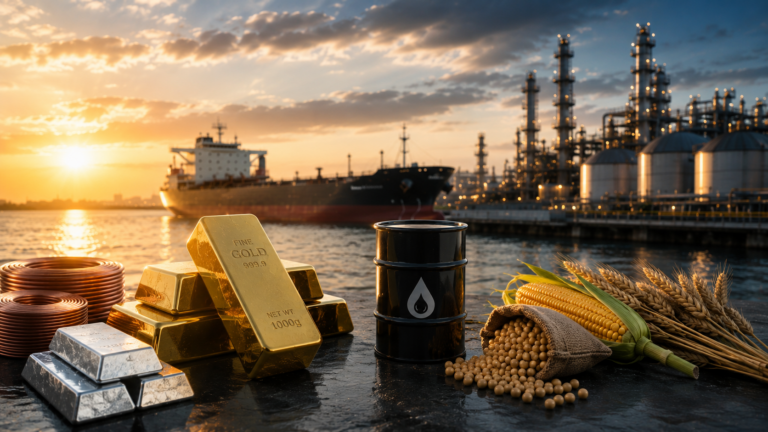
Egypt Targets 9.8 Billion Dollars of Mineral Exports by 2040 Under a World Bank Group Compact

Egypt’s country compact with the World Bank Group targets 9.8 billion dollars of metals and minerals-related exports by 2040 and a 6 percent minerals contribution to GDP by 2030, under plans announced in Bangkok on 16 October. Egypt was one of 8 countries to announce compacts or partnerships there, alongside Argentina, Bolivia, India, Kazakhstan, Malawi, Mauritania and Zambia. Its plan rests on legal and fiscal reforms, better geological data, digital systems and processing hubs, and the group and the European Bank for Reconstruction and Development (EBRD) will support governance, institutional capacity and investment readiness.
Egypt alone sets both a GDP goal and an export goal
Egypt’s is the only one of the 8 plans with both a GDP share target and an export value target, and the only one that names the EBRD as a partner, on our reading of the release. Kazakhstan aims to mobilise up to 20 billion dollars by 2031, and India’s partnership seeks to mobilise 5 billion dollars of capital through 2031. Zambia’s minister, Musokotwane, said the country is targeting copper production of 3 million tonnes a year by 2031. The summaries for Argentina, Bolivia, Malawi and Mauritania carry priorities but no headline figure.
Minister of Petroleum and Mineral Resources Badawi said Egypt was carrying out a full transformation of the sector, modernising its operating framework, improving the investment climate and working more closely with the private sector and international lenders. He said Egypt was laying the foundation for “a globally competitive, sustainable, and investment-driven mineral industry”.
The World Bank Group plans to increase its metals and minerals support fivefold to 19 billion dollars between fiscal 2026 and fiscal 2030, combining its own financing with private capital mobilisation. Its lending arm will provide policy advice and public financing, IFC will invest and mobilise private money, and MIGA will provide guarantees.
Headline targets in the 8 compacts and partnerships announced on 16 October
| Country | Stated target | By |
|---|---|---|
| Egypt | Minerals at 6% of GDP | 2030 |
| Egypt | $9.8bn of metals and minerals-related exports | 2040 |
| Kazakhstan | Mobilise up to $20bn | 2031 |
| India | Mobilise $5bn of capital | 2031 |
| Zambia | 3 million tonnes of copper a year | 2031 |
Targets as set out in the 16 October 2026 release; Zambia’s is from its minister’s statement in the release. Argentina, Bolivia, Malawi and Mauritania carry no headline figure.
A target worth more than a fifth of today’s goods exports
The 9.8 billion dollar goal is large against Egypt’s current trade. In the 2025/26 fiscal year, which ended in June, non-oil merchandise export proceeds rose 7.8 percent to 37.3 billion dollars and oil exports rose 18.1 percent to 6.6 billion dollars, according to the Central Bank of Egypt’s balance of payments release of 12 October. Together that is 43.9 billion dollars of goods exports, 9.2 percent more than the 40.2 billion of 2024/25, on our calculation.
Set against that base, the 2040 minerals target equals 22.3 percent of last year’s goods exports and 26.3 percent of non-oil exports, on our calculation. It is also more than 1.4 times Egypt’s oil export proceeds in 2025/26, on our calculation. The starting point is already moving: the central bank named gold among the products that led the rise in non-oil exports last year, alongside vegetables, ready-made clothes, household electrical appliances and fruit.
Egypt’s goods exports against the 2040 minerals target, billion dollars
| Measure | 2024/25 | 2025/26 |
|---|---|---|
| Non-oil merchandise exports | 34.6 | 37.3 |
| Oil exports | 5.6 | 6.6 |
| Total goods exports | 40.2 | 43.9 |
Balance of payments figures for fiscal years ending in June. The totals are our calculation. The 9.8 billion dollar target for 2040 equals 22.3 percent of the 2025/26 total.
The Sukari gold mine has produced 6.8 million ounces since production began in June 2009, Badawi said at the Egypt Mining Forum on 28 September. At the same event, Calderon, chief executive of AngloGold Ashanti, which holds Sukari in an equal partnership with the state through the Mineral Resources and Mining Industries Authority, said the mine generated record returns for Egypt of more than 590 million dollars in a single year, and that Egyptians make up 97 percent of its workforce.
Licensing, legal reform and phosphate behind the 6 percent goal
The mining sector contributes less than 1 percent of GDP today, the minister said in September, which leaves 4 years to raise that share more than sixfold, to the 6 percent goal for 2030, on our calculation. Since Egypt launched open area licensing for mining blocks on 10 June 2026, 335 blocks covering close to 45,000 square kilometres have been put on offer, with gold, phosphate, talc and kaolin among the targets. Bids have come in for 118 of them, or 35.2 percent of the blocks offered, and the 403 bids received average 3.4 for each of those 118 blocks, on our calculation. The count covers bids received, not awards.
Some legal groundwork predates the compact. Law 87 of 2025 converted the mineral resources authority into an economic authority with a board that includes the environment, industry and finance ministries, a new model gold exploitation agreement has been prepared, and the executive regulations were amended to give exploration more flexibility and reduce cost risks in the early stages. The minister also set out a nationwide targeted airborne survey to give investors a fuller geological database; better geological data is one of the 4 levers the release lists for Egypt.
Phosphate is the processing case. Egypt holds the world’s third largest phosphate reserves and was the seventh largest producer in 2025, the minister said, and he cited 8 new industrial projects. The first phase of the phosphoric acid complex at Abu Tartour carries investment of up to 650 million dollars and is due to start production in 2028.
Why it matters: The compact turns Egypt’s mining ambitions into dated, measurable targets backed by two multilateral lenders. Mineral exports of 9.8 billion dollars would bring in foreign currency on a scale above today’s oil exports, while processing hubs would keep more of the value, and the jobs, inside Egypt. The licensing reforms, the bidding response and the returns from Sukari give the targets a working base.
Outlook: The next markers are the share of the group’s 19 billion dollar minerals programme that reaches Egypt, the first awards under open area licensing, the start of production at Abu Tartour in 2028 and the 2030 checkpoint for the 6 percent goal, each a step toward the 9.8 billion dollar export target for 2040.
Sources: World Bank Group, Ministry of Petroleum and Mineral Resources, Central Bank of Egypt, The Edge.