
Georgieva Puts IMF Commitments at 240 Billion Dollars as Growth Forecast Holds at 3.1 Percent

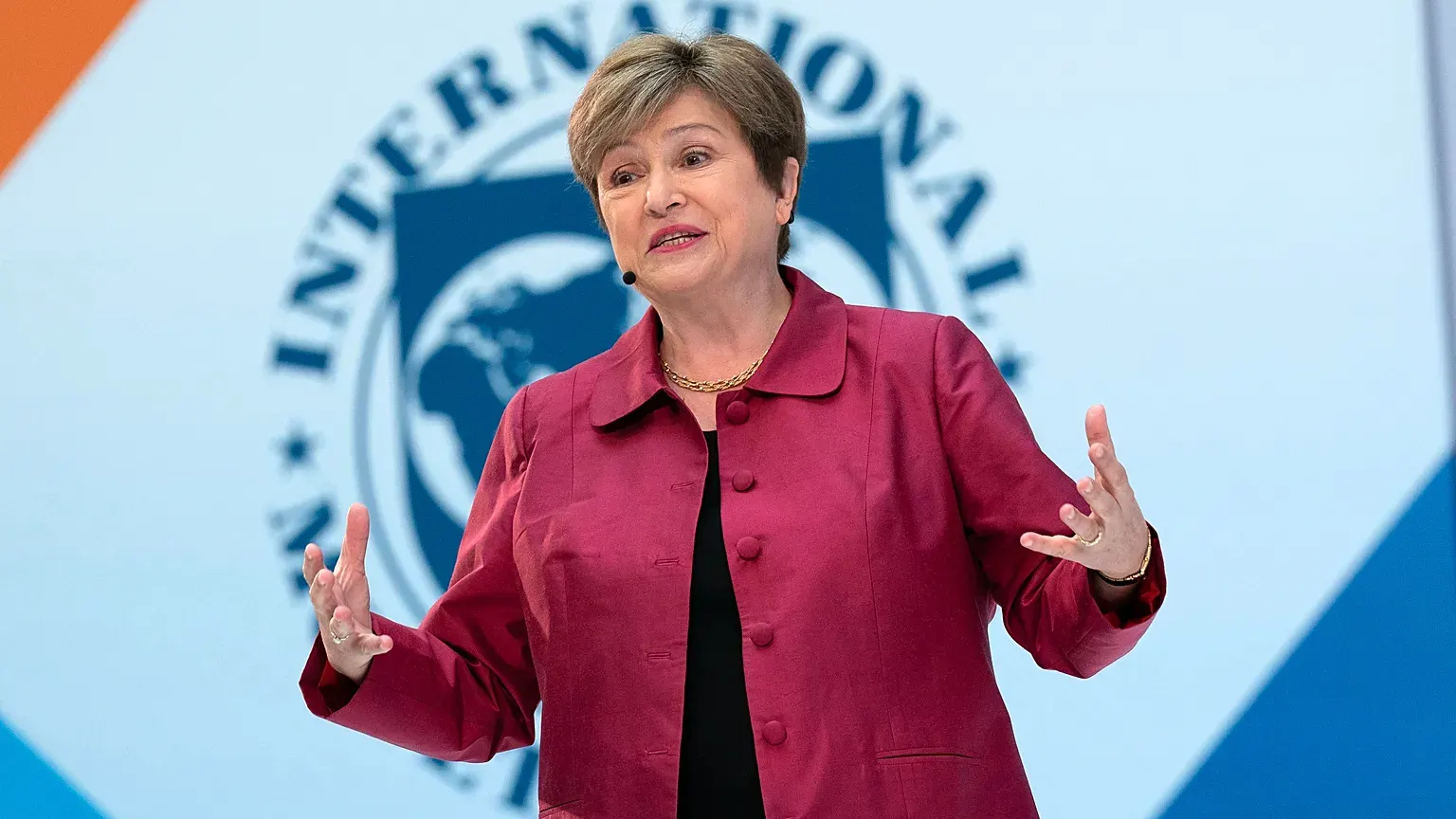
The International Monetary Fund’s credit outstanding plus undrawn commitments stands at 240 billion dollars, Managing Director Kristalina Georgieva told the plenary of the 2026 Annual Meetings in Bangkok on 16 October, and its concessional lending, at 36 billion dollars, is roughly four times its historical average. She said unused lending capacity is roughly three times the 240 billion dollar figure, and that growth has been steady: the 2026 growth forecast was 3.1 percent in October 2025 and is still 3.1 percent a year later.
That steady line, she said, is the net of two large opposing forces: an energy shock weighing on growth and an AI boom lifting it. Underneath it the picture diverges. Economies hit by war have taken large growth downgrades, while those in the AI value chain, the United States, China, India and others mostly in Asia, have been upgraded.
Growth Forecast Holds at 3.1 Percent as Inflation Rises to 4.7 Percent
The IMF’s October 2026 World Economic Outlook, published on 13 October, projects global growth of 3.1 percent in 2026 and 3.4 percent in 2027, with headline inflation rising to 4.7 percent this year before easing to 4.1 percent in 2027.
The energy supply shock, she said, pushes inflation up and growth down: shipping remains at risk, and refinery and natural gas shortfalls are biting. She argued that no plausible pickup in growth on its own can reverse rising debt paths fast enough without fiscal effort. AI lifts growth but also fuels inflation in the short run, and it generates vast infrastructure needs that are increasingly funded by debt. This year’s super El Niño also adds to inflationary pressures through food prices.
On debt, she named rich countries as the worst offenders, with debt also rising in emerging markets. Low-income countries tend to carry lower debt ratios, she said, but face high and rising interest burdens that, with official aid declining, crowd out development spending.
Bond Yields Reached Multi-Year Highs as Georgieva Backs Tighter Policy
“The bond markets are talking to us,” Georgieva said. After significant increases this year, she said, US, German and Japanese 10-year government yields recently reached their highest levels since 2002, 2009 and 1996 respectively. She described market dynamics as orderly, with higher-debt countries seeing larger increases.
US and Japanese 10-Year Yields Are Up Since End-2025
| Market | End-2025 | 2026 peak | 15 Oct 2026 |
|---|---|---|---|
| US Treasury | 4.18% | 5.31% | 5.10% |
| Japan JGB | 2.066% | 3.111% | 2.948% |
US Treasury 10-year par yield and Japan Ministry of Finance 10-year JGB yield. End-2025 is 31 December for the US and 30 December for Japan; the 2026 peaks were on 5 October (US) and 7 October (Japan).
The official series show the size of this year’s move. The US 10-year par yield ended 15 October 92 basis points above its end-2025 level, after climbing 134 basis points from its 2026 low of 3.97 percent on 27 February to the 5 October peak, on our calculation. Japan’s 10-year yield is up 88 basis points since the end of 2025, and its 7 October reading of 3.111 percent was the highest in the Japanese Ministry of Finance series since August 1996. Both have eased since those peaks, the US by 21 basis points and Japan by 16. The gap between the two 10-year yields stood at 215 basis points on 15 October, and the 2-year to 10-year spread was 33 basis points in the US against 103.5 basis points in Japan.
Georgieva said the institution supports the recent tightening actions and firm language of the US Federal Reserve, the European Central Bank and the Bank of Japan. Rate increases now, she argued, are better than falling behind the curve and having to raise rates by more later. Tighter monetary policy lifts government funding costs, and does so faster where short-term public debt is large. Preserving stability, she said, requires fiscal consolidation in most high-debt countries, through credible medium-term plans supported by upfront measures in some cases, which is particularly relevant for systemically significant advanced economies with high debts and deficits. Her prescription was that the United States save more, China consume more and Europe invest more.
240 Billion Dollars Committed and a Trust Funding Push Toward 90 Percent
Lending and Trust Figures From the Bangkok Plenary
| Measure | Figure |
|---|---|
| Credit outstanding plus undrawn commitments | $240 billion |
| Concessional lending | $36 billion |
| Countries that have provided trust assurances | 39 |
| Assurances provided so far | almost 48% |
| With the EU countries’ combined contribution | 74% |
| Agreed objective | 90% |
| New capacity development commitments | more than $100 million |
Figures as stated in the Managing Director’s plenary speech of 16 October 2026.
The Poverty Reduction and Growth Trust is the main vehicle for concessional lending, and putting it on a self-sustaining path requires broad approval for distributions from an interim account. At almost 48 percent from 39 countries, assurances for the trust are a little more than halfway to the 90 percent objective, on our calculation. The combined contribution of EU countries, which Georgieva said would take the total to 74 percent, is worth more than 26 points on its own. Even with it, 16 points would remain to reach the objective.
She also reported more than 100 million dollars of new capacity development commitments secured during the Annual Meetings, which she put at roughly a quarter of annual spending on that work.
Why it matters: For the 191 member countries, the speech pairs explicit backing for central bank tightening with a call for fiscal consolidation in most high-debt countries, from a lender whose unused capacity is roughly three times what it has already committed. For low-income members, the trust’s path to self-sustainability depends on broad approval for distributions from an interim account and on the assurances still outstanding.
Outlook: The next marker for the trust is whether EU countries find a path to providing the assurances that would take the total to 74 percent, against the 90 percent objective. On the macro side, the World Economic Outlook has growth picking up to 3.4 percent in 2027 as inflation eases to 4.1 percent.
Sources: IMF, US Treasury, Japan Ministry of Finance, The Edge.