Georgieva Says the World Economy Stands on the AI Leg as Circular Financing Passes $1tn

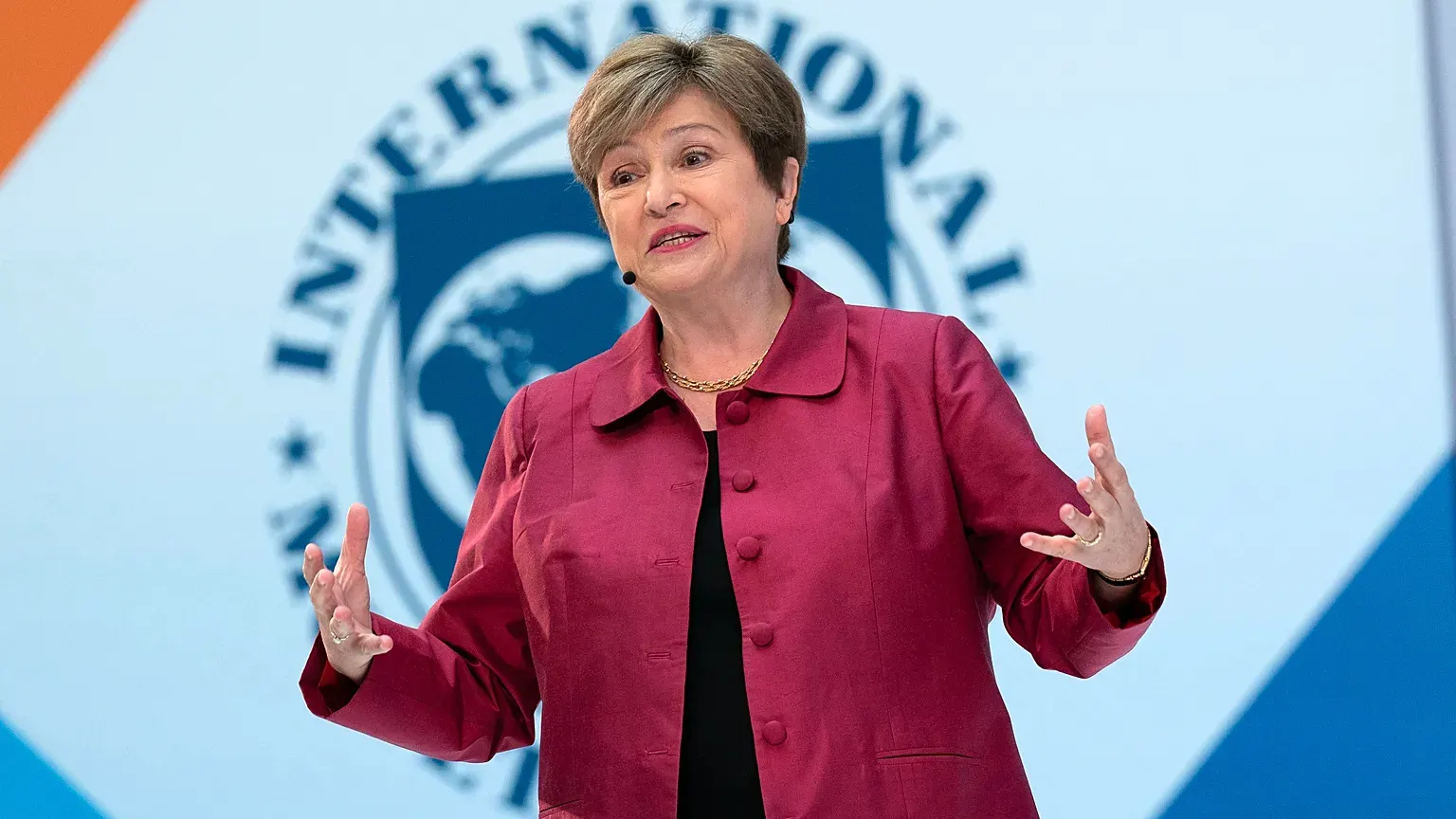
The Takeaway: IMF Managing Director Kristalina Georgieva told CNBC on Monday that the world economy is “standing on one leg”, artificial intelligence, and that a wobble could bring financial stability troubles. She put circular financing among AI companies at a little over $1 trillion, two-thirds of it funded by debt. Recent market swings have been orderly, she said, while the Fund’s October forecasts see global growth of 3.1% this year.
A sudden drop in investment confidence and a withdrawal from artificial intelligence could weaken global growth, the head of the International Monetary Fund warned on Monday in the Philippines.
Kristalina Georgieva was speaking to CNBC’s JP Ong on the sidelines of the summit of the Association of Southeast Asian Nations (ASEAN). “We have a world economy that is standing on one leg on the AI leg. If this leg wobbles, that can lead to financial stability troubles,” she said.
Georgieva puts AI circular financing at a little over $1 trillion
Circular financing is money invested in an AI company that ultimately flows back to the investor through purchase orders. Among AI companies it has grown to a little over $1 trillion, the Fund estimates. Two-thirds of it is funded by debt.
“It’s not a huge size, but it is a rapid increase,” the managing director said.
The enthusiasm of investors for AI reflects expectations running ahead of what the technology has proven it can deliver, in Georgieva’s view. “We tend to rush ahead,” she said, and as valuations climb, “some corrections” become necessary.
Recent swings in markets were “orderly”, Georgieva said, and unlikely to spiral into anything that could undermine the world economy. She still urged caution: “We have to be watchful.”
The Fund’s October review found $650 billion of debt in 14 deals
The IMF flagged the same arrangements in its Global Financial Stability Report of October, the twice-yearly survey of risks to the financial system. It reviewed 14 such transactions made since 2023.
Those deals combined about $300 billion of equity investment with $650 billion of debt. They were struck in exchange for $1.4 trillion in future revenue commitments.
The equity and debt together come to about $950 billion, with debt making up 68.4%, on The Edge’s calculation. The revenue commitments are 1.47 times that financing.
In The Edge’s reading, both figures point to heavy reliance on debt, but the interview did not say whether Monday’s estimate covers the same deals as the October review, so the two cannot be directly compared.
Stress at key companies receiving investment could lower revenue forecasts and valuations, the report warned, and that would weaken the value of the debt piled up in those deals. Hyperscalers, as the largest data center operators are known, are borrowing more and more, while investors have been using leverage to buy AI stocks.
Banks are the core of the system, and the report found them resilient overall under its adverse stress scenario. Banks holding 22% of global banking assets would end that scenario with capital ratios below regulatory limits, up from 18% a year earlier.
AI investment props up a forecast of 3.1% growth this year
The AI investment boom was one of two main sets of factors that helped the world economy absorb this year’s energy shock, the Fund said in its October World Economic Outlook. The other was the rerouting of energy supplies, new production elsewhere and other adjustments in energy markets.
The outlook projected global growth of 3.1% in 2026 and 3.4% in 2027, a forecast the Fund described as broadly unchanged from April.
IMF growth projections, October 2026 (real GDP, annual change in %)
| Economy | 2025 | 2026 | 2027 |
|---|---|---|---|
| World | 3.5 | 3.1 | 3.4 |
| Advanced economies | 2.0 | 2.1 | 1.8 |
| United States | 2.3 | 2.3 | 2.3 |
| Emerging market and developing economies | 4.5 | 3.7 | 4.4 |
| Emerging and developing Asia | 5.6 | 5.1 | 4.9 |
| China | 5.0 | 4.5 | 4.0 |
The 2026 and 2027 figures are projections. The estimates use data available through 30 September 2026, as the PDF edition of the October 2026 World Economic Outlook states.
That support comes from a narrow base. Technology investment “is concentrating risks”, the Fund said, “making the global expansion heavily reliant on a small number of firms, sectors, and economies.”
In Manila on Sunday, Georgieva described two opposing forces at work: a negative energy shock holding growth down and a positive AI investment shock pushing it up. Both are inflationary, she said, and central banks are responding by raising interest rates. The October outlook has global headline inflation rising to 4.7% this year, before easing to 4.1% next year.
ASEAN grows faster than the world, Georgieva tells its summit
Southeast Asia sits close to the AI build-out. Addressing the bloc’s leaders at their summit in Manila, the managing director put the region’s growth at 4.9%, against a global average of 3.1%. Some ASEAN economies are “at the vanguard of the AI building boom”, she said, with surging investment, trade and growth.
All members can and must aspire to be “the best kind of AI adopters”, she told the leaders, by increasing preparedness, controlling threats to financial stability, ensuring broad access and managing risks to jobs. The Fund’s work with the region will include helping members assess the impact of AI on financial stability, growth and jobs.
Trade inside the bloc is the other opening she named. Reducing nontariff barriers could lift ASEAN’s GDP by 4.3% over the long run, including up to 2.5% from services trade reforms alone. With smart labor market policies, the Fund estimates, that could create 4 million jobs.
The Fund has also measured how far AI reaches into jobs. In a January 2024 analysis, it found that almost 40% of global employment is exposed to AI, and that about 60% of jobs in advanced economies may be affected.
Method: quotes from the interview are from Managing Director Kristalina Georgieva’s remarks to CNBC published on 16 November 2026; the ASEAN figures are from her remarks at the 49th ASEAN Summit, posted by the International Monetary Fund on 15 November 2026; forecasts are from the IMF’s World Economic Outlook of October 2026 and its blog of 12 October 2026; the transactions review and bank stress results are from the Global Financial Stability Report blog of 12 October 2026; AI exposure is from the IMF blog of 14 January 2024; sums and ratios not attributed to a source are The Edge’s calculations.
Sources: International Monetary Fund, CNBC, The Edge.