Pony.ai and Uber Plan More Than 2,000 Robotaxis Across Five European Cities
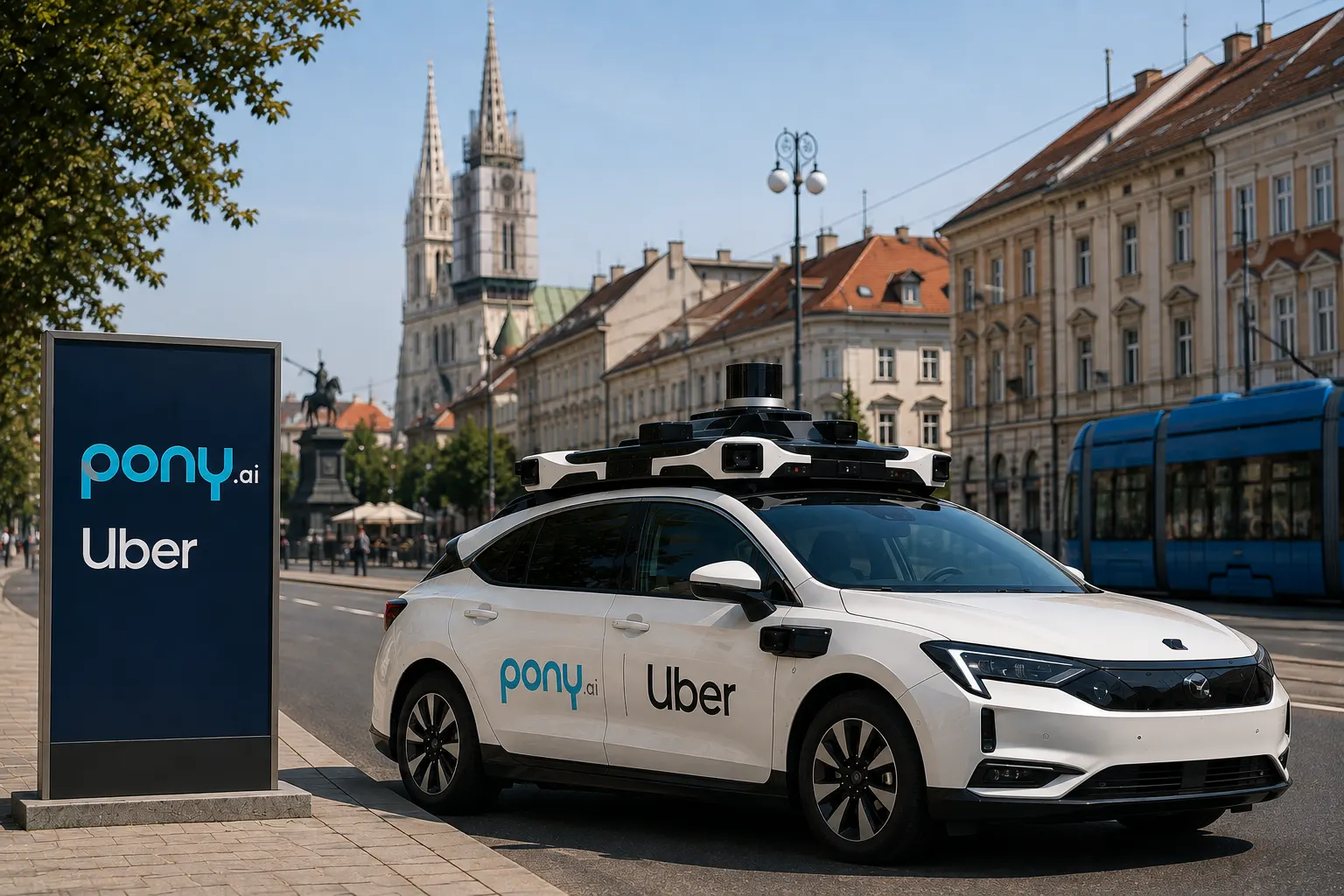
Pony AI Inc. and Uber Technologies announced an expanded partnership to deploy more than 2,000 Pony.ai robotaxis across Europe, in a joint release issued on 13 August 2026. The partnership expands from the existing commercial service in Zagreb, described as coming soon to the Uber platform, to four additional European cities. The release states that additional details about the rollout will be announced in phases, and that the expanded partnership also includes plans to deploy in the Middle East.
Neither company names the four additional cities, gives a deployment timetable, or identifies a Middle East market. The 2,000 figure therefore describes intended scale rather than a dated commitment.
What each side brings, and who pays
Under the expanded partnership, Pony.ai provides its Level 4 autonomous driving technology, rider experience and operational expertise. Uber provides customer access through its mobility platform, including booking, payment and customer service, alongside what the release calls its growing network of human drivers. Day to day fleet operations may be carried out by established local fleet partners selected for each market.
The commercially significant sentence is the one about capital. The release states that vehicle funding and ownership can sit with different partners depending on the market. That means the cost of the fleet does not have to sit on the technology provider’s balance sheet or the platform’s, and it creates a defined role for fleet operators and infrastructure investors.
Zagreb already shows the structure working. Europe’s first commercial robotaxi service was launched there in 2026 with the Croatian mobility company Verne, and the release states that Verne serves as the local fleet owner and operator. Pony.ai supplies the autonomous driving system, and Uber is integrating the service into its network.
The release also carries a claim about profitability that had not previously appeared in this partnership’s announcements. It states that Pony.ai operates paid, fully driverless robotaxi services in China’s four tier-one cities, and that it has achieved city-wide breakeven unit economics in multiple markets.
Dr James Peng, founder and chief executive of Pony.ai, said the agreement “marks an important new phase in the partnership”. Sarfraz Maredia, Uber’s global head of autonomous mobility and delivery, said the next chapter for autonomous mobility “is about moving from individual launches to repeatable commercial scale”.
The number against the company’s own disclosures
| Pony.ai, from its own filings and releases | Figure |
|---|---|
| Robotaxis planned for Europe under the expanded partnership | more than 2,000 |
| European cities in the plan | five, of which one, Zagreb, is operating |
| Global robotaxi fleet disclosed at Q1 2026 | more than 1,700 units |
| Year-end 2026 fleet target, raised 26 May 2026 | over 3,500 units, from 3,000 |
| Year-end 2026 geographic target | over 20 cities worldwide |
| Q1 2026 total revenue | US$34.3 million, up 145.0 percent year on year |
| Q1 2026 robotaxi revenue growth, year on year | 395.4 percent |
| Q1 2026 fare-charging revenue growth, year on year | 456.5 percent |
| 2026 robotaxi revenue target, raised 26 May 2026 | more than 3.5 times 2025, from 3 times |
Pony AI Inc. and Uber Technologies, joint release of 13 August 2026, and Pony AI Inc. first quarter 2026 results of 26 May 2026.
The comparison has to be made carefully. Pony.ai disclosed that its fleet had exceeded 1,700 units and targets over 3,500 by year end. Both are thresholds rather than counts, so it cannot be concluded that the European plan is larger than the company’s existing global fleet.
What can be said is that the 2,000 vehicle European figure is about 57 percent of the 3,500 unit year-end threshold, that the two are not necessarily on the same timetable, and that the European plan is of the same order of magnitude as the company’s entire current global operation. Pony.ai also reported that average weekly paid orders in May 2026 were 119 percent above January, and that registered users more than tripled year on year.
Three markets, three different structures
The European announcement extends a pattern rather than starting one. In June 2026 Pony.ai announced an autonomous mobility testing programme in Luxembourg with Bolt and Stellantis. Later the same month it opened its Singapore service, operated with ComfortDelGro, to consumers through the Zig app. Zagreb came earlier in the year with Verne.
Those are a testing programme with a rival ride-hailing platform and a carmaker, a commercial service with a local transport operator, and now a platform-scale agreement with Uber’s global mobility platform. The separation of technology, platform, fleet capital and operations is the model, and it is what allows expansion without the technology company financing every vehicle.
Why it matters
For MENA, the Middle East sentence is the one to read, but it should not be read as a first move. Uber is already operating autonomous vehicles in the region with a different supplier, and the verified deployments are concentrated in the United Arab Emirates and Saudi Arabia.
In February 2026 WeRide and Uber committed to deploy at least 1,200 robotaxis across the Middle East, spanning Dubai, Abu Dhabi and Riyadh. On 31 March 2026 the two launched fully driverless fare-charging operations in Dubai across the Jumeirah and Umm Suqeim districts, in partnership with the Roads and Transport Authority, with Tawasul as the service operator providing fleet management. WeRide had over 200 robotaxis in the Middle East at that point, and stated that its Middle Eastern subsidiary has been operationally profitable in robotaxi since 2025. The Roads and Transport Authority has a stated goal of 25 percent autonomous journeys by 2030. Uber has separately disclosed that it beneficially owns approximately 5.82 percent of WeRide’s Class A ordinary shares.
Pony.ai would therefore be entering an Uber autonomous ecosystem that already exists in the region rather than an empty one. On the same day as the Pony.ai announcement Uber also announced a robotaxi pilot in Tokyo with Hinomaru Kotsu, and on 5 August it announced progress with Wayve toward autonomous rides in London. The pattern is a platform running several technology suppliers at once rather than betting on one.
That is the useful conclusion for regional fleet companies, infrastructure funds and sovereign investors. A strategically important role in this structure is neither the technology nor the platform. It is the party that owns the vehicles, and the release says explicitly that this party can be someone else.
No Middle East country, fleet size, partner or launch date has been announced by either company for the Pony.ai agreement, so nothing beyond that can be assessed yet.
Outlook
Pony.ai reports second quarter and interim 2026 results on 18 August 2026, three days after this announcement, and that is the first opportunity to attach a timetable, a capital plan or named cities to the European number. The markers are whether the year-end target of over 3,500 vehicles in over 20 cities is revised again, whether the more than 3.5 times robotaxi revenue target holds, whether the breakeven unit economics claim is quantified, and whether any Middle East market is named.
Sources: Pony AI Inc. and Uber Technologies, Inc., joint release of 13 August 2026. Pony AI Inc., first quarter 2026 financial results of 26 May 2026; Luxembourg testing programme announcement of 9 June 2026; Singapore service announcement of 22 June 2026; results date announcement of 17 July 2026. Uber Technologies, Inc., investor relations releases of 31 March 2026 and 13 August 2026.