
Economic Report · Macroeconomic & Market Outlook
Global Markets at a Crossroads
March 2026 · By The Edge Research Team
Report summary
Global markets have entered a "multi-shock" regime: geopolitical risk has abruptly repriced energy, while the global macro backdrop remains defined by disinflation that is incomplete, policy rates that are still restrictive in real terms for parts of the world, and pockets of financial-system fragility outside traditional banks. The most acute near-term transmission channel is an oil-and-shipping shock centered on the Strait of Hormuz, with markets reacting to disruption risks rather than only realized shortages. The historical analogy that fits best is not "a repeat of 2008" in structure, but a rhyme: a large commodity move exposes leverage, liquidity mismatches, and confidence-sensitive funding models, this time more in private credit and market-based finance, and less in subprime mortgage securitization. IMF analysis has repeatedly flagged the potential for non-bank finance to amplify shocks; BIS work has similarly highlighted fragilities in credit intermediation and funding under stress. Oil is the pivotal macro variable because it can (i) push headline inflation up quickly, (ii) squeeze real incomes, and (iii) complicate monetary policy reaction functions at precisely the wrong time, when many economies are trying to secure "soft landings". Empirically, research finds meaningful oil-to-inflation pass-through (the scale varies across episodes and economies), while central banks remain sensitive to second-round effects and inflation expectations. Baseline global growth expectations entering 2026 were resilient but uneven, with the IMF projecting 3.3% global growth in 2026 and 3.2% in 2027 (January 2026 WEO Update).
Running on Buffers: The IMF's October 2026 Outlook and the Second Opinion on the Gulf's War Year
October 2026
A Reversal of Fortunes: Inside the World Bank's October Reading of the Hormuz Shock, the 2027 Rebound and the Region's AI Opening
October 2026
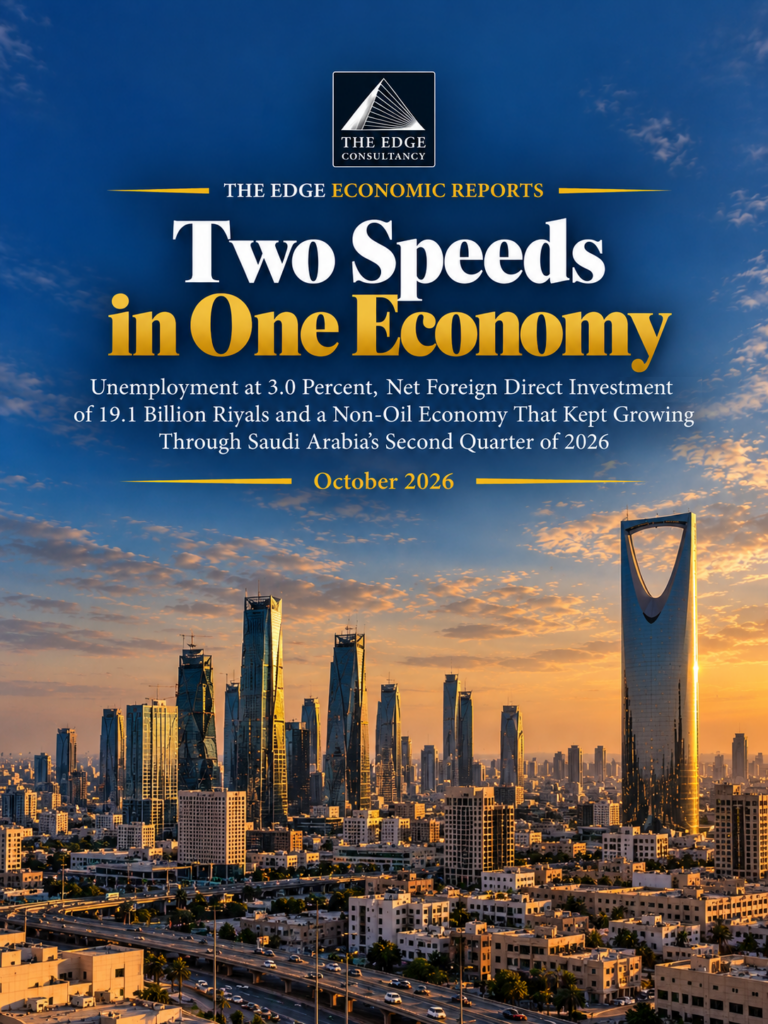
Two Speeds in One Economy: Unemployment at 3.0 Percent, Net Foreign Direct Investment of 19.1 Billion Riyals and a Non-Oil Economy That Kept Growing Through Saudi Arabia's Second Quarter of 2026
October 2026