Trump and Xi Meet as Bessent Says the Trade Truce Now Runs to 10 January
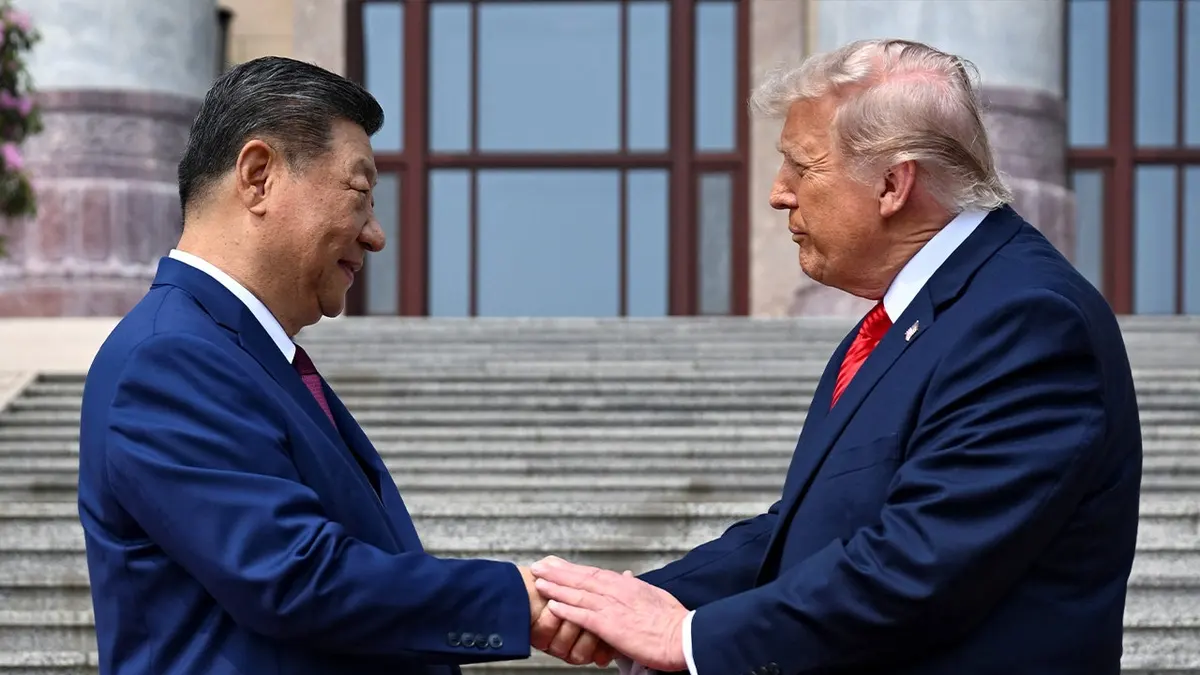
US President Donald Trump and Chinese President Xi Jinping met at the White House on 24 September, with trade and artificial intelligence among the economic issues on the table. According to China’s official readout, Xi said the two trade teams had reached “a new joint arrangement”, and Trump said the latest consultations had achieved new outcomes. Neither government had published the terms as of 25 September. The one firm date came a day earlier, when US Treasury Secretary Scott Bessent said in a Fox News interview that the trade truce had been extended by two months, from 10 November to 10 January 2027.
A new expiry of 10 January
Bessent spoke hours after his second meeting in four days with Chinese Vice Premier He Lifeng, held on 23 September at the World Bank’s headquarters in Washington. He said the extension gives both sides more time to work on the economic front, while Washington wants Beijing to deliver more fully on its existing commitments.
The truce dates from last autumn. Under the deal announced in November 2025, the United States kept its heightened reciprocal tariffs on Chinese goods suspended until 10 November 2026, leaving a 10 percent reciprocal tariff in place, the White House said at the time. China agreed to suspend the rare earth export controls it had announced on 9 October 2025 and to issue general licences for exports of rare earths, gallium, germanium, antimony and graphite. On our reading, this is the package China’s Ministry of Commerce calls the joint arrangement from the Kuala Lumpur economic and trade consultations.
What the negotiators discussed
The summit followed an eighth round of trade talks, which began in New York on 20 September. He Lifeng led the Chinese side, and Bessent and US Trade Representative Jamieson Greer led the US side. The ministry said on 24 September that the talks covered carrying out commitments from earlier rounds, arrangements for reciprocal tariff cuts, the setting up of a trade council and an investment council, and an extension of the Kuala Lumpur arrangement. The two sides reached several points of consensus, it said, and will stay in close contact on follow up work. It gave no tariff rates or purchase figures.
On our reading, the two councils are the Board of Trade and Board of Investment that Trump and Xi chartered during Trump’s visit to China in May, according to the White House. That package also committed China to buy at least 17 billion dollars a year of US farm products, prorated for 2026 and in full for 2027 and 2028, on top of its soybean commitments.
Before the summit, Bessent said announcements could follow on the two countries’ goal of removing tariffs on 30 billion dollars of non critical goods, and on financial services and farm purchases. The ministry said on 17 September that progress on the reciprocal tariff arrangement would be released in due course. No such announcement had been published as of 25 September.
He Lifeng and Bessent also held their first dialogue on artificial intelligence under the trade consultation mechanism. Bessent said the two sides discussed an alert system for AI incidents.
What the leaders said
Xi called the new arrangement good news for industry and people in both countries and for the global economy. A stable economic relationship, he said, requires “expanding the list of cooperation, and shortening the list of problems”. Trump called on both sides to keep talking to reach a better agreement. Both leaders called for continued dialogue on artificial intelligence, and they confirmed that each side would support the other in hosting this year’s APEC Economic Leaders’ Meeting and G20 Leaders’ Summit.
A smaller trade flow
The truce governs a trade flow that has contracted sharply. US Census Bureau data show US goods trade with China at 414.6 billion dollars in 2025, down from 583.6 billion dollars in 2024. On our calculation, that is a fall of 29 percent. The contraction has continued in 2026, with imports driving it while exports held steady.
| Measure (billion dollars) | January to July 2025 | January to July 2026 | Change |
|---|---|---|---|
| US exports to China | 65.1 | 65.2 | Broadly unchanged |
| US imports from China | 194.0 | 156.4 | Down 19.4% |
| US goods trade deficit with China | 128.8 | 91.2 | Down 29.2% |
| Total goods trade | 259.1 | 221.6 | Down 14.5% |
US Census Bureau data, not seasonally adjusted; changes on our calculation.
Why it matters: On our reading, the new date removes the risk that the suspended US tariffs return on 10 November, but it buys only about three and a half months. The larger pieces, the 30 billion dollar tariff cuts and the trade and investment councils, still have no published terms, so businesses on both sides are planning around a deadline rather than a deal.
Outlook: The next milestones are the APEC Economic Leaders’ Meeting in Shenzhen on 18 and 19 November, the G20 Leaders’ Summit in Miami on 14 and 15 December, and the truce’s new expiry on 10 January 2027.
Sources: Xinhua, China’s Ministry of Commerce, White House, US Census Bureau, CNBC, Reuters.