World Bank Lifts Jordan to Upper Middle Income as First Quarter Growth Accelerates

The World Bank has reclassified Jordan as an upper-middle-income economy in its annual income classifications effective 1 July, a milestone that coincides with a pickup in Jordanian growth to 2.9 percent in the first quarter of 2026. It is a rare category change: Jordan was one of only five economies worldwide to move up from lower-middle to upper-middle income in this cycle, alongside Micronesia, the Philippines, Sri Lanka and Vietnam, while Togo moved from low to lower-middle income.
In the update for the World Bank’s 2027 fiscal year, the upper-middle-income band runs from a gross national income per capita of 4,636 to 14,375 dollars, calculated on 2025 data using the Atlas method. That band is about 9,700 dollars wide, and Jordan enters near its floor, our calculation from the published thresholds, meaning the classification reflects crossing a level rather than a large jump in living standards. For reference, two of the other economies that moved up this cycle sit just above the threshold, the Philippines at about 4,850 dollars and Vietnam at about 4,970 dollars per capita, which places new entrants roughly 200 to 350 dollars above the 4,636 dollar floor. Jordan’s own exact GNI per capita figure was not published in the release and remains to be confirmed. The upper end of the band, at 14,375 dollars, is where economies graduate to high-income status, the group that includes the GCC states, so Jordan has moved into the same broad category while still sitting toward its lower edge.
The World Bank attributed Jordan’s move to two forces working together. A national-accounts rebasing by Jordan’s Department of Statistics found the economy about 10 percent larger than previously estimated, and that level shift, combined with growth of about 2.8 percent in 2025, pushed measured GNI per capita across the threshold. In other words, most of the reclassification reflects a more accurate statistical base rather than a sudden acceleration in output, a distinction that matters for how much weight to give the milestone.
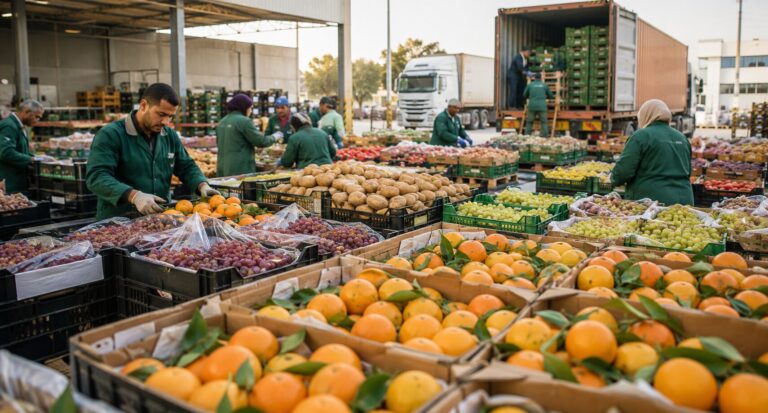
The current-quarter data reinforces the picture. Jordan’s Department of Statistics reported that real GDP grew 2.9 percent in the first quarter of 2026, up from 2.7 percent a year earlier, an improvement of 0.2 percentage points, and already 0.3 percentage points above the World Bank’s full-year forecast of about 2.6 percent, our comparison from the stated figures. Agriculture led with growth of 6.8 percent, followed by manufacturing at 5.3 percent, mining and quarrying at 4.7 percent and electricity at 4.3 percent. The most telling detail is the composition: production sectors contributed more than 55 percent of total growth, against an average of about 33.8 percent in the years 2015 to 2021. That is a shift of more than 21 percentage points toward production-led growth, our calculation, which suggests the expansion is being driven by output in tradable and productive sectors rather than consumption alone.
The milestone also lands against an improving credit backdrop. Jordan secured its first sovereign credit-rating upgrade in more than two decades in 2024, reaffirmed in 2025, supported by contained inflation, a stable external position and reforms under its Economic Modernization Vision 2033. An income reclassification, a rating upgrade and first-quarter growth running ahead of forecasts together point in the same direction, which is why the change is being read as confirmation of a trend rather than a single data point.
There is a cost to weigh against the prestige. Moving up the income ladder typically narrows access to the cheapest concessional financing over time, since the most heavily subsidised development lending is targeted at lower-income economies, so Jordan will increasingly fund itself on terms closer to market rates and through instruments priced off its sovereign rating rather than its income category. The offset is that a higher classification, a better rating and demonstrably production-led growth can lower the risk premium investors attach to Jordanian debt and equity, which matters for a country that relies on external financing and Gulf capital. Whether the reclassification is a net positive therefore depends on the pace of reform and growth: if the shift toward production sectors that drove more than 55 percent of first-quarter growth persists, the improvement in market access can more than offset the gradual loss of concessional terms.
Why it matters: An income reclassification is a signal about the level and durability of an economy’s output, not a one-off headline, and here it reflects both a more accurate statistical base and genuinely stronger production. Reaching upper-middle-income status can influence how investors, lenders and development partners view a country’s risk and creditworthiness, even as it may gradually change the terms of the concessional finance available to it, since higher-income classifications typically come with less access to the cheapest development lending. For Jordan, arriving at the threshold with first-quarter growth already running ahead of forecasts, and with more than half of that growth coming from production sectors, strengthens the story of resilience through a difficult regional backdrop. For the wider region, a more competitive Jordan, closely tied to Gulf investment and labour markets and donor networks, reduces regional financing risk and reinforces a strategic neighbour.
Outlook: The question is durability. Sustaining the upgrade will depend on whether the shift toward production-led growth continues, whether reforms lift investment and jobs, and how the transition affects access to concessional financing over time. Continued momentum above the 2.6 percent forecast, alongside Jordan’s improved credit standing, would help convert the reclassification into lasting gains rather than a statistical milestone.
Sources: World Bank; Jordan Department of Statistics.