Egypt Talks Offshore Wind With CIP, Plans About 32,000 MW of Solar and Wind by 2030

The Takeaway: Egypt’s power sector plans about 32,000 MW of new solar and wind, roughly three times the renewable capacity connected in October. Offshore wind is the newest part of that push: the talks are with Copenhagen Infrastructure Partners, whose funds finance 150,000 MW of renewable projects worldwide, though no project, capacity or financing for Egypt has been announced.
Egypt’s electricity minister discussed bringing offshore wind to the country with CIP on Tuesday; the sector plans to add about 32,000 megawatts (MW) of solar and wind by 2030.
Mahmoud Esmat, Minister of Electricity and Renewable Energy, met Robert Helmes, a partner and board member of Copenhagen Infrastructure Partners (CIP), on the sidelines of the World Economic Forum’s strategic meeting on Egypt, the Egyptian Cabinet said. Helmes leads the group’s offshore wind development and the investments of its growth markets funds, which target renewable energy infrastructure in fast-growing economies.
The two sides looked at ways to bring new investment and offshore wind technology into Egypt. Mona Rizk, head of the Egyptian Electricity Transmission Company, which runs the national transmission system, attended the meeting.
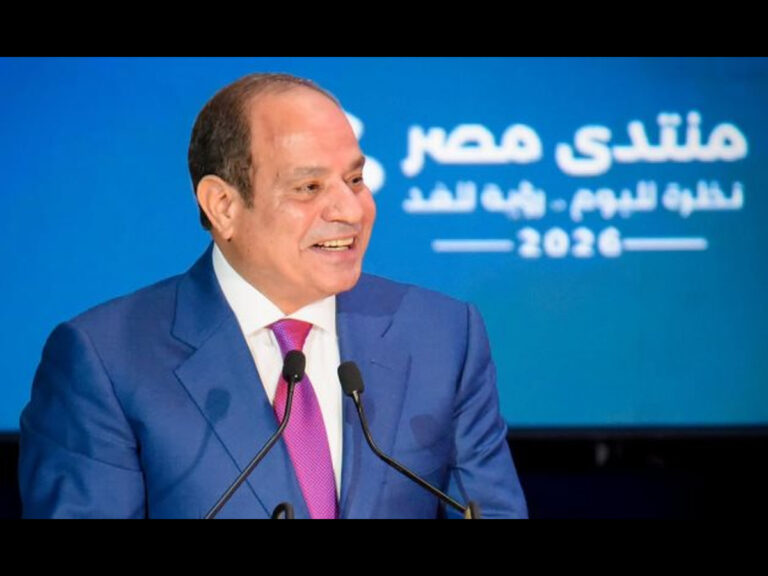
President Abdel Fattah El-Sisi opened the forum’s meeting earlier in the day, with Prime Minister Mostafa Madbouly, Central Bank of Egypt Governor Hassan Abdalla, ministers and Egyptian and foreign business leaders attending.
A partner whose funds back 150,000 MW
CIP works in offshore and onshore wind, solar power, energy storage, electricity transmission and distribution, and biofuels. It manages 15 investment funds, which finance 150,000 MW of renewable energy projects around the world, the statement said.
The meeting set the plan against the state’s drive to reduce its reliance on conventional fuel, with wider use of storage batteries alongside the new plants.
The 2030 plan is three times the current renewable base
Renewable capacity on the grid stood at 10.5 gigawatts (GW) in October, out of 64.4 GW installed in total, the minister told the Egypt Forum 2026 conference, according to the Egyptian Electricity Holding Company. Battery storage had reached 1.1 GW.
Renewables and storage together supplied 18% of the energy mix, the minister said. Set against that base, the 2030 additions are about three times the renewable capacity now connected, and close to half of everything installed today.
Much of that is already in train. Projects under way with the private sector will add 11,569 MW of wind and 7,620 MW of solar, Esmat said in October.
They also include 13,220 megawatt-hours of storage batteries, and 46,500 square kilometers of land has been allocated to renewable projects.
Taken together, the wind and solar projects come to 19,189 MW, about 60% of the 2030 figure, although the ministry has not said how the two numbers relate.
The build-out serves a goal, set out earlier, of lifting renewables to 45% of the energy mix by 2028. The previous target was 42% by 2030.
Grid upgrades to absorb the new capacity
The talks also covered the plan to improve the efficiency of the electricity networks by developing the transmission system, so that it can take in the growing volume of power generated. Egypt is working with international consultancies to assess what the national grid needs to integrate renewable sources and to reinforce it for the expected rise in renewable capacity.
Lines and cables added to the extra-high and high voltage grid since 2014 total 18,000 kilometers, the minister said in October. Over the same period 196 transformer stations were built at those voltages.
The grid carried an unprecedented peak load of 40.2 GW in August, and supply held steady across all voltages, he said.
Egypt’s power sector investment spent to date (in EGP billions; share in %)
| Segment | Investment | Share |
|---|---|---|
| Thermal and renewable generation | 2,700 | 53.4 |
| El Dabaa nuclear plant | 1,600 | 31.6 |
| Transmission networks | 646 | 12.8 |
| Distribution networks | 110 | 2.2 |
| Sum of segments | 5,056 | 100 |
Segments as the minister gave them in October; he put total investment in generation, transmission and distribution at nearly EGP 5 trillion. Shares are The Edge’s calculation on the sum of the four segments.
In The Edge’s reading, the grid is where the 2030 plan will be tested. The additions equal close to half of today’s installed base, while transmission has taken about 13% of the sector’s investment so far.
Links to the Gulf and to Europe
Esmat said Egypt has given the energy sector top priority under its Vision 2030 and has built very large solar and wind projects. He pointed to work on smart grid technology and on the newest energy storage solutions.
Egypt already has interconnections with Jordan, Libya and Sudan, and a link with Saudi Arabia is due. Studies are being completed for a connection to Europe through Greece to export 3,000 MW of renewable power, and for a link with Italy, which the minister said would strengthen Egypt’s role as an energy bridge between Africa and Europe.
The Saudi line, built to exchange 3,000 MW, had reached 100% completion, with trial operations under way, the minister said in October.
He said the Greece link would cut carbon dioxide emissions by 10 million tonnes and save 4.5 billion cubic meters of natural gas a year.
Efficiency gains are already showing in fuel use. Since 2014, fuel burned per kilowatt-hour of electricity has fallen by about 18%, on the minister’s October figures.
That has saved more than 65 billion cubic meters of natural gas, with an economic value of more than $38 billion, he said.
The ministry has not said whether the talks with CIP will lead to a site, a capacity figure, financing or a timetable for an offshore wind project, and no date has been given for commercial operation on the Saudi link or for the end of the Greece studies.
Method: the meeting, CIP’s activities, fund count and financed capacity, and the 2030 solar and wind plan are from the Ministry of Electricity and Renewable Energy’s statement published by the Egyptian Cabinet on 17 November 2026; installed, renewable and storage capacity, the energy-mix share, projects under way, land, the 2028 target, grid, investment, peak-load, interconnection, fuel and gas figures are from the minister’s remarks at Egypt Forum 2026 published by the Egyptian Electricity Holding Company on 22 October 2026; ratios, shares, the projects’ sum and the fuel-rate change are The Edge’s calculations.
Notes: the ministry describes the 2030 figure as new solar and wind capacity to be added; the 10.5 GW base covers all renewable capacity on the grid. Fuel use was 214.09 grams per kilowatt-hour in 2014 and 174.57 grams in October 2026.
Sources: Egyptian Cabinet, Ministry of Electricity and Renewable Energy, Egyptian Electricity Holding Company, Copenhagen Infrastructure Partners, The Edge.