Egypt’s 5 Largest Listed Banks Earn Combined 71.9 Billion Pounds in Standalone First-Half Profit
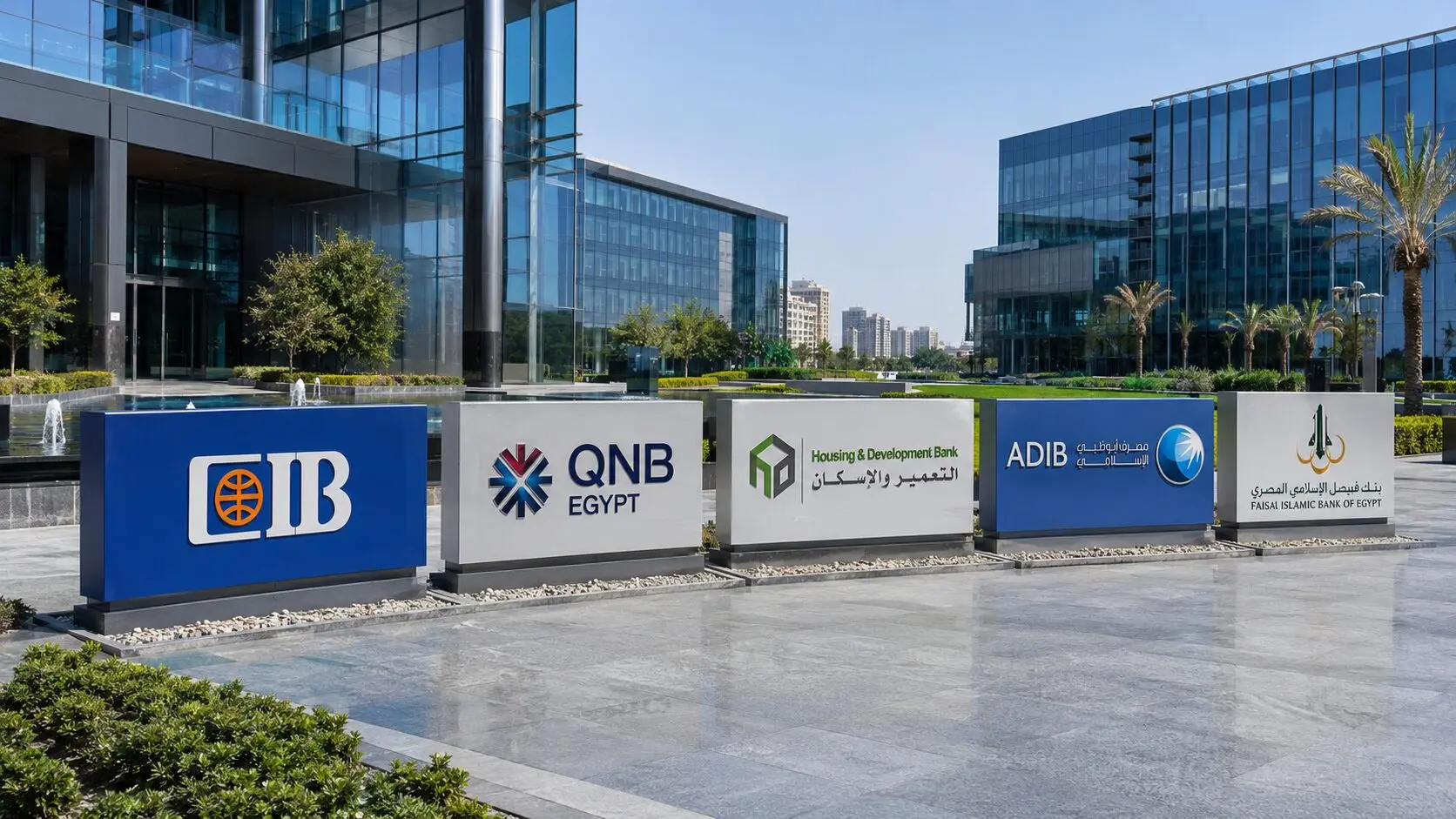
Commercial International Bank Egypt (CIB), QNB Egypt, Abu Dhabi Islamic Bank Egypt (ADIB Egypt), Suez Canal Bank and Faisal Islamic Bank of Egypt, the 5 largest banks listed on the Egyptian Exchange by standalone total assets at the end of June 2026, all reported double digit standalone net profit growth for the first half of 2026, according to each bank’s own financial statements. On a standalone basis, the accounting basis all 5 banks report and the one used throughout this comparison for consistency, CIB earned 39.235 billion Egyptian pounds, up 17.4 percent from the first half of 2025; QNB Egypt earned 17.789 billion pounds, up 20.4 percent; ADIB Egypt earned 7.34 billion pounds, up 21.6 percent; Suez Canal Bank earned 3.63 billion pounds, up 17.7 percent; and Faisal Islamic Bank of Egypt earned 3.88 billion pounds, up 193 percent. Combined, on our calculation from these 5 standalone figures, the banks earned approximately 71.9 billion pounds in the first 6 months of 2026, up approximately 22.6 percent from the same 5 banks’ combined first-half 2025 standalone profit, a period in which the Central Bank of Egypt (CBE) kept its overnight deposit and lending rates at 19.00 percent and 20.00 percent for most of the half following a rate cut in February. Both CIB and QNB Egypt also report higher consolidated group profit, 39.3 billion pounds and 18.6 billion pounds respectively, which include subsidiaries; those consolidated figures are noted in each bank’s own subsection below but are not the ones used in the 5-bank comparison. The 6th-largest EGX-listed bank by standalone assets, Housing and Development Bank, reported total assets of 256.44 billion pounds as of June 30, 2026, below Faisal’s 274.68 billion pounds, which is what supports the “5 largest” framing here.
CIB Egypt: Standalone Profit Rises 17.4 Percent to 39.24 Billion Pounds
CIB’s standalone financial statements, covering the bank on its own without subsidiaries, show first-half 2026 net profit of 39.235 billion pounds, up 17.4 percent from 33.410 billion pounds a year earlier, with standalone total assets of 1.682 trillion pounds as of June 30, 2026, up from 1.436 trillion pounds at the end of 2025, and standalone customer deposits of 1.304 trillion pounds, up from 1.105 trillion pounds. Separately, CIB’s consolidated group earnings release reported first-half 2026 revenue of 65.6 billion pounds, up 20 percent from a year earlier, and consolidated net income of 39.3 billion pounds, up 18 percent, or 10.2 pounds per share, with a net interest margin of 8.61 percent, return on average equity of 33.5 percent, net fee and commission income of 5.8 billion pounds, up 40 percent, a loan to deposit ratio of 52.2 percent, capital adequacy of 28.4 percent and a common equity tier 1 ratio of 24.4 percent, all above CBE minimum requirements.
QNB Egypt: Standalone Profit Rises 20.4 Percent to 17.789 Billion Pounds
QNB Egypt’s standalone financial disclosure gives first-half 2026 net profit of 17,789,347,687 pounds, up 20.4 percent from 14,774,295,463 pounds in the first half of 2025. Standalone total assets were not independently confirmed to a precise figure this pass; QNB Egypt is nonetheless clearly the second-largest of the 5 banks in this comparison by assets, well ahead of ADIB Egypt, Suez Canal Bank and Faisal Islamic Bank of Egypt on any basis. Separately, QNB Egypt’s own results release reports consolidated net profit of 18.6 billion pounds, up 23 percent, with consolidated total assets reaching 1.08 trillion pounds, up 16 percent, supported by a 23 percent increase in net interest income and a 23 percent expansion in total net banking income. Consolidated gross loans reached 526 billion pounds, up 13 percent, and consolidated customer deposits reached 908 billion pounds, up 17 percent, giving a gross loan to deposit ratio of 57.9 percent. The bank maintained a cost to income ratio of 18.7 percent, a non-performing loan ratio of 3.96 percent, a coverage ratio of 120.3 percent, and a capital adequacy ratio of 25.68 percent on a consolidated basis.
ADIB Egypt: Standalone Assets Up 19.7 Percent to 411.85 Billion Pounds
Abu Dhabi Islamic Bank Egypt reported standalone total assets of 411.85 billion pounds as of June 30, 2026, up 19.7 percent from 344.15 billion pounds at the end of 2025, according to the bank’s own condensed interim separate financial statements. Customer deposits reached 332.67 billion pounds and net financing and facilities to customers reached 190.81 billion pounds. Standalone net profit for the first half reached 7.34 billion pounds, up 21.6 percent from 6.04 billion pounds in the first half of 2025, on net revenue from funds of 11.95 billion pounds, up from 9.36 billion pounds, and net fee and commission income of 1.50 billion pounds, up from 1.35 billion pounds. On our calculation, net financing and facilities to customers equaled approximately 57.4 percent of customer deposits, a ratio ADIB Egypt’s own release does not state directly.
Suez Canal Bank: Net Interest Income Up 47.4 Percent
Suez Canal Bank reported first-half 2026 net profit of 3.63 billion pounds, up 17.7 percent from 3.08 billion pounds a year earlier, according to the bank’s own results release. Net interest income reached 5.70 billion pounds, up 47.4 percent, while net banking income reached 8.54 billion pounds, up 41.1 percent. Total assets reached 307.0 billion pounds as of June 2026, up 13.6 percent from 270.1 billion pounds at the end of 2025. Customer deposits reached 238.9 billion pounds, up 14.3 percent, and net customer loans reached 135.6 billion pounds, up 10.8 percent. Return on average equity stood at 33.42 percent and the capital adequacy ratio at 18.02 percent. On our calculation, net customer loans equaled approximately 56.8 percent of customer deposits, a ratio the bank’s own release does not state directly.
Faisal Islamic Bank of Egypt: Standalone Profit Up 193 Percent
Faisal Islamic Bank of Egypt reported standalone net profit after tax of 3.878 billion pounds for the first half of 2026, up 193 percent from 1.323 billion pounds in the first half of 2025, according to the bank’s own standalone financial statements for the period ended June 30, 2026. Profit before income tax rose to 5.765 billion pounds from 2.386 billion pounds, and net interest income, the label the bank’s own English-language statement uses, rose 31.8 percent to 6.531 billion pounds from 4.954 billion pounds. Earnings per share reached 5.766 pounds, up from 1.881 pounds a year earlier. Total assets reached 274.68 billion pounds as of June 30, 2026, up 6.5 percent from 257.94 billion pounds at the end of 2025, and savings pools and savings certificates, the bank’s Islamic-banking equivalent of customer deposits, reached 210.81 billion pounds, up from 195.47 billion pounds at the end of 2025. Total equity reached 44.06 billion pounds, up from 41.64 billion pounds, on paid-up capital of 7.21 billion pounds. On a consolidated basis, which includes the bank’s subsidiaries, net profit reached 4.44 billion pounds, up 198.2 percent year on year. A different total-assets figure, 282.62 billion pounds, also appears on the bank’s own investor page; that figure is dated 31 July 2026, a later and separate reporting date, not a conflicting 30 June 2026 figure, so it is not used here.
| Bank | Standalone net profit (1H 2026) | YoY | Total assets, Jun 2026 |
|---|---|---|---|
| CIB Egypt | EGP 39.235 billion | +17.4% | EGP 1.682 trillion |
| QNB Egypt | EGP 17.789 billion | +20.4% | n/a* |
| ADIB Egypt | EGP 7.34 billion | +21.6% | EGP 411.85 billion |
| Suez Canal Bank | EGP 3.63 billion | +17.7% | EGP 307.0 billion |
| Faisal Islamic Bank of Egypt | EGP 3.88 billion | +193% | EGP 274.68 billion |
| Combined | EGP 71.9 billion | +22.6% | n/a* |
*All profit figures use each bank’s standalone (entity-level, no subsidiaries) financial statements for consistency, confirmed to the underlying filing for all 5 banks. QNB Egypt’s standalone total assets could not be independently confirmed to a precise figure this pass (only its consolidated figure, 1.08 trillion pounds, was confirmed), so no combined total-assets row is offered; this does not affect QNB Egypt’s rank, since it is clearly the 2nd-largest of the 5 by assets on any basis.
The Rate Backdrop
The CBE’s Monetary Policy Committee cut its key policy rates by 100 basis points on February 12, 2026, taking the overnight deposit rate, overnight lending rate and main operation rate to 19.00 percent, 20.00 percent and 19.50 percent, respectively, and lowering the required reserve ratio for commercial banks from 18 percent to 16 percent. That cut was the 6th in an easing cycle the CBE began on April 17, 2025. On our calculation, based on the CBE’s own meeting by meeting rate announcements, those 6 cuts totaled 825 basis points, taking the overnight deposit rate from 27.25 percent in February 2025 to 19.00 percent in February 2026. The CBE then held rates unchanged at its following 4 meetings, on April 2, May 21, July 9 and August 20, 2026, keeping the deposit rate at 19.00 percent, the lending rate at 20.00 percent and the main operation rate at 19.50 percent through its most recent decision.
Annual headline inflation, measured by Egypt’s statistics agency CAPMAS and reported by the CBE, rose to 14.9 percent in July 2026 from 14.3 percent in June, while annual core inflation rose to 14.7 percent from 14.3 percent over the same period. On our calculation, the CBE’s 19.00 percent overnight deposit rate as of July 2026 sat 4.1 percentage points above that month’s headline inflation reading, and the 20.00 percent lending rate sat 5.1 percentage points above it. This ex-post gap illustrates how restrictive monetary policy has remained; it is not a direct measure of any bank’s net interest margin, which depends on funding mix, loan repricing and securities holdings rather than the policy rate alone. In its August 20 statement, the CBE said annual headline inflation is projected to accelerate through the third quarter of 2026, partly on an unfavorable base effect, before the pace of increase moderates and the disinflation path resumes from the first quarter of 2027, converging toward the CBE’s target of 7 percent, plus or minus 2 percentage points, during the second half of 2027.
Why it matters:
For Egypt, the results show 5 differently sized lenders, a conventional private bank, a foreign-owned unit, 2 Islamic banks and a mid-sized state-linked bank, all reporting stronger first-half earnings while policy rates remained high despite the cumulative easing cycle, with the combined 825 basis point reduction since April 2025 still leaving benchmark rates well above the latest inflation reading. That matters for bank capital positions, for domestic financial conditions and sovereign borrowing costs, which are influenced by the policy-rate environment, and for the pace at which credit becomes cheaper for Egyptian borrowers as the cycle continues.
Outlook:
The CBE’s published 2026 meeting calendar shows its next scheduled rate decision falling on September 24, 2026, followed by meetings on October 29 and December 17. The CBE’s own August 20 statement flagged an unfavorable base effect pushing headline inflation higher through the third quarter before the disinflation path is expected to resume in 2027, a dynamic that will shape whether the committee holds, cuts, or resumes easing at its coming meetings. None of the 5 banks has yet published third quarter results.
Sources: Central Bank of Egypt (CBE); Commercial International Bank Egypt (CIB); QNB Egypt (Qatar National Bank S.A.E.); Abu Dhabi Islamic Bank Egypt (ADIB Egypt); Suez Canal Bank; Faisal Islamic Bank of Egypt.