Commodities Wrap: Oil Extends Its Decline and Precious Metals Steady as Markets Brace for the Fed

Prices in this review are approximate levels as of Monday 15 June 2026 and move in real time. Global markets reopened on Monday after the weekend, with the Federal Reserve’s policy decision on Wednesday 17 June the dominant catalyst for the week.
Commodity markets opened the new week under pressure, as a further easing of the regional risk premium in oil and a firm United States dollar weighed on crude, while gold and silver steadied after recent losses. The moves were driven less by demand fundamentals than by two macro forces: growing expectations that the Strait of Hormuz disruption could be resolved, and a repricing of interest-rate expectations after the hottest United States inflation reading since 2023.
Crude gives back more of its rally
Brent crude traded near $84 a barrel on Monday, in a range of about $83.80 to $84.50, down a further 3% to 4% from Friday’s settlement of about $87.33. West Texas Intermediate eased to around $81.50, from about $84.88 at the previous close. The declines extended a drop of close to 6% over the prior week. Even after the pullback, crude remains well above the levels seen before regional tensions escalated in late February 2026, and more than 20% below its 2026 peak above $108 a barrel, a reminder that a substantial risk premium is still embedded in the price even as it unwinds.
The proximate driver was diplomatic rather than physical. Signals that the United States and Iran were moving toward an agreement that could reopen the Strait of Hormuz prompted traders to release more of the premium that had carried Brent above $108 a barrel at its peak. A senior United States official cautioned that an agreement was not certain, leaving the market caught between a still-elevated geopolitical risk premium and the prospect of its removal. For a waterway that carries a large share of the world’s seaborne oil and liquefied natural gas, the path of those talks remains the single most important swing factor for energy prices in the near term.
Supply and demand signals stay mixed
On the supply side, OPEC and its partners continued to unwind earlier production restraint, having announced an output increase of about 188,000 barrels per day at their early-May meeting. On demand, the group’s latest Monthly Oil Market Report kept 2026 global oil demand growth at roughly 1.2 million barrels per day, with the bulk of the increase coming from economies outside the group, and held its global growth assumption at about 3.1% for 2026. The mix of gradually returning supply and a steady but unspectacular demand outlook leaves prices sensitive to headlines, with the geopolitical track dominating near-term action.
Precious metals steady off their lows
Gold has stabilised after a sharp retreat. Front-month futures fell to about $4,046 an ounce earlier in June, the lowest since November and down roughly 6% on the week, before recovering toward the $4,210 to $4,230 range. That leaves bullion around a quarter below the record high near $5,589 an ounce reached in late January 2026. The decline came even as inflation pressures intensified, an unusual combination that underscores how rate expectations, rather than inflation alone, are setting the tone for metals.
The key driver is the prospect of higher-for-longer United States interest rates. With May inflation at its highest since 2023, markets have shifted toward pricing a possible Federal Reserve rate increase later in the year, lifting real yields and the dollar and reducing the appeal of non-yielding assets. Analysts pointed to an unwinding of the so-called debasement trade, with gold-backed exchange-traded funds recording roughly $20 billion of outflows in a single week. Official-sector demand remains a structural support, however: central banks bought about 244 tonnes of gold in the first quarter of 2026, the fastest pace in more than a year, and the People’s Bank of China extended its buying streak in May.
Silver moved in tandem, trading around $67.50 to $68.50 an ounce after retreating sharply from 2026 highs above $110 an ounce. The gold-to-silver ratio remains historically elevated near 62, reflecting how far silver has lagged the earlier bullion rally. Silver carries an industrial-demand component, from solar and electronics, that can differentiate it over time, but for now the same macro forces of a firmer dollar and higher yields dominate its near-term direction.
Natural gas reflects the chokepoint divide
Natural gas continued to show a sharp split between regions. The United States Henry Hub benchmark held in a stable range of about $3.00 to $3.15 per million British thermal units, supported by ample domestic storage, while European and Asian benchmarks remained elevated after the late-February Hormuz disruption, which affected an estimated one fifth of global liquefied natural gas trade. QatarEnergy, the single largest supplier of liquefied natural gas through the strait, declared force majeure in early March, and Asian buyers turned to spot cargoes to cover their needs. A resolution that eased the disruption would loosen seaborne gas markets while leaving well-supplied domestic markets little changed.
The dollar and the Fed take centre stage
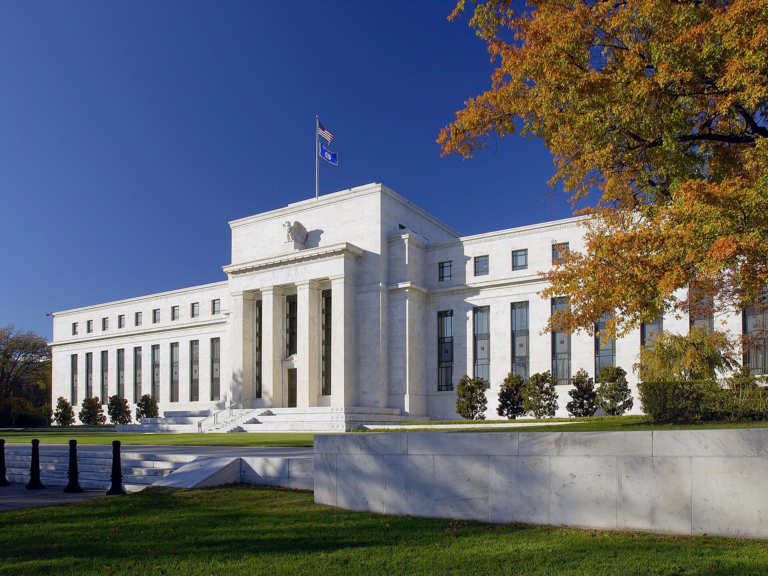
The macro backdrop is dominated by the Federal Reserve. The benchmark ten-year Treasury yield climbed above 4.53% in early June after a firm labour-market report and held near 4.5% into mid-month, supporting a stronger dollar that weighed across the commodity complex. The Federal Open Market Committee meets on 16 and 17 June, with a decision due on Wednesday. Markets widely expect rates to be held in the 3.50% to 3.75% range, but attention is on the new projections and the tone of guidance, with futures pricing a meaningful probability of a rate increase by December. The outcome will shape the dollar, real yields and, in turn, the direction of both oil and gold.
Outlook
The near-term direction of commodities rests on two questions that should become clearer this week: whether the United States and Iran finalise an arrangement on the Strait of Hormuz, and how hawkish the Federal Reserve sounds on Wednesday. A credible de-escalation would extend the pullback in oil, while a firmly hawkish Federal Reserve would keep pressure on metals through a stronger dollar and higher real yields. With supply gradually returning and the macro setting in flux, headline risk is likely to keep volatility elevated across energy and metals into the second half of the year.
Sources: ICE Brent and NYMEX WTI futures; COMEX gold and silver futures; United States Energy Information Administration; OPEC Monthly Oil Market Report; United States Federal Reserve; International Monetary Fund; World Gold Council; as reported by Reuters, CNBC and Bloomberg.