Egypt’s 1.1 Gigawatt Obelisk Solar and Storage Complex Reaches Full Operation on a Dollar Contract Backed by a Sovereign Guarantee
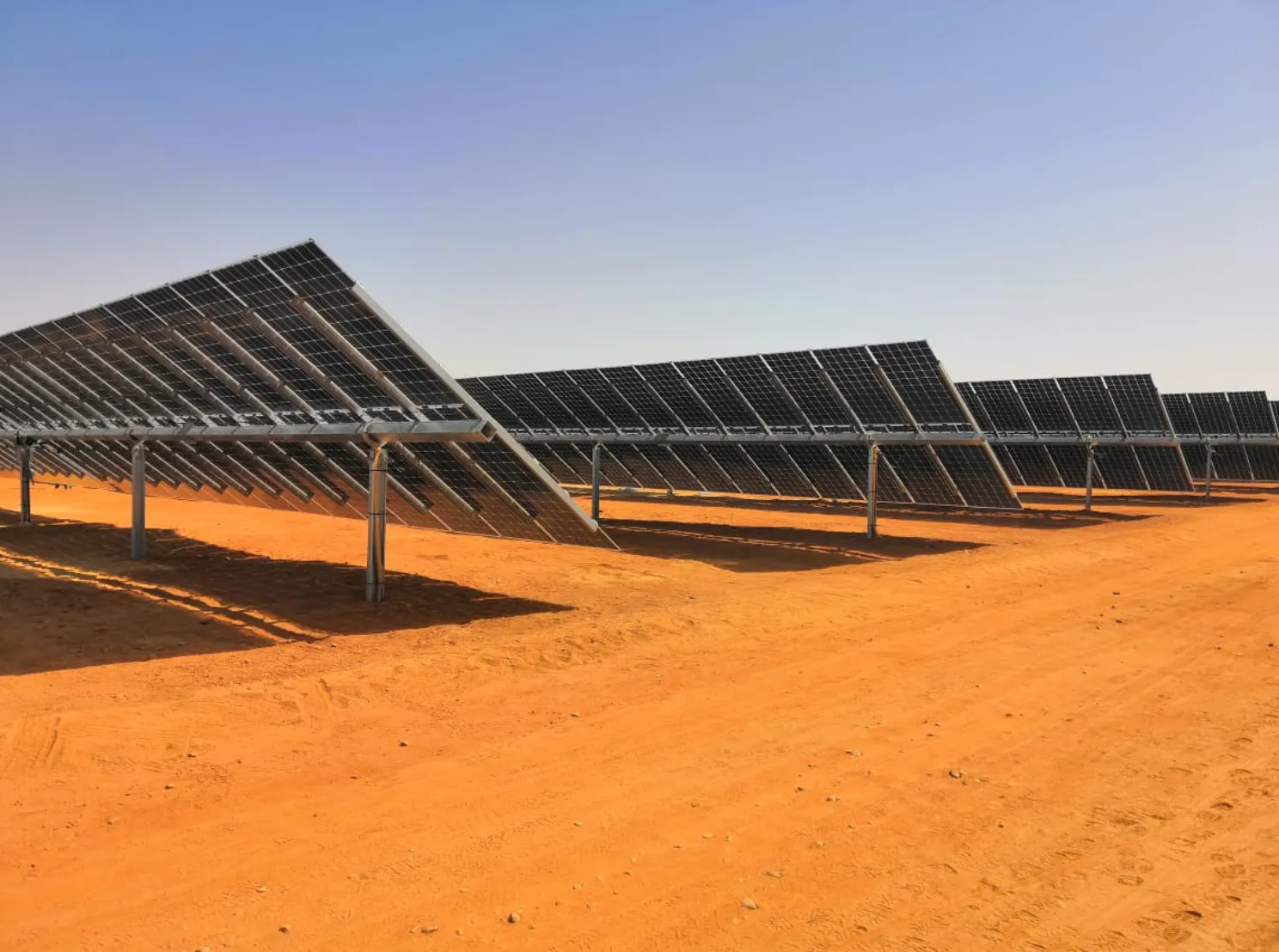
The final phase of Egypt’s Obelisk solar and battery complex entered commercial operation on 12 August, bringing the full 1.1 gigawatt plant and its 100 megawatt battery into service, the project’s developer Scatec said. The first phase was inaugurated by the Prime Minister at Nagaa Hammadi in January, according to Egypt’s State Information Service.
The complex is built in two roughly equal parts, 561 megawatts in the first phase and 564 megawatts in the second, for a combined 1,125 megawatts, our calculation, which the developer rounds to 1.1 gigawatts. The battery is rated at 100 megawatts of power and 200 megawatt hours of storage, which gives it two hours of discharge at full rated output and a power rating equal to 8.9 percent of the solar nameplate, our calculations. That is a configuration built for shifting part of the afternoon’s generation into the evening peak and for supporting the grid, rather than for carrying supply through the night. Scatec expects the complex to generate more than 3,000 gigawatt hours a year, which on the 1,125 megawatt nameplate implies a utilisation rate of about 30 percent, our calculation, and estimates it will avoid more than 1.2 million tonnes of carbon dioxide annually.
The commercial structure is the part that matters most for Egypt. Output is sold to the Egyptian Electricity Transmission Company under a power purchase agreement running 25 years, denominated in United States dollars and, according to the developer’s financial-close disclosure, backed by a sovereign guarantee. For a project financed largely through international capital, dollar denominated revenues reduce the currency mismatch between contracted project revenues and hard currency financing obligations, while the sovereign guarantee adds state credit support behind the utility’s obligations. What the public record does not show is the tariff, its indexation or the detailed settlement mechanics, so the full allocation of currency and payment risk over the 25 year term cannot be assessed from outside.
The financing evolved as the project progressed. At financial close in June 2025, Scatec reported 479.1 million dollars of non-recourse project financing from the European Bank for Reconstruction and Development, the African Development Bank and British International Investment, equivalent to about 80 percent of the then estimated 590 million dollars of capital expenditure. The European Investment Bank subsequently signed 150 million dollars of financing in December 2025, and Scatec now lists all four institutions as senior lenders. On the equity side, the developer reported in May that it holds a 40 percent economic interest while retaining majority control through a layered ownership structure, with the National Bank of Egypt, EDF Power Solutions and Norway’s development finance institution Norfund each holding 20 percent. The National Bank of Egypt’s 20 percent economic interest gives an Egyptian institution a material direct stake in the project’s economics.
Table – Obelisk solar and storage complex:
| Item | Detail |
| Solar capacity | 1,125 MW, phase one 561 MW and phase two 564 MW |
| Battery storage | 100 MW / 200 MWh |
| Battery duration | 2 hours at rated output, our calculation |
| Battery power as share of solar nameplate | 8.9 percent, our calculation |
| Offtaker | Egyptian Electricity Transmission Company |
| Contract | 25 years, denominated in US dollars, backed by a sovereign guarantee |
| Expected generation | more than 3,000 GWh a year |
| Implied utilisation | about 30 percent of nameplate, our calculation |
| Avoided emissions | more than 1.2 million tonnes of CO2 a year, developer’s estimate |
| Estimated capex at June 2025 financial close | about $590 million |
| Project financing at financial close | $479.1 million from EBRD, African Development Bank and British International Investment, about 80 percent of estimated capex |
| Subsequent financing | $150 million from the European Investment Bank, December 2025 |
| Senior lenders | EBRD, African Development Bank, British International Investment, European Investment Bank |
| Equity | Scatec 40 percent economic interest with majority control; National Bank of Egypt, EDF Power Solutions and Norfund 20 percent each |
Project figures from Scatec’s releases of 15 June 2025, 6 May 2026 and 12 August 2026; the December 2025 financing from the European Investment Bank.
Why it matters: The dollar denomination is the fact that will attract the most comment, and it deserves a more careful reading than it usually gets. Egypt has spent two years working to attract hard currency and reduce the drain on it, and a 25 year dollar commitment for electricity looks at first like a new call on reserves. The comparison that matters is therefore not against zero. Egypt’s domestic natural gas balance has tightened and the country has increased its reliance on imported pipeline gas and liquefied natural gas, and the European Bank for Reconstruction and Development has said the project reduces the need to import expensive fossil fuels. To the extent that Obelisk displaces imported gas or other fuel in power generation, the relevant comparison is between a long term dollar denominated electricity commitment and exposure to internationally priced fuel imports, which means the project has the potential to change the composition of Egypt’s hard currency energy exposure rather than simply add to it. Which structure proves cheaper over 25 years cannot be determined without the tariff, the indexation terms, the actual dispatch profile and the displaced fuel volumes, none of which is public. What can be said is that the structure works. A long dollar offtake with a sovereign guarantee, four development banks lending senior and four equity holders spanning Norway, France and Egypt is a deliberately de-risked assembly, and it is the assembly that made a project of this size financeable in this market.
Outlook: The first test is performance against the 3,000 gigawatt hour expectation, and a full year of output will settle whether the plant meets the assumptions its financing was built on. The second question is storage, and the next programme already points to a substantially larger role for batteries in Egypt’s power system. In January the developer signed another 25 year dollar denominated agreement with the same offtaker covering an aggregate 1.95 gigawatts of solar and 3.9 gigawatt hours of battery storage, with financial close expected in the second half of this year. That programme consists of one integrated solar and battery hybrid system together with two standalone battery projects. Across the programme as a whole, solar capacity is about 1.7 times Obelisk’s level while battery energy capacity is 19.5 times larger, our calculations. Because the developer has not disclosed how the 3.9 gigawatt hours is divided between the integrated plant and the standalone batteries, that comparison should not be read as a direct solar to storage ratio for the new plants. What it does show is a sharp increase in the scale of storage being contracted alongside Egypt’s renewable build-out, covering both energy shifting and dedicated grid support. The third is replication of the financing itself, and the tariffs agreed on the next projects, once disclosed, will show whether Egypt’s cost of clean power is still falling.
Sources: Scatec ASA; European Bank for Reconstruction and Development; European Investment Bank; Egypt State Information Service; US Energy Information Administration.