Japan Brings 10 Billion Dollar Asian Energy Financing to IEF17 as Oil Stocks Cover 206 Days
Japan’s Economy, Trade and Industry Minister Akazawa used the 17th International Energy Forum (IEF) ministerial meeting on 11 October to promote POWERR Asia, the 10 billion dollar framework Tokyo launched in April to finance crude purchases and build oil stockpiles across Asia. He spoke while Japan’s own reserves covered 206 days of domestic consumption at the end of July, down from 243 days at the end of February.
Akazawa joined online and spoke at the opening session immediately after Saudi Arabia’s Minister of Energy, Prince Abdulaziz bin Salman, at a meeting Saudi Arabia hosted in hybrid format. The IEF ministerial brings together energy ministers from 60 or more major oil and gas producing and consuming countries. According to the Ministry of Economy, Trade and Industry (METI), Akazawa set out the Asia Zero Emission Community (AZEC) approach under POWERR Asia: oil stockpiling systems and infrastructure for Asia, closer links with producing countries and coordinated emergency response. He presented Japan as a hub connecting Middle Eastern producers with Asian countries.
What the 10 billion dollars is meant to finance
Prime Minister Takaichi Sanae announced the Partnership on Wide Energy and Resources Resilience Asia on 15 April at an online AZEC Plus meeting. The ministry’s overview prices the package at 1.5 trillion yen of financial support, which it puts at 10 billion dollars, and says the financing could facilitate crude imports of up to 1.2 billion barrels a year, which it equates to close to one year of ASEAN crude imports.
The money runs on two tracks. The emergency track lends to Asian companies in Japan’s supply chain to buy crude and products, enhances credit for alternative supplies such as US crude, and offers emergency support loans to partner governments through JICA. The structural track funds stockpiling and release systems, new storage tanks, the restoration of production capacity at Middle Eastern oil producers, and diversification into LNG, biofuels, next generation solar, small modular reactors and critical minerals. Delivery sits with JBIC, through a new POWERR Asia FAST Window inside the Japan Strategic Investment Facility set up in October 2025, and with NEXI, whose internal task force was set up on 17 April to consider insuring crude sales by Japanese trading houses to regional buyers, which would add to those buyers’ creditworthiness.
POWERR Asia in numbers
| Item | Figure | Detail |
|---|---|---|
| Financial support | 1.5 trillion yen | $10 billion |
| Crude imports it could support | 1.2 billion barrels | up to, per year |
| Launch | 15 April 2026 | AZEC Plus online meeting |
| Delivery | JBIC and NEXI | financing window, insurance under study |
Source: METI news release of 21 April 2026 and its POWERR Asia overview; joint statements of 28 May (Philippines) and 2 July (India).
The 1.5 trillion yen is the scale of support on offer through loans, credit enhancement and insurance under study. Two bilateral statements have followed: a 28 May joint statement with the Philippine Department of Energy covers the Philippines’ strategic national petroleum reserve programme and ASEAN wide joint stockpiling, and a 2 July statement with India’s Ministry of Petroleum and Natural Gas covers energy resilience, including stronger oil stocks.
How far Japan’s own reserves have been drawn
Japan holds oil in three pools: state stocks, stocks that private companies must keep under the Oil Stockpiling Act, and crude that producer-country national oil companies store in leased Japanese tanks. The Agency for Natural Resources and Energy’s latest monthly reading, for the end of July, set against the end of February, the last month before releases began on 26 March, shows where the drawdown landed.
Japan’s oil stocks in days of consumption
| Holder | End Feb 2026 | End Jul 2026 | Change, days |
|---|---|---|---|
| National | 145 | 103 | -42 |
| Private | 91 | 98 | +7 |
| Producer-country joint | 6 | 4 | -2 |
| Total | 243 | 206 | -37 |
Days are computed on domestic consumption under the Oil Stockpiling Act; parts may not sum to the total because of rounding in the source, and changes are our calculation. On the IEA basis the total fell from 206 days to 176. Source: Agency for Natural Resources and Energy, April and September 2026 editions.
Japan’s oil stocks by volume, million kilolitres of product equivalent
| Holder | End Feb 2026 | End Jul 2026 | Change |
|---|---|---|---|
| National | 41.11 | 28.96 | -29.55% |
| Private | 25.73 | 27.49 | +6.84% |
| Producer-country joint | 1.79 | 1.06 | -40.78% |
| Total | 68.62 | 57.52 | -16.18% |
Parts may not sum to the total because of rounding in the source. Percentage changes are our calculation.
The state carried the load. National crude holdings fell from 41.77 million kilolitres to 28.99 million, a drop of 12.78 million kilolitres or 30.60 percent, on our calculation. The national share of Japan’s total stock slipped from 59.91 percent to 50.35 percent over the five months, while the private share rose from 37.50 percent to 47.79 percent, on our calculation.
Private stocks went the other way. They climbed to 98 days even though the legal minimum was cut from 70 days to 55 on 16 March, so at the end of July private stocks stood at 1.78 times the obligation, 43 days above it, on our calculation. Private crude rose 10.79 percent to 13.04 million kilolitres and private products 3.85 percent to 15.11 million, on our calculation. In July the ministry said private stocks were recovering to the 90 day level and to their end February volume, with July procurement expected to return to last year’s level.
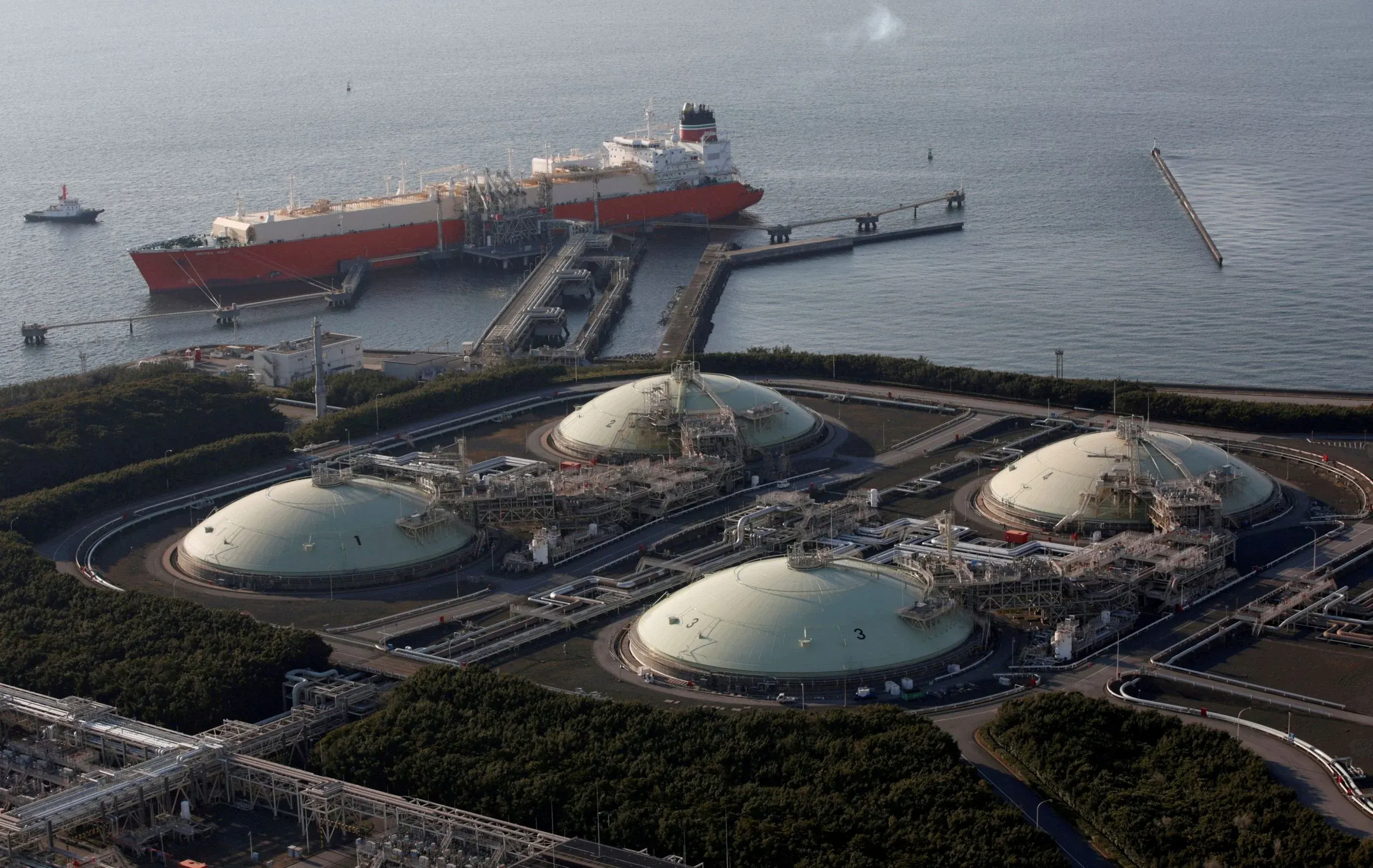
The producer-country pool is the smallest. Under it, the government supports leasing private crude tanks in Japan to producer national oil companies, which use them as a relay and storage base for East Asia and give Japan priority supply in a shortage. Releases from it began alongside the state releases on 26 March, and its volume fell 40.78 percent by the end of July.
Planned scale of Japan’s two national crude releases
National crude release orders, 2026
| Order | Volume | Value | Release from |
|---|---|---|---|
| First, 24 March | 8.5 million kl | 540 billion yen | 26 March |
| Second, 24 April | 5.8 million kl | 540 billion yen | 1 May |
| Total | 14.3 million kl | 1.08 trillion yen | 26 March and 1 May |
Each order lists ENEOS, Idemitsu Kosan, Cosmo Oil and Taiyo Oil as recipients. The first drew on 11 storage bases and the second on 10. Volumes and values are approximate in the source.
Each order carried a value of approximately 540 billion yen, so the two together came to approximately 1.08 trillion yen, on our calculation; these are the approximate values of the oil scheduled for release, not government spending. The first, set at one month of supply, ran from 26 March; the second, at 20 days, from 1 May. When announcing the second release on 15 April, the ministry said more than half of oil supply could come through alternative sources by May compared with last year, and that it expected supply to be secured beyond year end while limiting how much stock had to be released.
Why it matters: Japan drew down 30.60 percent of its state crude between the end of February and the end of July, on our calculation, and still covered 206 days of consumption, with private stocks rebuilt above their February level. POWERR Asia offers financing to Asian partners building their own stock and release systems, and part of it is aimed at Asian companies inside Japan’s own supply chain. For Middle Eastern producers, the framework includes support for restoring production capacity, and Japan has cast itself as the hub linking them with Asian countries.
Outlook: The 55 day private obligation stays in place for the time being, until the IEA Governing Board decides its policy on the IEA’s collective action, the coordinated release of 412 million barrels that member countries agreed in March. The agency’s next monthly edition will show whether national stocks have settled and private stocks keep rebuilding, and JBIC and NEXI deals under POWERR Asia will show how quickly the 10 billion dollars reaches Asian buyers and storage projects.
Sources: Ministry of Economy, Trade and Industry, Agency for Natural Resources and Energy, The Edge.