Jordan Launches JOD 4.68 Billion National Water Carrier From Aqaba to Amman

The Takeaway: The stated cost of Jordan’s National Water Carrier is now $800 million above the government’s April total, a gap no launch statement broke down, and none said its financing has formally closed. The project is meant to supply about 40% of drinking water needs. The longer test is fiscal: the state expects to buy this water for more than twice what consumers pay on average, leaving the Water Authority to carry the difference.
Deputizing for His Majesty King Abdullah II, His Royal Highness Prince Faisal bin Al Hussein launched Jordan’s JOD 4.68 billion ($6.6 billion) National Water Carrier in Aqaba on Wednesday.
Prime Minister Jafar Hassan called it the largest strategic project in the Kingdom’s history. Water and Irrigation Minister Raed Abu Saud said delivery should begin by the end of 2030.
The carrier would bring 2.5 times Disi’s maximum flow
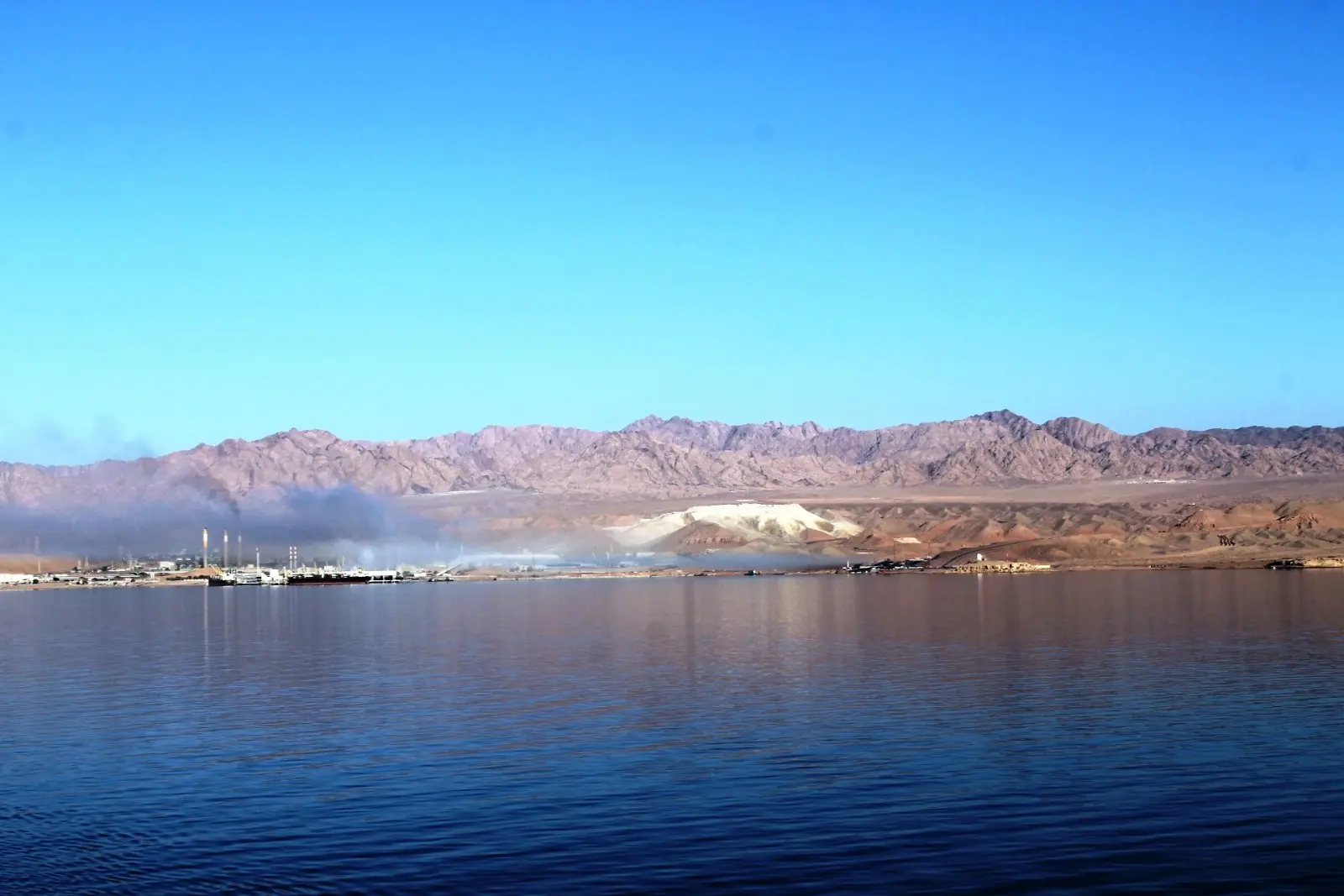
The plant will draw on the Gulf of Aqaba to supply 300 million cubic meters of drinking water a year, about 40% of national needs. That share implies total drinking water needs of about 750 million cubic meters a year.
The new supply is 2.5 times the 120 million cubic meters a year that the minister gave in May as the maximum from the Disi basin. The government’s April statement put it at nearly three times Disi’s output, without stating the base.
A pipeline of about 417 kilometers will carry the water north, with pumps lifting it as high as 1,100 meters above sea level. Meridiam is lead developer and sponsor and SUEZ is technical and operating partner, under a build-operate-transfer contract. Full ownership passes to the government 26 years after operations begin.
Planned capacity has grown threefold since the ministry first conceived the scheme in 2016 as a pipeline carrying 100 million cubic meters a year.
Launch figures against lender documents
| Item | Launch | Lenders |
|---|---|---|
| Total cost | $6.6bn | $6bn |
| Pipeline | 417 km | 438 km |
| Solar | 300 MW | 281 MWp |
| Solar share | 30% | 27% |
Lender figures are from disclosures by the International Finance Corporation, the World Bank Group’s private-sector arm; its cost is an estimate subject to further optimization, and its environmental review gives the pipeline as about 440 km. The European Bank for Reconstruction and Development, a multilateral lender, also lists 438 km and 281 MWp. The launch solar figure is in megawatts and the lender figure in megawatts peak, the panels’ rated maximum, so the two are not directly comparable.
The stated cost is $800 million above April’s total
The government put the total cost, financing included, at $5.8 billion when the final technical and legal agreement was signed in April, of which $4.3 billion was capital cost.
On that total, Wednesday’s figure is 13.8% higher. The launch announcements gave no breakdown, so the gap cannot be read as a construction overrun. The comparison is also not fully settled, because the ministry itself described $5.8 billion as the capital cost in July.
Set against the economy, the project equals 10.7% of Jordan’s 2025 GDP of JOD 43.7 billion.
It is also 2.8 times the JOD 1.7 billion of capital spending in the draft 2027 budget now before Parliament. Most of the money will not come from that budget, and it will be spent over several years.
Financing outlined in April (amounts in $ billions)
| Source | Amount | Share |
|---|---|---|
| Private financing | 2.9 | 50.0% |
| Jordanian banks | 1.1 | 19.0% |
| Treasury | 0.722 | 12.4% |
| Grants | 0.663 | 11.4% |
Shares are of the $5.8 billion April total. The bank figure is an upper limit, and the four lines are not a complete breakdown. No split of the $6.6 billion was given at the launch.
The government described its $722 million as the largest budget outlay on any single capital project. The Social Security Investment Fund is due to take 15% of the equity alongside Meridiam.
Financial close has yet to be announced
Financial close, the point at which lenders’ commitments take legal effect and funds can flow, was targeted for early July. A Cabinet decision reported on 9 November was still securing a EUR 16 million contribution from KfW, Germany’s state development bank, as part of those arrangements.
The International Finance Corporation’s board approved a loan of up to $375 million on 19 February, and its project page still lists the investment as pending signing. The European Bank for Reconstruction and Development lists a senior loan, repaid ahead of junior debt, of up to $475 million. Wednesday’s announcements did not say whether close has been reached, and they reported no setback to the financing.
Meridiam’s regional director said in May that construction would take four years. With 26 years of operation after that, it fits the 30-year concession in lender documents. The water minister called Wednesday’s groundbreaking the start of implementation.
SUEZ said on Wednesday that the groundbreaking begins a four-year construction program and put the investment at more than $6.7 billion. The launch reports gave $6.6 billion.
Its release gives a water network of 418 kilometers, close to the launch figure. It puts the solar plant at 280 megawatts, against about 300 megawatts at the launch.
The state expects to pay more than double the consumer price
Government Communication Minister Mohammad Momani said in April that the state would buy the water at about JOD 1.90 per cubic meter.
Consumers would pay an average of JOD 0.80, depending on their consumption band, with the Water Authority of Jordan bearing the subsidy.
The price has already come down. April’s agreement set an indicative price of about $2.70 per cubic meter, against about $3 in 2024. The government valued that cut at about $2.5 billion over the life of the project. Talks on the inflation formula were still open at that stage.
In The Edge’s reading, the subsidy is the project’s main long-term fiscal question. As an illustration only, applying the JOD 1.10 gap to all of the carrier’s annual output gives JOD 330 million a year.
That equals 73% of the JOD 450 million primary deficit, the shortfall before interest payments, targeted for 2027, a comparison of scale and not a forecast of that budget. The illustration assumes every cubic meter is priced and sold at April’s indicative purchase price and average consumer price. It leaves out network losses, differences between tariff bands and other financing.
The minister put the Water Authority’s debt at JOD 4.5 billion in May. In July, his ministry warned that water sector debt would rise to about JOD 15 billion by 2040 without reforms and lower losses. A tariff reform program is under way.
The new water alone covers about half of the stated per-person gain
Jordan starts from extreme scarcity. The Multilateral Investment Guarantee Agency, the World Bank Group’s political risk insurer, puts renewable water at under 61 cubic meters a person a year and says groundwater is being used twice as fast as it is replenished.
The ministry says the carrier will lift availability from about 60 to about 110 cubic meters a person. Supply would rise to three days a week from one. Even then, Jordan would stay far below the 500 cubic meter water poverty line, the international marker of absolute scarcity.
The arithmetic leaves a gap. Spread over the 11.9 million people the Central Bank of Jordan lists for 2025, the carrier’s output comes to 25 cubic meters each, about half the stated gain.
Water expert Hazem Nasser expects a further 150 million to 200 million cubic meters of treated water a year for farming, an estimate of his own and not the ministry’s.
Adding that farm water to the carrier’s drinking water would give 38 to 42 cubic meters a person, on The Edge’s calculation. The launch statements do not show how the rest is reached.
The project also has an industrial side. A steel pipe and coating plant with investment of up to JOD 120 million is planned in Aqaba, with about 420 jobs. Half its output is reserved for the carrier.
What to watch: The Jordan-EU Investment Conference opens at the Dead Sea on Thursday 19 November with water projects on its agenda, including 11 network upgrades to receive desalinated water.
Correction, 18 November 2026: An earlier version said the launch reports gave no construction start date; the water minister called the groundbreaking the start of implementation. It also gave the steel plant’s investment as JOD 120 million; the figure is up to JOD 120 million.
Method: based on Jordan News Agency reports of 18 November 2026 and of 21 April, 14 May, 5 July, 9 November and 14 November 2026, the International Finance Corporation’s project summary (last updated 25 February 2026) and environmental review (last updated 20 October 2026), the Multilateral Investment Guarantee Agency’s project page, the European Bank for Reconstruction and Development’s project page (last updated 19 August 2025), SUEZ’s press release of 18 November 2026, and the Central Bank of Jordan’s September 2026 monthly report and statistical bulletin. Percentages, ratios, sums and per-person figures not attributed to a source are The Edge’s calculations.
Sources: Jordan News Agency (Petra), Central Bank of Jordan, International Finance Corporation, Multilateral Investment Guarantee Agency, European Bank for Reconstruction and Development, SUEZ, The Edge.