Lagarde Says ECB Cannot Look Through Energy Shock as Deposit Rate Stands at 2.50 Percent
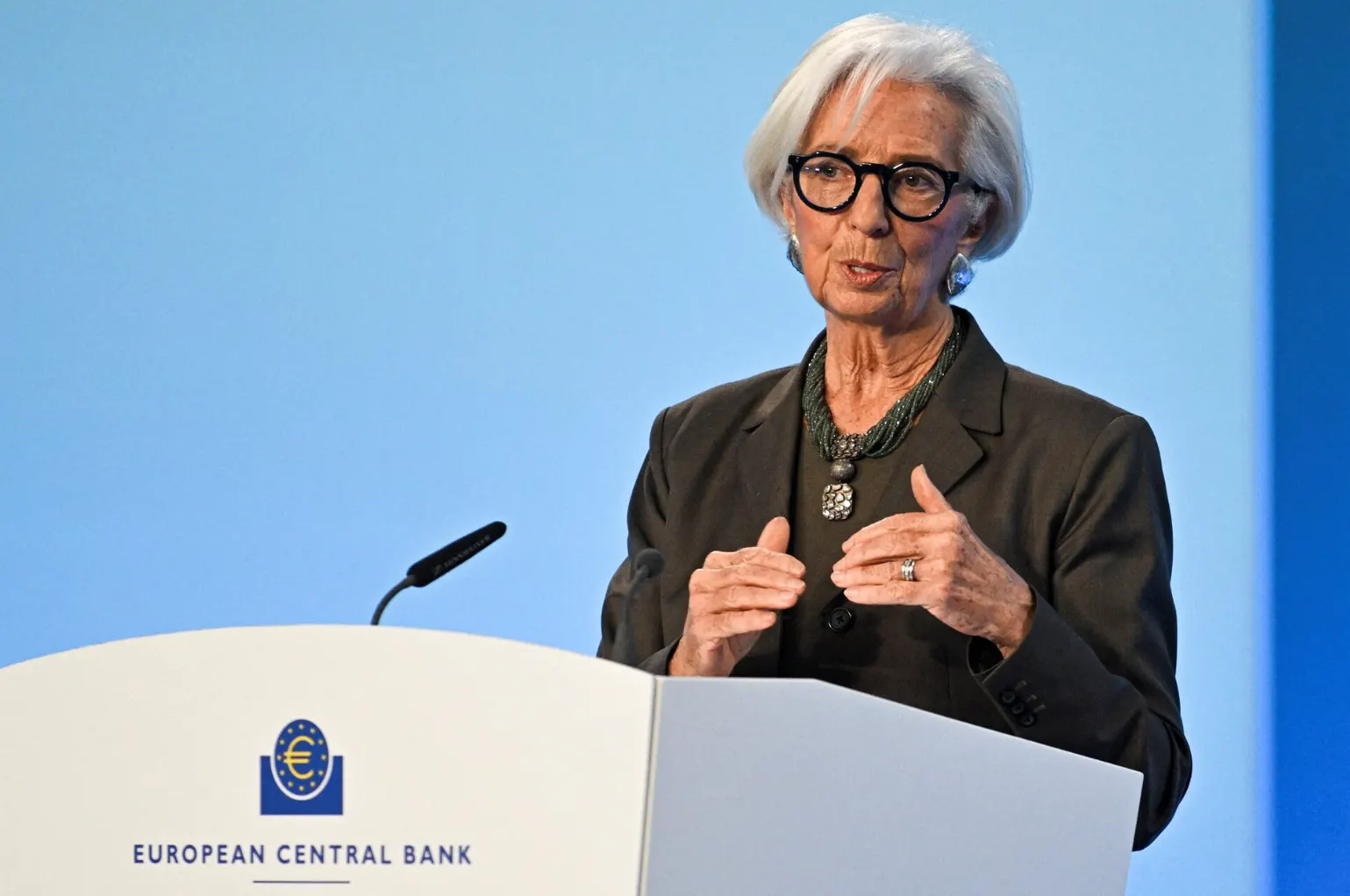
European Central Bank President Christine Lagarde told the International Monetary and Financial Committee on 17 October that the energy shock is too large to “look through”, while arguing that a measured response remains appropriate to keep inflation in check. The bank raised its three key rates by 25 basis points in June and again in September, lifting the deposit facility rate to 2.50 percent, 0.50 points above the 2.00 percent it stood at before June. At that level the deposit rate matches core inflation of 2.5 percent and sits 1.3 points below the September headline rate, on our calculation.
Long-Term Yields Have Risen Since the September Decision
Financing conditions have tightened, Lagarde said, with long-term interest rates rising notably since the September meeting, and this will slow growth and reduce pass-through by more than projected in the staff’s September exercise.
The bank’s own yield curve shows the size of that move. Its all-issuer euro area 10-year spot rate stood at 3.86 percent on 9 September, the eve of the decision, and 3.95 percent on decision day. It reached 4.19 percent on 1 October, its highest reading since the decision and 0.24 points above the decision-day level, before easing to 4.00 percent on 15 October. That leaves it 0.05 points above the decision-day level and 0.14 points above the eve of the decision, and on 15 October the long rate stood 1.50 points above the deposit rate, on our calculation.
She set the policy case against the bank’s three criteria: the inflation outlook and its risks, underlying inflation, and the strength of transmission. On the second, she said there is no evidence at this stage of significant pass-through of energy prices to other prices and wages beyond what the projections already include, and that wages have so far shown no material response to the shock. In September the Governing Council said it was not pre-committing to a particular rate path.
Deposit Rate Against the Latest Inflation Readings
| Measure | Latest | Deposit rate gap, pts |
|---|---|---|
| Deposit facility rate | 2.50% | n/a |
| Headline HICP, Sep 2026 | 3.8% | -1.3 |
| Core HICP, Sep 2026 | 2.5% | 0.0 |
| Services HICP, Sep 2026 | 3.2% | -0.7 |
Deposit rate in force from 16 September 2026. Annual rates for the euro area. Core excludes energy, food, alcohol and tobacco. The gap is the deposit rate minus each measure, a simple comparison of nominal rates rather than a measure of the real policy stance, our calculation.
September Data Run Ahead of the Staff Path
The monthly figures have moved faster than the staff baseline published on 10 September. Staff expected headline inflation to peak at 3.6 percent in the fourth quarter of 2026. September’s 3.8 percent, confirmed by Eurostat on 16 October, is already 0.2 points above that quarterly peak, although a single month and a quarterly average are not strictly comparable. Energy is the gap. Staff saw energy inflation peaking at almost 15 percent at the end of the year; it reached 18.9 percent in September, more than 3.9 points higher, and has swung by 22.9 points since January, when it stood at minus 4.0 percent, on our calculation.
The statement said higher energy prices should keep headline inflation well above target into the first half of 2027 and feed gradually through to core and food inflation, with the headline rate declining after the first quarter and returning to around target towards the end of 2027. The staff path has headline inflation at 2.5 percent in the second quarter of 2027 and close to 2.0 percent thereafter, with core inflation peaking at 2.8 percent in the first quarter of 2027.
Growth has also come in above the staff’s starting point. The staff worked from a flash estimate of 0.4 percent growth in the second quarter; the statistics office’s estimate of 7 September put it at 0.6 percent on the quarter, 0.2 points higher, and at 1.2 percent on the year, double the 0.6 percent of the first quarter, on our calculation. The baseline projects growth of 0.9 percent in 2026, 1.4 percent in 2027 and 1.5 percent in 2028, and unemployment falling from 6.2 percent this year to 5.9 percent in 2028. On the staff’s Irish-adjusted measure based on modified domestic demand, the figures are 1.2 percent in both 2026 and 2027.
Staff Scenarios for Inflation and Growth
| Scenario | HICP 2027 | HICP 2028 | GDP 2027 |
|---|---|---|---|
| Milder | 1.9% | 1.8% | 1.5% |
| Baseline | 2.5% | 2.1% | 1.4% |
| Adverse | 3.2% | 2.3% | 1.1% |
| Severe | 5.4% | 3.2% | 0.4% |
September 2026 staff projections, annual averages.
In the severe case inflation in 2027 would be 2.9 points above the baseline and growth 1.0 point below it, at 0.4 percent, on our calculation. Only the milder scenario keeps inflation under 2 percent in both 2027 and 2028.
Oil Assumptions and Refined Fuel Supply
The return to target rests on energy prices that markets expect to fall. The projections assume Brent crude averages 89.5 dollars a barrel in 2026, 29.5 percent above the 69.1 dollars of 2025, before easing to 78.0 dollars in 2027 and 73.6 dollars in 2028, which is 17.8 percent below the 2026 level, on our calculation. Those paths were taken from futures markets up to a cut-off of 19 August, and the 2026 figure is 7.6 dollars below the June assumption. Dutch gas is assumed at 51.0 euros per megawatt hour in 2026, 40.9 percent above 2025, falling to 30.3 euros in 2028, below the 2025 level.
The staff linked the sharper rise in refined transport fuel prices than in crude oil to lower global supply of refined fuels owing to the closure of the Strait of Hormuz, alongside higher seasonal demand and attacks on Russian refining capacity. On the baseline, energy inflation turns negative in the second half of 2027 and the first half of 2028.
Staff Technical Assumptions
| Assumption | 2026 | 2027 | 2028 |
|---|---|---|---|
| Brent crude, $ a barrel | 89.5 | 78.0 | 73.6 |
| Dutch TTF gas, € per MWh | 51.0 | 43.3 | 30.3 |
| Wholesale electricity, € per MWh | 108.7 | 90.2 | 73.1 |
| Three-month EURIBOR, % | 2.4 | 3.0 | 3.0 |
Market-based assumptions with a cut-off date of 19 August 2026, as published in the September 2026 staff projections. Brent was assumed at $88 a barrel in the third quarter of 2026.
The same assumptions already built in a three-month rate 0.6 points higher in 2027 than in 2026, on our calculation.
EUREP, the Digital Euro and Public Finances
Beyond rates, the statement said more than 30 central banks have expressed interest in EUREP, the Eurosystem repo facility for central banks, in the past six months. The Governing Council set its operational features and onboarding process in July.
On retail payments, the Eurosystem will run a 12-month internal pilot of the digital euro in the second half of 2027, and adopting the regulation establishing it by the end of 2026 is key to making that possible. She also noted that Pontes went live on 21 September.
On fiscal policy she asked that any response to the energy shock be temporary, targeted and tailored. The staff baseline includes temporary energy support worth 0.1 percent of GDP, a deficit of 3.6 percent of GDP this year peaking at 3.7 percent in 2027, and a debt ratio rising from 87.1 percent in 2025 to 89.4 percent in 2028, an increase of 2.3 points, on our calculation. Euro area banks keep strong capital and liquidity buffers, she said, and the region’s financial institutions have limited direct exposure to private credit.
Why it matters: The statement confirms that the bank is responding to the energy shock rather than looking through it, while keeping that response measured. The risk sits in the data: energy inflation in September was already above the peak the staff expected for the end of the year, and the severe scenario takes inflation to 5.4 percent in 2027.
Outlook: The Governing Council meets in Frankfurt on 28 and 29 October, with its decision and press conference on 29 October, and again on 16 and 17 December. Eurostat’s preliminary flash estimate of third-quarter GDP follows on 30 October, the October flash inflation estimate on 4 November and the full October figures on 18 November. The measures to watch are those the statement named: long-term yields, underlying inflation and wages, against energy prices that the projections assume will fall through 2028.
Sources: European Central Bank, Eurostat, The Edge.