Masdar Reaches Financial Close on the World’s First Gigascale Round-the-Clock Renewable Project
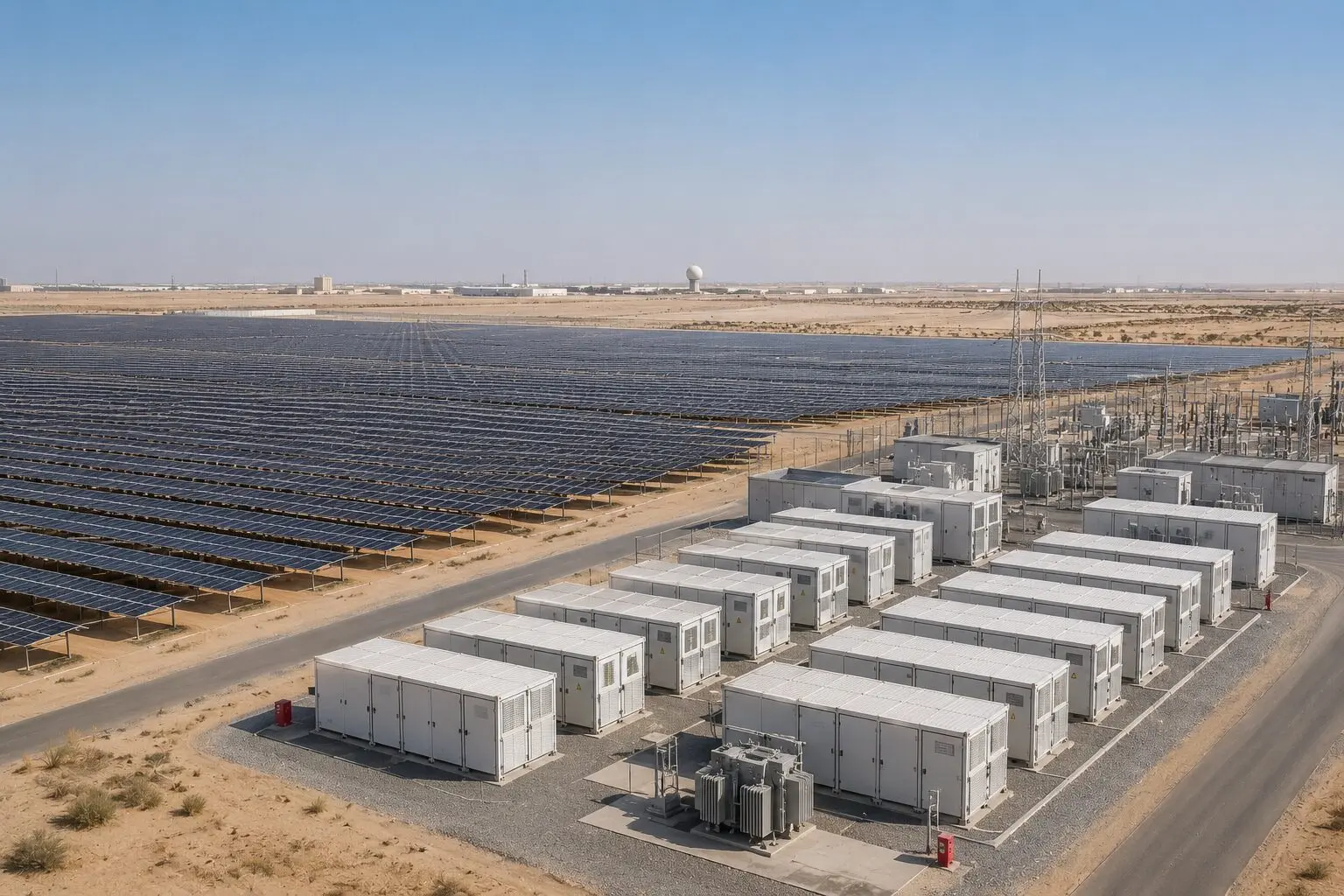
Abu Dhabi’s Masdar has reached financial close on what it calls the world’s first gigascale round-the-clock renewable-energy project, a 6.1 billion dollar plant in the emirate that will pair a vast solar array with one of the largest battery systems yet built to deliver a steady gigawatt of clean power day and night. The company announced the milestone on Monday through the state news agency WAM.
The project, developed with Emirates Water and Electricity Company, combines a 5.2 gigawatt solar plant with a 19 gigawatt-hour battery energy storage system, engineered to supply 1 gigawatt of continuous, dispatchable power rather than the intermittent output that has long limited solar. The 6.1 billion dollar cost is funded by 1 billion dollars of Masdar equity and a 5.1 billion dollar debt package from a consortium of thirteen local and international banks, and the plant is expected to be operational in 2027. The project broke ground in October 2025, so financial close does not start construction but completes the funding structure for a plant already being built.
| Indicator | Figure |
|---|---|
| Solar capacity | 5.2 GW |
| Battery storage | 19 GWh |
| Continuous baseload power | 1 GW |
| Total investment | 6.1 billion dollars |
| Debt package, 13 banks | 5.1 billion dollars |
| Masdar equity | 1 billion dollars |
| Groundbreaking | October 2025 |
| Expected operational | 2027 |
| Masdar portfolio all stages, 2030 target | 65 GW, 100 GW |
The point of the design is to answer the oldest objection to solar, that the sun does not shine at night. By storing 19 gigawatt-hours during the day and discharging after dark, the plant behaves more like a conventional baseload station, a model the industry increasingly calls 24/7 clean power. That capability is becoming commercially important as artificial-intelligence data centres and advanced manufacturing drive round-the-clock electricity demand, our reading. Masdar’s renewable portfolio exceeds 65 gigawatts across operating, under-construction and committed projects, and it is targeting 100 gigawatts by 2030.
Why it matters: For the UAE, the project advances an energy strategy built on cheap solar and, increasingly, storage, and it lets Abu Dhabi meet rising demand from AI and industry without leaning on gas at the margin. For the Gulf more broadly, financing a 6.1 billion dollar clean-power plant with a thirteen-bank syndicate signals that lenders are ready to back giant round-the-clock renewables in the region, a template Kuwait and other GCC economies pursuing diversification will watch. It also fits a wider shift in which the value in renewables moves from the panels to the storage and system engineering that make them dependable.
Outlook: The immediate marker is construction progress toward the 2027 commissioning target, and whether the plant delivers its promised gigawatt of firm output on schedule and on budget. Beyond that, the question is how quickly the 24/7 model spreads, both across Masdar’s 100 gigawatt pipeline and among other Gulf developers, as storage costs fall and data-centre demand rises.
Sources: Masdar; WAM.