Suez Canal Receives Tanker Boost as Energy Routes Adjust to Hormuz Disruption
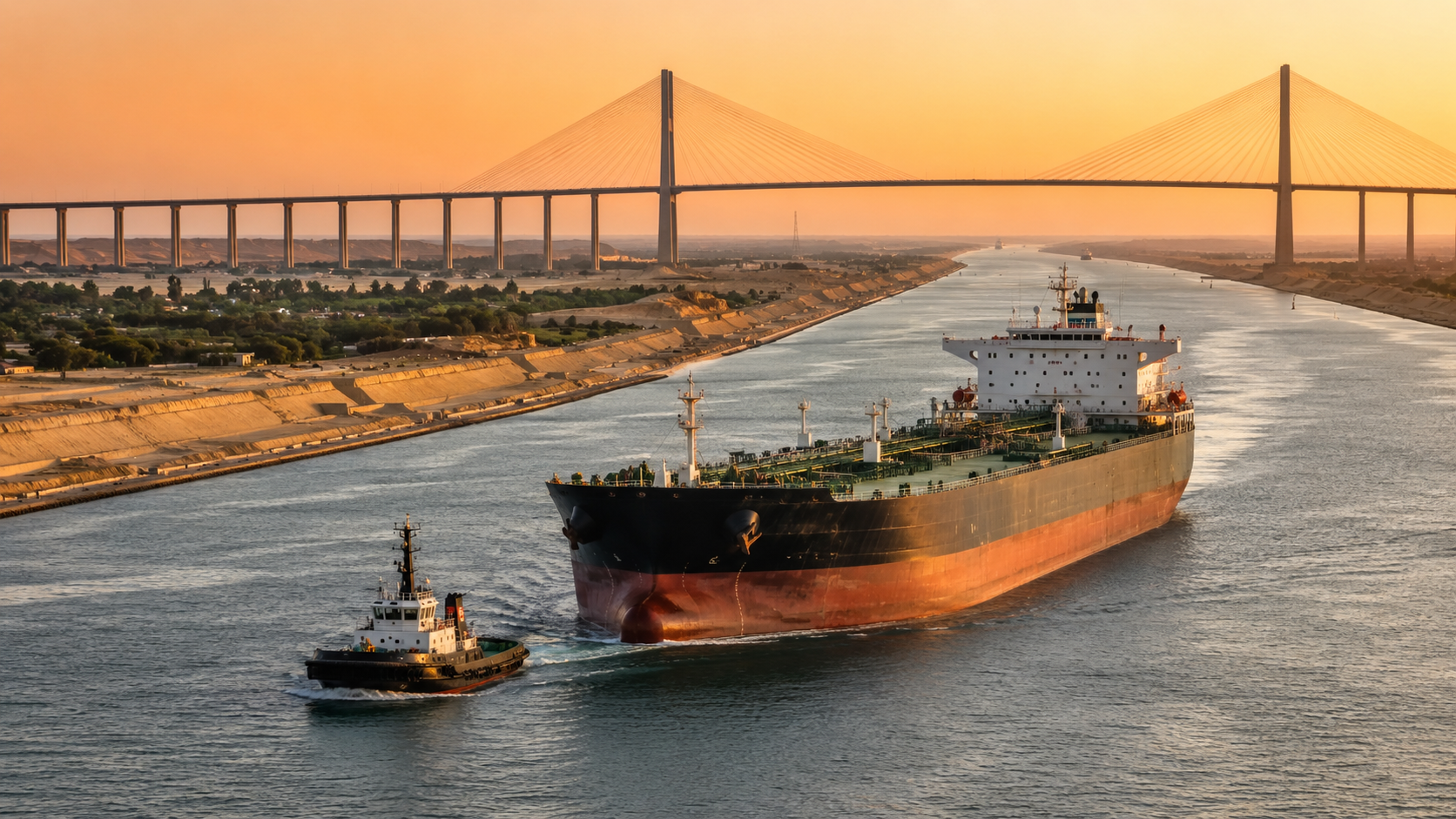
The Suez Canal recorded a clear recovery signal in April 2026, as oil tanker traffic increased sharply amid the effective closure and disruption of the Strait of Hormuz. The improvement gave Egypt’s strategic waterway its strongest monthly revenue level since early 2024, but the data also show that the recovery remains partial and heavily concentrated in energy flows.
According to reported Suez Canal traffic data, 529 tankers crossed the Canal in April, up 27.8% compared with the same month last year. Total vessel transits reached 1,182 ships, an increase of 13.9% year on year. Canal revenue rose to about $419.6 million in April, compared with $408.1 million in March.
This marks a meaningful improvement for Egypt, where the Canal remains one of the country’s most important sources of foreign currency. However, the composition of the rebound matters. Tankers are recovering faster than other vessels, while total traffic remains far below the levels recorded before the Red Sea disruption.
Oil Tankers Lead the Recovery
The strongest signal in April was the rise in oil tanker crossings.
With 529 tankers crossing the Canal, tanker traffic increased by around 115 vessels compared with the implied April 2025 level of about 414 tankers. Tankers accounted for nearly 44.8% of all Suez Canal transits in April 2026, compared with roughly 39.9% a year earlier.
This means the recovery was not evenly distributed across all shipping categories. Energy related traffic was the main driver, while non tanker vessels recovered more slowly. Other vessel types reached 653 ships in April, up only 4.6% year on year.
The contrast is important. It shows that the Canal is benefiting from rerouted energy flows, but it has not yet seen a full return of container shipping and general cargo activity.
Revenue Improves but Remains Below the Old Peak
Suez Canal revenue reached about $419.6 million in April, the highest monthly level since early 2024. Compared with March revenue of $408.1 million, this was a monthly increase of about $11.5 million, or 2.8%.
On a year on year basis, the increase was stronger. A reported 27% annual rise implies that April 2025 revenue was around $330 million. This means the Canal generated roughly $89 million more in April 2026 than in the same month last year.
The improvement is meaningful, but it should not be confused with full normalisation. If April’s revenue level were annualised, it would imply about $5.0 billion per year. That remains far below the record revenue level of more than $10 billion achieved before the Red Sea disruption.
The Canal is therefore recovering from a low base, but it is still operating below its previous earnings capacity.
Hormuz Disruption Redirects Energy Flows
The direct reason for the tanker boost was the disruption around the Strait of Hormuz, one of the most important energy chokepoints in the world.
The International Energy Agency estimates that around 20 million barrels per day of crude oil and oil products moved through the Strait in 2025, equal to about one quarter of global seaborne oil trade. When this route is disrupted, energy producers, traders, and shipping companies look for alternative export paths.
Some flows can be redirected through pipelines and Red Sea ports before moving through the Suez Canal toward Europe and other destinations. This does not mean every diverted barrel passes through Egypt, but the April data suggest that enough tanker movement shifted to provide a clear revenue boost for the Canal.
The oil price environment also reinforced the effect. The U.S. Energy Information Administration reported that Brent crude averaged $117 per barrel in April, sharply higher than earlier in the year, as Hormuz disruption tightened global supply conditions.
This combination of rerouted energy cargoes and higher oil market volatility created a favourable short term environment for Suez Canal tanker activity.
Four Month Data Confirms the Tanker Led Trend
The January to April numbers also confirm that tankers are leading the recovery.
During the first four months of 2026, 4,506 ships crossed the Canal, up 12.1% compared with the same period last year. Tanker crossings reached 1,917 vessels, an increase of 25.0%, while other vessel types totalled 2,589, up only 4.2%.
This means tanker traffic grew almost six times faster than non tanker traffic during the first four months of the year.
Net tonnage also improved. Total Suez Canal net tonnage reached 196.5 million tons in the first four months of 2026, up 25.6% year on year. Transit fees reached about EGP 78.1 billion, up 25.4%.
These figures show that the recovery is not only about vessel numbers. Larger ships, higher tonnage, and energy related cargoes are also supporting stronger revenue performance.
Still Far Below Normal Traffic
Despite the improvement, total traffic remains well below previous levels.
In April 2023, before the Red Sea crisis disrupted global shipping routes, around 2,300 ships crossed the Canal. By comparison, April 2026 traffic of 1,182 ships represents only about 51% of that benchmark.
This is the central point for investors and policymakers. The Canal is recovering, but it is not yet normalising.
Many container lines remain selective because Red Sea security risk, insurance costs, and route reliability still make the Cape of Good Hope route preferable for some services. Until container shipping and general cargo return more fully, Canal revenue will remain dependent on tanker flows and regional energy routing.
Macroeconomic Importance for Egypt
The recovery matters because Suez Canal revenue directly supports Egypt’s external position.
The Canal generates foreign currency income with limited imported input requirements. This makes its revenue especially valuable for the balance of payments, particularly at a time when Egypt is working to strengthen foreign currency liquidity and reduce external financing pressure.
The scale can be illustrated through a simple calculation. If Canal revenue remained at the April 2026 run rate of about $419.6 million per month, annual revenue would be around $5.0 billion. If revenue eventually returned to the previous record level of more than $10 billion, the difference would be roughly $5 billion per year.
Egypt’s current account deficit reached $9.5 billion in the first half of FY2025/2026. If that deficit were annualised to about $19 billion, an additional $5 billion in Canal revenue would be equivalent to roughly one quarter of the annualised gap.
This is only an illustrative comparison, not a forecast. It does not account for changes in imports, tourism, remittances, oil prices, freight costs, or external financing. However, it shows why a sustained recovery in Canal receipts would be one of the most important positive external shocks for Egypt.
Why the Data Matters
The April data matter for three main reasons.
First, they show that Egypt is receiving a real revenue lift from shifting energy trade patterns. The rise in tanker crossings is large enough to affect monthly Canal income and foreign currency inflows.
Second, they show that the recovery is concentrated. Tankers are improving much faster than other vessels, making the rebound vulnerable to changes in energy routing, Hormuz conditions, and oil market disruption.
Third, they show that full normalisation has not yet happened. Total vessel crossings remain almost half below the April 2023 benchmark, and broader shipping activity is still constrained by Red Sea security and insurance considerations.
Outlook
The outlook for the Suez Canal will depend on three main forces: the duration of Hormuz disruption, security conditions in the Red Sea, and the willingness of major carriers to restore regular routes through the Canal.
If Hormuz disruption continues, tanker traffic through Suez could remain supported. If Red Sea security improves, container and general cargo activity could recover more broadly. But if regional risks rise again, shipping companies may continue to favour longer but safer routes around the Cape of Good Hope.
Overall, April 2026 marked an important improvement for the Suez Canal. Tanker traffic rose sharply, revenue reached its strongest level since early 2024, and broader transits improved. Yet the recovery remains incomplete. The Canal is benefiting from energy market disruption, but a full return to historical revenue levels will require a broader recovery across container shipping, general cargo, and global trade flows.
Sources: CAPMAS reported Suez Canal data, Suez Canal Authority, CEIC, International Energy Agency, U.S. Energy Information Administration, Central Bank of Egypt, and verified maritime market information available as of June 2026.