USMCA Enters Annual Review Cycle as US Declines Straight 16 Year Renewal
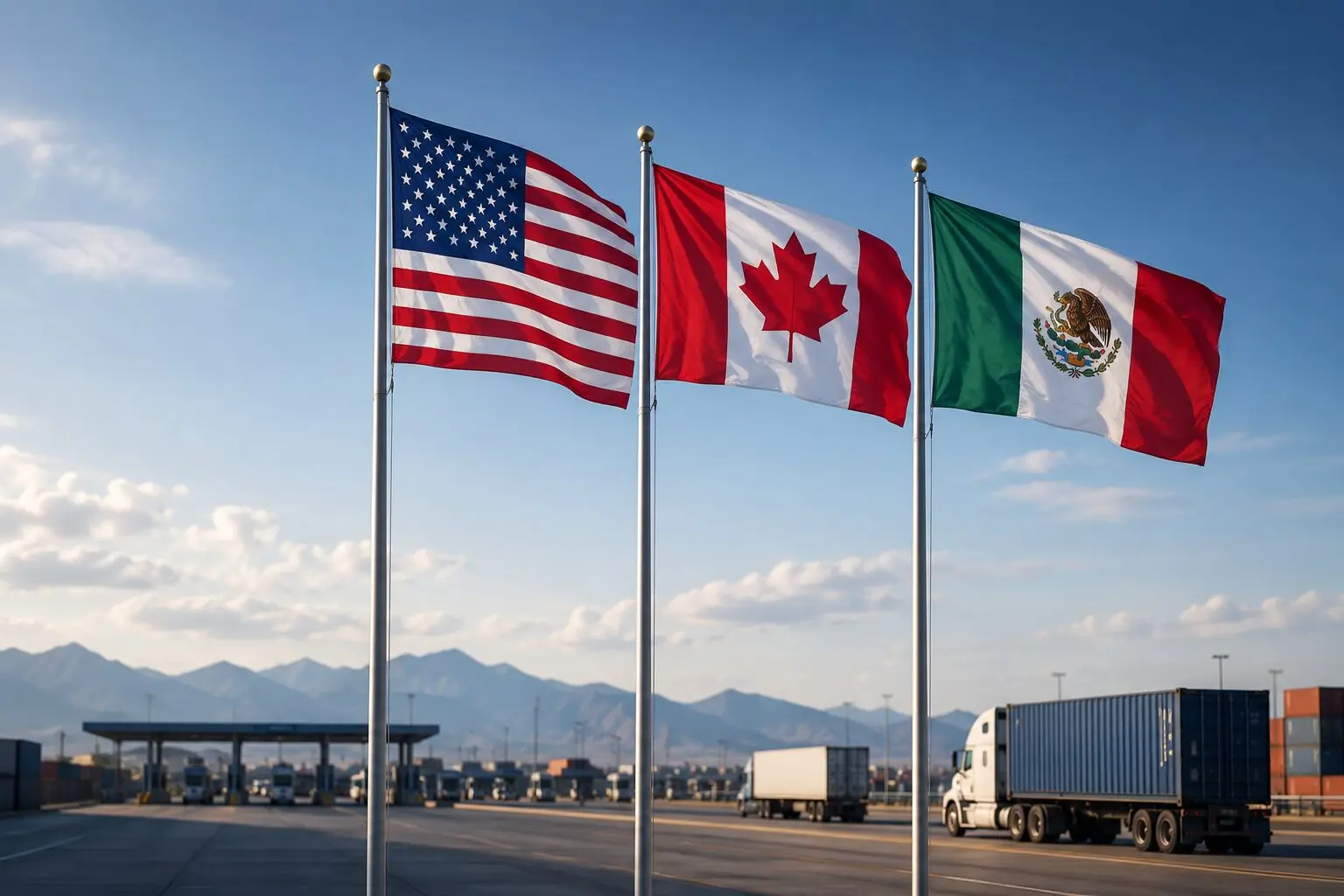
The United States has declined to renew the United States Mexico Canada Agreement in its current form, shifting North America’s core trade framework into a period of annual reviews and heightened policy uncertainty. The pact remains in force, but the decision removes the cleaner outcome sought by Canada and Mexico, a straight 16 year extension that would have carried the agreement beyond its current 2036 expiry.
This is not an immediate collapse of North American free trade. The USMCA does not expire overnight, and companies do not revert to a pre agreement tariff regime. Instead, the agreement now enters the review mechanism built into its original text. Article 34.7 provides that the pact terminates 16 years after entry into force unless all parties confirm they want a new 16 year term. If one party does not confirm, the Free Trade Commission must meet every year for the remainder of the term, unless the parties later agree to extend the agreement.
USMCA entered into force on 1 July 2020, replacing NAFTA, and the first six year joint review fell due on 1 July 2026. Canada’s official description of the process confirms that if there is no consensus to extend the agreement in 2026, annual reviews are held until the parties agree to an extension or until the agreement expires in 2036. The United States Trade Representative said the United States did not agree to renew the USMCA in its current form and would continue engaging with Mexico and Canada to address the agreement’s shortcomings and US trade deficits, while confirming the agreement remains in force pending resolution of these issues or until termination.
The practical impact is not a sudden stop in trade. It is the loss of long term certainty for one of the world’s most integrated production regions. USMCA underpins nearly US$2 trillion in US goods and services trade within North America, according to USTR, with deep cross border supply chains in autos, energy, agriculture, machinery, electronics, textiles and medical devices. A 16 year renewal would have strengthened the planning horizon for factories, logistics networks and cross border sourcing. Annual reviews create a recurring policy overhang, especially for sectors where investment payback periods are long and compliance rules are central to profitability.
The scale of exposure is visible in the trade data. In 2024, US goods and services trade with Mexico totaled an estimated US$935.1 billion and trade with Canada totaled US$909.1 billion, putting combined US trade with its two USMCA partners at about US$1.84 trillion. On the goods side, USTR data show US goods trade with Mexico at US$872.8 billion in 2025 and US$719.5 billion with Canada, a combined US$1.59 trillion, with Mexico representing roughly 55 percent of the total and Canada about 45 percent.
The trade balance explains why Washington is keeping pressure on the agreement. The US goods deficit with Mexico reached US$196.9 billion in 2025, up 14.8 percent from 2024, while the goods deficit with Canada narrowed 25.1 percent to US$46.4 billion. Combined, the US goods deficit with both partners was about US$243.3 billion, with Mexico accounting for roughly 81 percent. Services soften the overall picture but do not remove the political pressure around goods trade: the United States ran a US$33.2 billion services surplus with Canada and a US$5.3 billion services surplus with Mexico in 2024, a combined US$38.5 billion that offsets only part of the much larger goods deficit.
Early 2026 data show trade has remained active despite the policy uncertainty. US Census figures for January to April 2026 put US goods trade with Mexico at about US$317.3 billion and trade with Canada at about US$240.9 billion, a combined US$558.2 billion that implies an annualized pace of roughly US$1.67 trillion. The combined goods deficit with the two partners stood at about US$72.5 billion over the four months, with Mexico accounting for US$60.1 billion, or about 83 percent, reinforcing why US negotiators are expected to focus heavily on Mexico related rules of origin and industrial content.
The negotiating agenda is already visible. USTR has announced bilateral negotiating rounds with Mexico tied to the first joint review, covering economic security, rules of origin for key industrial goods, agriculture and a level playing field, with a third round scheduled for the week of 20 July in Mexico City. Autos remain the most exposed sector: vehicle and parts production across the three countries depends on repeated border crossings and detailed rules of origin, and any tightening of North American content requirements, steel and aluminium thresholds or third country input restrictions could raise compliance costs and reshape investment decisions across the regional supply chain. For Mexico, the key risk is that stricter rules reduce the advantage of using the country as a nearshoring platform into the US market. For Canada, the challenge is preserving preferential access while addressing US concerns in sectors such as dairy, steel, aluminium, energy and digital policy.
Why it matters: The decision replaces long term certainty with a recurring annual negotiation cycle for one of the world’s most integrated trading regions, and that changes how policy risk is priced far beyond North America. For MENA and Gulf investors, exporters and industrial companies, North America remains a large and attractive market, but Mexico centric nearshoring strategies into the United States now carry higher policy risk. Firms supplying aluminium, petrochemicals, fertilizers, energy products, auto components, logistics services and industrial inputs into North American value chains may need to reassess origin compliance and exposure to possible rule changes, since sector specific rules can now become part of a broader political bargaining process each year.
Outlook: USMCA is alive, but its risk profile has changed. The 1 July decision replaced long term certainty with the prospect of annual reviews through 2036, and the parties can still agree a new 16 year term at any point in that window. Near term attention turns to the third US Mexico negotiating round in the week of 20 July and to whether Canada secures a parallel track. For businesses and investors, the question is no longer whether North American trade continues today but how much policy risk must be priced into supply chains, factory investment and cross border market access.
Sources: United States Trade Representative; US Census Bureau; Government of Canada.