Report: A Reversal of Fortunes: Inside the World Bank’s October Reading of the Hormuz Shock, the 2027 Rebound and the Region’s AI Opening
Report page: summary and downloads →
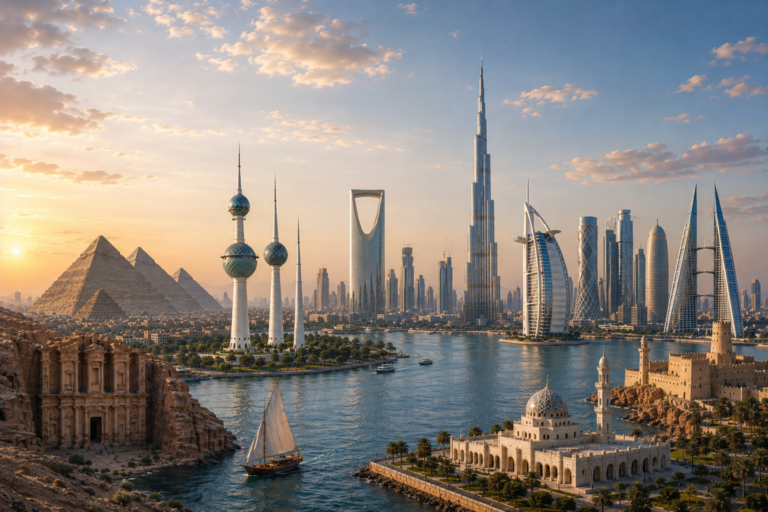
For half a century, when energy prices surged, the Gulf gained; the surge of 2026 is taxing it instead. That inversion is the central finding of the World Bank Group’s October 2026 economic update for the Middle East, North Africa, Afghanistan and Pakistan region, and the subject of The Edge’s new report, A Reversal of Fortunes, published today. The Bank projects regional output to contract 2.1 percent in 2026 after growth of 3.3 percent in 2025, with the Gulf Cooperation Council economies contracting 4.3 percent on average, and it traces the whole result to a single mechanism: the binding constraint of this shock is volume, not price.
A shock that taxes the Gulf instead of paying it
The effective closure of the Strait of Hormuz, which normally carries around one fifth of globally traded oil and liquefied natural gas, cut Gulf oil production from about 26 million barrels per day before the conflict to about 16 million in March, so higher prices arrived precisely when several exporters had fewer barrels to sell. The losses track each economy’s reliance on the strait as its sole export corridor. Qatar is projected to contract 20.9 percent, its weakest performance in more than five decades, Kuwait 14.6 percent, Iraq 12.4 percent and Bahrain 2.9 percent, while Saudi Arabia, which redirected crude to the Red Sea, is projected to contract just 2.0 percent and the United Arab Emirates 1.6 percent. Oman, whose ports face the open ocean, stands alone as the Gulf economy projected to grow this year, at 3.1 percent.
The rebound is arithmetic, and conditional
On the Bank’s central assumption that the conflict subsides by the end of 2026, the deepest cuts become the steepest rebounds: Qatar is projected to expand 26.7 percent in 2027, Kuwait 22.0 percent, Iraq 16.9 percent and the Council as a group 10.3 percent. The report presses one caution on those spectacular rates: they measure the speed of refilling a hole, not the height of a new structure. On The Edge’s calculation from the Bank’s rounded rates, Qatar’s 2027 expansion would return its output only to roughly its 2025 level, and Qatar’s recovery also rides on repaired liquefaction capacity, with the Bank’s country profile recording an estimated 17 percent loss of LNG export capacity and the North Field East expansion postponed to 2027.
Markets, importers and the food channel
Financial markets have so far declined to amplify the shock: by early September, sovereign spreads in nine regional economies, including Kuwait and Saudi Arabia, sat below their levels of 27 February, the eve of the conflict, though spreads in Bahrain, Qatar and the United Arab Emirates remained above them. The region’s developing oil importers are accelerating through the shock, with group growth projected to rise to 4.3 percent, led by Egypt, whose 5.1 percent fiscal year estimate carries the largest upgrade in the Bank’s table. The disruption’s price effects are arriving through food: the update records June food inflation above 12 percent in Qatar against headline inflation just above 2 percent, with wide gaps in Bahrain and Oman as well.
The AI opening
The update’s second half examines the transformation the region cannot postpone. The Bank finds artificial intelligence more likely to augment the region’s workers than to replace them, with fewer than 10 percent of jobs facing near term automation risk against 13 to 20 percent carrying significant augmentation potential, and it names Saudi Arabia and the United Arab Emirates as the region’s only economies in the global top 25 for both AI model development and high performance computing capacity. Between promise and productivity stand three gaps, in localization, usage and foundational capital, and the report argues the fastest route through all three is regional collaboration rather than a dozen national projects.
The full report carries the complete forecast table, the production and tanker evidence, the levels arithmetic behind the rebound, country sections on Qatar and Kuwait, and the monitoring set The Edge will track through the recovery, in English and Arabic.
Download the full report
⬇ Download the report in English
⬇ تحميل التقرير بالعربية
Sources: World Bank, The Edge.