Fed Chairman Warsh Rejects Pause Label and Restates the 2 Percent Target
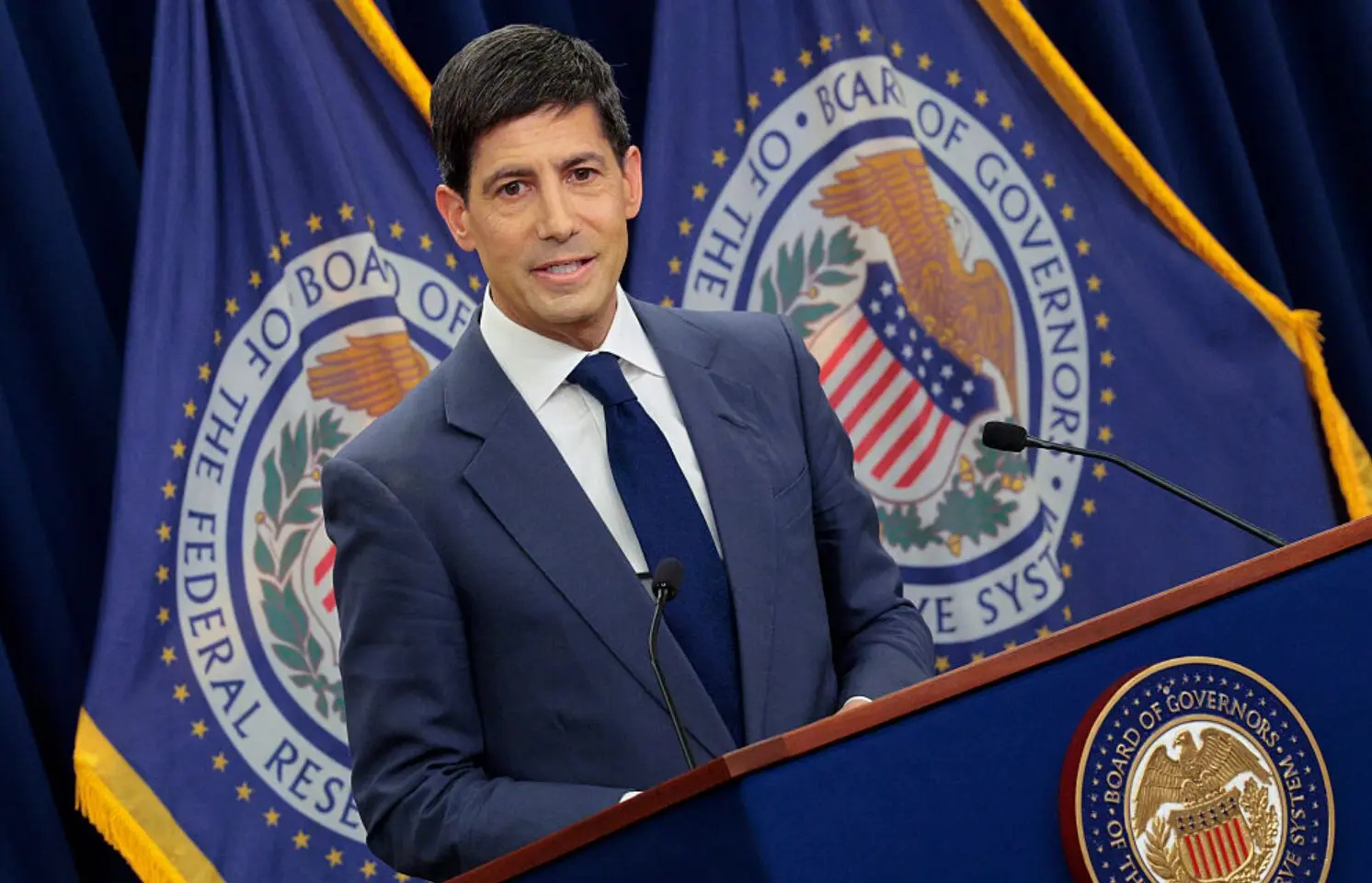
Kevin Warsh spoke for roughly ten minutes before taking questions on 29 July, in his second news conference as Chairman of the Federal Reserve. The decision itself, and the voting record behind it, are covered separately in Federal Reserve Holds Rates at 3.50 to 3.75 Percent With Three Hike Votes. What follows is confined to what the Chairman said, and to the arguments he chose to make on the record.
He made them in an unusual format. The Federal Reserve has so far published only the opening statement, a three-page document marked preliminary, and it is written in a register the institution rarely uses in a same-day communication: it names the questions the Committee argued over, states a commitment in flat declarative language, and defends a change in how the central bank communicates. The question period has not been released as an official transcript.
| Theme | What Warsh said | Source |
|---|---|---|
| The inflation target | There is no soft inflation target, and only one target, at 2 percent | Opening statement, verbatim |
| Credibility | This Fed will not waver, and credibility rests on performing its duties | Opening statement, verbatim |
| The decision | Not a pause, but a rigorous review of the economic situation | News conference question period |
| The dissents | He asked for a good family fight and got one | News conference question period |
| Market pricing | Participants are learning to play the ball, not the referee | Opening statement, verbatim |
| Readiness to act | Where necessary and appropriate, the Committee will not hesitate to act | Opening statement, verbatim |
| The news conference itself | He is committing to press conferences for the rest of this year | News conference question period |
Opening-statement quotations as published by the Board of Governors of the Federal Reserve System, preliminary opening statement issued at the Chairman’s news conference of 29 July 2026. No official transcript of the question period has been released; question-period quotations are as reported in CNBC’s live coverage of the news conference.
There is only a target, and it is 2 percent
The most deliberate passage of the statement was aimed at a belief the Chairman said had taken hold after five years of above-target inflation: that the Federal Reserve had quietly settled for something above 2 percent. He rejected it in the plainest language the Board has published in some time, saying there is no soft target and no soft implicit target, and that there is only a target, and it is 2 percent. Not one colleague on the Committee, he said, is under any illusion about it.
He paired that with an explicit limit on what the institution can deliver quickly. Five-plus years of inflation above target, he said, cannot be cured in nine weeks or by a single month of modest price decreases. That is a reference both to the length of his own tenure, which began on 22 May 2026, and to the June consumer-price report, in which the all items index fell over the month while the twelve-month rate stayed well above target.
The formulation does two things at once. It raises the stated commitment to the target, and it lowers the expectation of an immediate policy response to any single reading. Those are not in tension, and together they are the closest thing to a reaction function the Chairman has offered: the target is fixed, the response to individual data points is not automatic.
Not a pause
Asked during the question period about the case for pausing rather than raising or lowering rates, the Chairman declined the word. He said he would not characterise the decision as anything like a pause, but rather as a rigorous review of the economic situation, of the large unresolved questions in front of the Committee, and of the work the Committee has set itself to answer them. He added that this is the beginning of a story rather than the end of one.
Mechanically the two are indistinguishable — nothing moved. But the distinction he is drawing is between waiting because there is nothing to decide and waiting because the analysis is unfinished. Only the second reading is consistent with a meeting at which three officials voted to tighten.
He was also asked whether the news conference itself would survive his review of Federal Reserve communication, and he committed to keeping it. His predecessors and the institution had committed to press conferences for this year, he said, and he was committing to press conferences this year. The commitment was made for the period between now and year end, and he did not extend it beyond that. Read alongside his refusal to offer forward guidance, it sets out the shape of the new arrangement fairly precisely: the Chairman will keep appearing and answering questions, but he will not use the appearance to say what the Committee intends to do.
The four questions the Committee argued over
The statement enumerated the analytical agenda of the meeting, which is not something the Federal Reserve normally publishes on the day.
| Number | Question as posed by the Chairman |
|---|---|
| 1 | Whether five years of high inflation still conditions the present policy setting, or whether the past has really passed |
| 2 | Whether shocks of different origin, including supply chains, military conflicts, energy-supply disruptions, tariff increases and the surge in artificial-intelligence investment, differ in their effects on output and employment |
| 3 | Whether price increases arising from those shocks indicate a broader inflationary dynamic, or are simply the most visible prices |
| 4 | If interest-rate policy is the primary instrument, how much accommodation the balance sheet is still providing |
The fourth carries the largest potential consequence, and it maps onto one of the five task forces the Board announced on 9 July. Each task force has three named external leaders.
| Task force | Stated objective | Leaders |
|---|---|---|
| Communications | Review how the Federal Reserve conveys policy deliberations and decisions amid uncertainty | Peter R. Fisher, Arminio Fraga, Mervyn King |
| Balance Sheet Policy | Examine the costs, benefits and institutional implications of the current balance sheet regime | Karen Dynan, Raghuram Rajan, Jeremy Stein |
| Data | Improve the quality and timeliness of real economic signals | Raj Chetty, Doug McMillon, Kevin Murphy |
| Productivity and Jobs | Assess the economic impact of new general-purpose technologies, including artificial intelligence | Marc Andreessen, Charles I. Jones, Asha Sharma |
| Inflation Frameworks | Revisit how the Federal Reserve understands and responds to the drivers of inflation | Greg Mankiw, Thomas Sargent, William White |
If the balance-sheet review concludes that the portfolio is delivering more accommodation than intended, that is a route to tighter financial conditions that does not require moving the target range at all. It is the least-discussed consequence of the July meeting and potentially the most durable.
Play the ball, not the referee
The Chairman noted that nominal and real yields are materially higher across the Treasury curve since the previous meeting 42 days earlier, and said some of the inter-meeting increases rank around the top decile of moves over the last two decades. He then explained the rise as a consequence of reduced forward guidance rather than a failure of it: market attention, he said, centred on real data and real economic developments, prices reacted in real time to incoming information, and participants are learning to play the ball, not the referee.
He went further than description. The change is in his view one for the better, and the central bank need not always and everywhere be the centre of attention. He acknowledged the appetite for rolling forecasts and commentary and declined it, saying the Committee needs to observe market reaction direct and unfiltered, while stressing that its decisions matter a great deal and that it will not hesitate to act where necessary and appropriate.
This appears to be the most significant institutional change introduced under the current Chairman, and its effects are likely to outlast any single rate decision. A central bank that reads a large inter-meeting move in bond yields as evidence that its communication strategy is working reflects a markedly different framework from the one that prevailed for the past two decades.
The capital-expenditure claim
The one quantitative claim in the statement concerned business investment, which the Chairman called the most striking feature of the economy. In the artificial-intelligence-related category of high-tech equipment and software, he said, the most recent data show four-quarter growth rates of nearly 20 percent, which is helping to sustain the momentum of manufacturing output.
He did not present it as unambiguously good news. Capital expenditure prepares the ground for future growth, he said, but the precise timing and magnitude of the effects on the supply side remain hard to predict. That is the third of his four questions restated as a live problem: an investment boom that raises the prices of memory and logic chips and related infrastructure may be an inflationary dynamic, or may be a relative-price movement that is simply easier to see than the alternatives.
A good family fight
On the three dissents, the Chairman said he had asked for a good family fight and had got one, describing a meeting in which most of the discussion went to the large questions and in which there was more interaction among colleagues than is customary. He said the Committee did not hide from those questions.
The precedent is worth noting for scale. Three dissents in the same direction was last seen on 21 September 2016, when Esther L. George, Loretta J. Mester and Eric Rosengren each preferred to raise the target range to 0.50 to 0.75 percent and the Committee declined. At the following meeting, on 14 December 2016, the Committee voted unanimously to raise the target range to 0.50 to 0.75 percent, the level the three dissenters had wanted three months earlier, with George, Mester and Rosengren all voting in favour. It is a precedent, not a forecast, and the Chairman offered no guidance on either point.
What it means for the Gulf
Nothing the Chairman said changes any Gulf policy setting; the anchors and the regional rates are covered in the decision article. What does reach the region is informational. A Federal Reserve that publishes no forward guidance between projection rounds leaves regional treasuries, banks and debt issuers a longer stretch of calendar to cover on their own analysis, and shifts the weight onto the data releases and onto the September projections.
For well-established GCC issuers with stable ratings and deep investor books, that is an adjustment in process rather than in cost. The peg and basket frameworks are unaffected by a change in how the Federal Reserve talks. But market participants who had read intent from official language may increasingly have to rely on movements in the Treasury curve instead, and that curve moved a great deal in the six weeks before this meeting.
Why it matters: The rate was known before the Chairman began speaking. What the news conference added was the reasoning, and the reasoning has changed. The Federal Reserve is asserting a hard 2 percent target, declining to say what it will do next, and treating a large move in Treasury yields as confirmation that the arrangement is working. For anyone pricing off the dollar curve, including Gulf borrowers, the practical implication is that the curve now carries more information and the Federal Reserve’s words carry less, by design.
Outlook: Four things to watch, all of them about communication rather than the rate. First, whether the Board publishes a full question-and-answer transcript of this news conference, which would be the first test of how far the new communications posture extends. Second, the Jackson Hole Economic Policy Symposium on 27 to 29 August, hosted by the Federal Reserve Bank of Kansas City on the theme of financial innovation and its implications for payments and policy, where the Chairman said his keynote is at present a blank piece of paper and may draw on check-ins with the five task forces over the coming weeks. Third, the balance-sheet task force, because the fourth of the Chairman’s four questions points to a tightening channel that does not require the target range to move. Fourth, whether the no-forward-guidance doctrine survives contact with the September projection round, when every participant must publish a number regardless of what the Chairman declines to say.
Sources: Board of Governors of the Federal Reserve System, opening statement at the Chairman’s news conference of 29 July 2026, FOMC statements of 21 September and 14 December 2016 and task force announcement of 9 July 2026; Federal Reserve Bank of Kansas City; CNBC live coverage of the news conference.