Maersk and Hapag-Lloyd Return a Container Service to the Suez Canal as the Red Sea Corridor Steadies
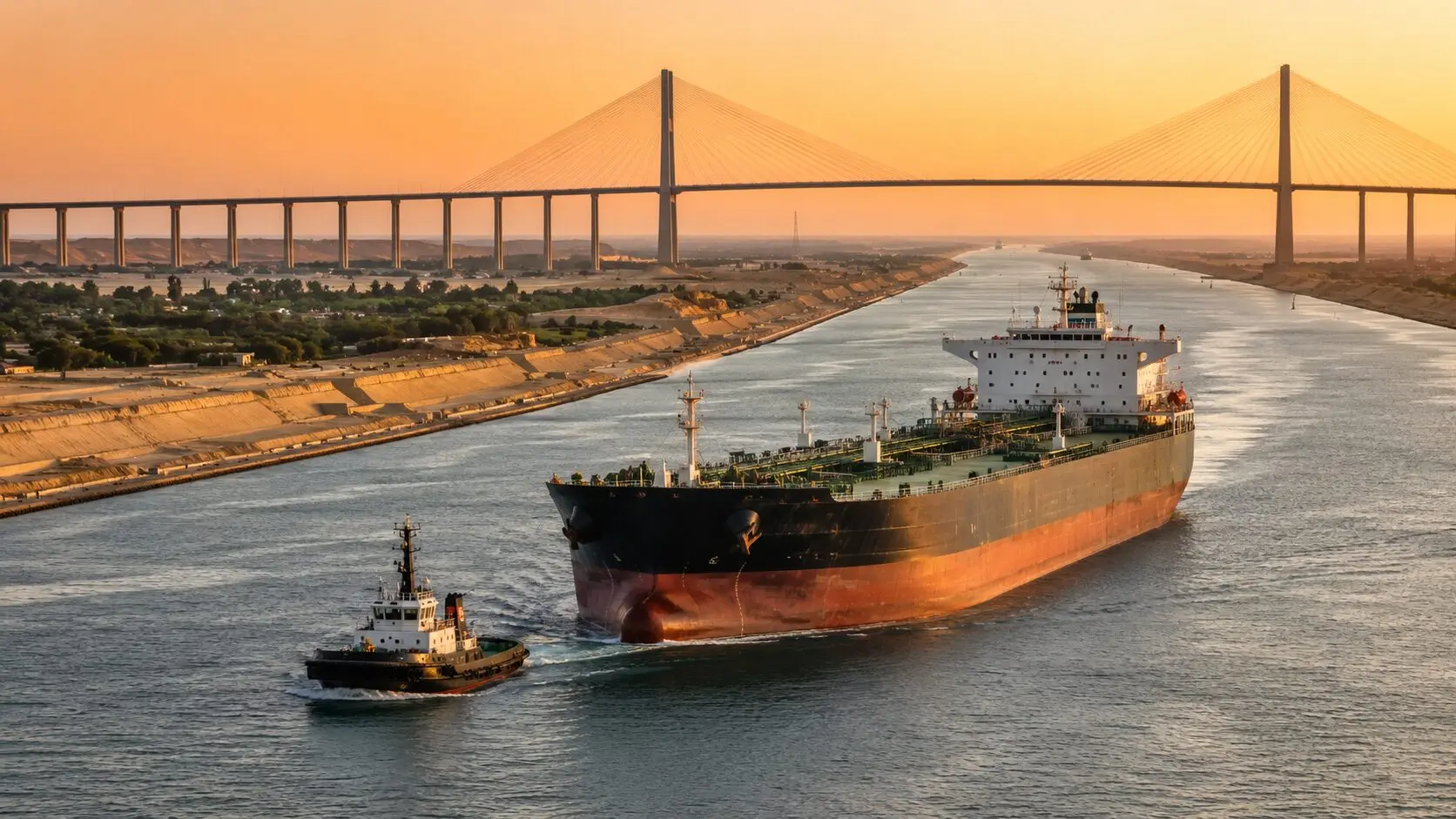
Two of the world’s largest container lines, Maersk and Hapag-Lloyd, are returning one of their main Asia to Europe services to the Suez Canal, a step that signals a cautious but meaningful normalisation of the shipping corridor that carries a large share of global trade. The partners, who operate jointly under the Gemini Cooperation, said on Monday 6 July that their AE15 service would switch from the long detour around the Cape of Good Hope back to the trans-Suez route through the Red Sea, with the vessel Majestic Maersk making the first sailing.
The decision matters because the Suez Canal is one of the most important arteries in world trade, historically handling roughly 12 percent of global shipping traffic and providing the shortest maritime link between Asia and Europe. For more than a year, security risks in the Red Sea and the Bab al-Mandeb strait had pushed most major container operators to reroute around southern Africa, adding thousands of miles, one to two weeks of transit time and significant fuel cost to each voyage, while stripping the Suez Canal of the traffic and revenue on which Egypt depends.
Maersk was careful to frame the move as measured rather than a wholesale return. In its own guidance, the company said the AE15 change followed thorough assessments of the security situation in the Red Sea area, that it applies to this single service rather than its wider East to West network, and that contingency plans remain in place to revert to the Cape of Good Hope routing if conditions deteriorate. The new AE15 rotation runs Qingdao, Kwangyang, Ningbo, Tanjung Pelepas, Port Said, Damietta, Colombo and Singapore, placing the Egyptian ports of Port Said and Damietta back inside a core Asia to Europe loop and giving the canal a visible container-service recovery marker.
This is therefore best read as a further step in a gradual process rather than a full reopening. The Gemini partners had already taken an earlier step in February, when they moved their India and Middle East to Mediterranean service, known as IMX, back through the Red Sea and Suez. The AE15 switch extends that approach to a core Asia to Europe loop.
The direction of travel across the industry points the same way. Other large operators have been steadily increasing their use of the canal through 2026 as conditions have improved, and the Suez Canal Authority has reported a recovering flow of vessels. In the period from the start of January to 8 February 2026, the canal recorded 1,315 ships, about 56 million tons of net tonnage and about 449 million dollars in revenue, up from 1,243 ships, 47 million tons and 368 million dollars in the same period a year earlier. That is an increase of about 5.8 percent in vessel numbers, 19.1 percent in net tonnage and 22.0 percent in revenue. The faster rise in revenue than in ship numbers points to an improving mix of larger, higher-tonnage vessels returning to the route. Tanker traffic in particular rose sharply through the spring as energy flows were rerouted to the Red Sea corridor, adding to the recovery in transits.
The scale of what is being recovered is considerable. Suez Canal revenue reached a record of about 10.25 billion dollars in 2023 before the disruption took hold, then fell to roughly 4 billion dollars in 2024, a decline of about 60 percent, as transits ran well below their pre-crisis levels. For Egypt, that drop removed one of its most reliable sources of foreign currency at a time when the country was already managing external financing pressures. Every incremental return of container and tanker traffic therefore feeds directly into Egypt’s hard-currency earnings and its balance of payments, which makes the resumption of a major service by two of the top global carriers a genuinely positive signal for Cairo.
The Suez Canal Authority has also been adjusting its pricing as traffic returns. The authority has set revised transit surcharges to take effect on 15 July 2026, its first broad revision in three years, including a surcharge on container vessels, with the changes framed as temporary measures tied to market conditions. Timing a fee adjustment alongside recovering volumes reflects the authority’s effort to rebuild revenue while remaining competitive against the alternative Cape route, which, though longer, carries no canal toll. The balance the authority must strike is between maximising revenue per transit and giving carriers enough incentive to choose Suez over the detour as they weigh cost, time and security.
For global supply chains, the return of services to Suez is a disinflationary signal. Shorter voyages free up vessel capacity that has been absorbed by the longer route around Africa, which tends to ease container freight rates and reduce the cost of moving goods between Asia and Europe. That effect compounds as more services return and as new vessel capacity enters the market, and it feeds through, with a lag, into the landed cost of traded goods. For importers and exporters across the Mediterranean and the Gulf, a steadier Suez corridor means more predictable schedules and lower shipping costs than the detour imposed.
For the wider region, the significance is both economic and strategic. A functioning Suez Canal underpins Egypt’s external accounts and reinforces the corridor’s role as critical infrastructure for Europe, Asia and the Gulf alike. The pace of the return will remain conditional on security conditions, and carriers have been explicit that they retain the flexibility to reroute if the situation changes. But the trajectory through 2026, from the February IMX move to the AE15 switch and the steady recovery in canal statistics, points toward gradual normalisation, and that is a constructive development for Egypt and for the trade flows that connect the region to the rest of the world.
Why it matters: The Suez Canal is both a linchpin of global trade and a top source of foreign currency for Egypt, so the return of a core Asia to Europe service by Maersk and Hapag-Lloyd is more than a routing decision. It signals that the corridor is steadying after a prolonged disruption, it supports Egypt’s hard-currency earnings at a sensitive time, and it points to easing pressure on global freight rates as shorter voyages free up shipping capacity.
Outlook: The pace of normalisation will depend on security conditions in the Red Sea, with carriers keeping contingency plans to reroute if needed. The markers to watch are whether more container services follow AE15 back to Suez, how the revised surcharges from 15 July affect volumes, and the trajectory of the canal’s monthly traffic and revenue figures, which will show how far Egypt’s most important trade asset has recovered.
Sources: Maersk; Hapag-Lloyd; Suez Canal Authority; Egypt State Information Service.