Imports Delivered 99.9 Percent of the 29.2 Percent Fall in the US Goods Deficit With China
The United States goods trade deficit with China narrowed 29.2 percent in the first seven months of 2026 against the same period of 2025, on our calculation, and almost none of that came from selling more to China. Exports over those seven months were 65,172.5 million dollars against 65,148.3 million a year earlier, a rise of 24.2 million dollars, or 0.04 percent, on our calculation.
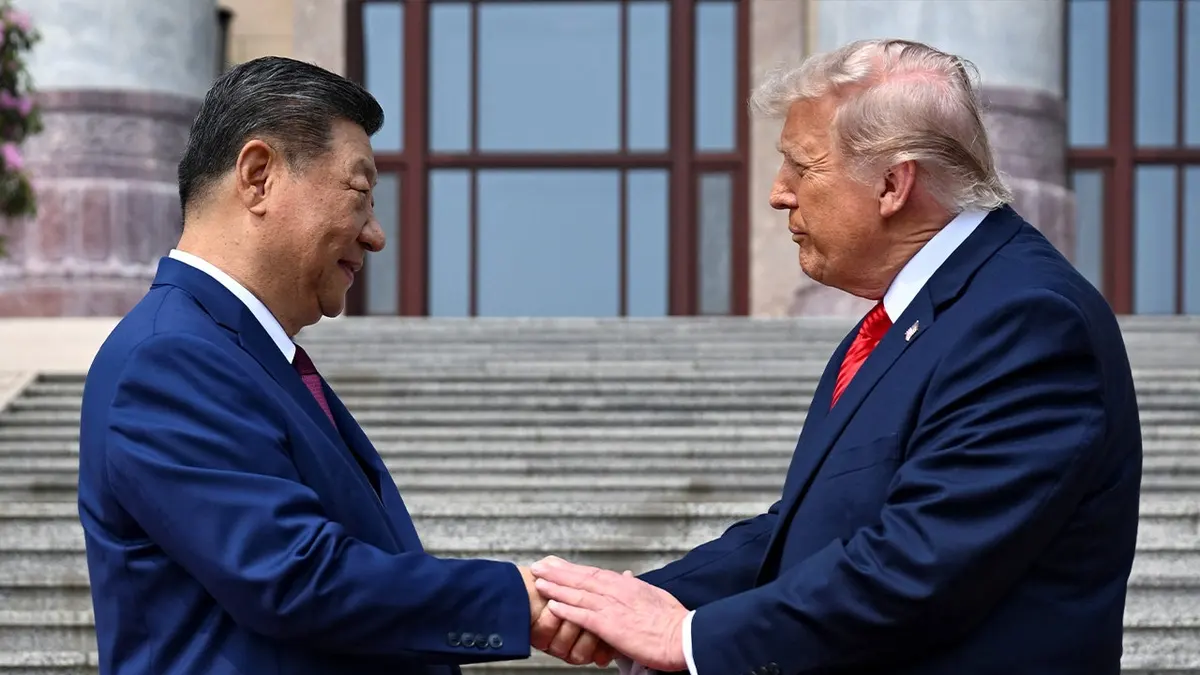
Treasury Secretary Scott Bessent and Chinese Vice Premier He Lifeng opened a day of talks at JPMorgan Chase’s headquarters in Manhattan on 20 September 2026, with United States Trade Representative Jamieson Greer also present. The talks precede a meeting between the two presidents in Washington that Reuters reports is expected on 24 September 2026. No announcement carrying that date has been published by the White House, whose statement after the May meeting in Beijing said only that President Trump would welcome President Xi for a visit to Washington this fall.
Imports delivered 99.9 percent of the narrowing
| Period | Exports | Imports | Balance |
|---|---|---|---|
| January to July 2026 | $65,172.5m | $156,390.2m | -$91,217.7m |
| January to July 2025 | $65,148.3m | $193,975.0m | -$128,826.7m |
| Change | +$24.2m | -$37,584.8m | +$37,609.0m |
Source: United States Census Bureau, trade in goods with China, monthly series, latest month July 2026, in millions of dollars. The 2026 row is the published seven month total. The 2025 row is our own sum of the seven monthly figures.
Imports were 37,584.8 million dollars lower than a year earlier, a fall of 19.4 percent, and exports rose 24.2 million dollars. The balance improved by 37,609.0 million dollars, of which the fall in imports accounts for 99.9 percent and the rise in exports for 0.1 percent, on our calculation.
The monthly series turned in May
| Month | 2026 imports | 2025 imports | Year on year |
|---|---|---|---|
| January | $21,057.9m | $41,770.4m | -49.6% |
| February | $18,955.6m | $31,654.6m | -40.1% |
| March | $20,859.0m | $29,510.8m | -29.3% |
| April | $19,789.2m | $25,332.4m | -21.9% |
| May | $23,507.8m | $20,424.5m | +15.1% |
| June | $25,150.0m | $18,898.7m | +33.1% |
| July | $27,070.7m | $26,383.6m | +2.6% |
Source: monthly series as above, in millions of dollars. The year on year column is our own calculation.
American imports from China ran 49.6 percent below their year earlier level in January, on our calculation, and below it in every month through April. From May onward they ran above it. Those four months opened a gap of 47,606.5 million dollars against 2025, on our calculation. May, June and July gave back 10,021.7 million of it, leaving the seven month narrowing at 37,584.8 million.
The low point was February, at 18,955.6 million dollars. July was 27,070.7 million, 42.8 percent higher, on our calculation, though the level series did not climb every month: April fell back below March.
What the May meeting left unfinished
The White House said after the May meeting in Beijing that China had approved an initial purchase of 200 American made Boeing aircraft, which it described as China’s first commitment to buy Boeing aircraft since 2017, and that China would purchase at least 17 billion dollars a year of American agricultural products, prorated in 2026 and in full in 2027 and 2028. The same statement chartered a Board of Trade to manage bilateral trade across non sensitive goods and a Board of Investment as a government to government forum, and recorded that China would address American concerns over supply chain shortages in rare earths and other critical minerals, naming yttrium, scandium, neodymium and indium.
The Ministry of Commerce release announcing the current trip describes the consultations as guided by the consensus reached between the two heads of state and names no figures. It says He Lifeng will lead a delegation to the United States from 19 to 23 September 2026 for economic and trade consultations.
Bessent said before entering the talks that he looked forward to focused, fulsome and constructive discussions. On artificial intelligence he said the United States remains the leader in the field and is open to discussions on avoiding shared risks and avoiding bifurcation of the two systems.
The tariff authority underneath the talks has changed
Neither of the arrangements expiring in November restores the duties terminated by the February order, on our reading.
On 20 February 2026 the Supreme Court held that the International Emergency Economic Powers Act does not authorise the President to impose tariffs. Executive Order 14389, signed the same day, terminated the additional duties imposed under that authority, among them the order carrying the China fentanyl duties and the order carrying the reciprocal tariffs. The order states that it affects only duties imposed under that Act and does not affect any other duties, including those imposed under Section 232 of the Trade Expansion Act of 1962 and Section 301 of the Trade Act of 1974.
What sits on the November clock is Section 301, in two separate actions that expire on the same day. The Trade Representative extended 178 product exclusions from the Section 301 tariffs on Chinese goods through 9 November 2026. The Section 301 action covering China’s targeting of the maritime, logistics and shipbuilding sectors was separately suspended for one year, running from 10 November 2025 through 9 November 2026, following the trade and economic deal announced on 1 November 2025 after the two presidents met in South Korea.
Reuters reports that a separate investigation into industrial capacity in China is being finalised. No final determination or proposed tariff action from it has been published.
Why it matters: The narrowing is an import story. Exports were 65,172.5 million dollars across the seven months, 24.2 million above last year, on our calculation, so a 37,609.0 million dollar improvement in the balance delivered almost nothing to American sellers. Timing is the second point. Imports from China ran 49.6 percent below their year earlier level in January and 2.6 percent above it by July, on our calculation. The additional duties imposed under the International Emergency Economic Powers Act, including those on Chinese goods, were terminated on 20 February 2026. The monthly series did not cross above its year earlier level until May, three months later. No approved source has published an attribution linking the two, and this report does not offer one.
Outlook: Two dates carry the arithmetic. Both Section 301 arrangements expire on 9 November 2026, the 178 product exclusions and the suspension of the maritime action ending on the same day, and neither was touched by the February order. Whether they are extended, modified or allowed to lapse is the question in front of the negotiators. The second date is 6 October 2026, when the August trade figures are released. July ran 2.6 percent above its year earlier level, on our calculation. August is the first month that can show whether that is repeated. The export line is where a purchase commitment would show up. Across seven months it has moved 24.2 million dollars, on our calculation.
Sources: United States Census Bureau, The White House, Office of the United States Trade Representative, Supreme Court of the United States, Ministry of Commerce of the People’s Republic of China, Reuters.