US Services Sector Keeps Growing in June as Price Pressures Ease and Hiring Returns
The US services sector, which accounts for the largest share of the world’s biggest economy, expanded again in June, with the closely watched Institute for Supply Management Services PMI reading 54.0 percent, down half a point from 54.5 percent in May. The reading, released on Monday 6 July after a delay from its usual first-business-day timing because of the Independence Day holiday, marked the 24th consecutive month of expansion and pointed to an economy that is still growing even as the pace moderates. A number above 50 signals expansion in the services industries that make up roughly two thirds of US output.
The detail behind the headline was more encouraging than the modest dip suggested, because the two developments that matter most for the inflation and interest rate outlook both moved in a helpful direction. Price pressures eased and hiring returned.
The Prices Index, the survey’s inflation gauge, fell 3.6 points to 67.7 percent, its first reading below 70 percent since February and its lowest in four months. Prices paid by services firms have now risen for 109 consecutive months, so this is not deflation, but the slower pace of increase matters. Through the spring, services costs had been one of the stickier components of US inflation, and a move back below 70 suggests that some of the cost pressure feeding through supply chains is beginning to ease. The survey committee chair, Steve Miller, noted that respondents continued to cite tariffs as a theme in pricing but referenced petroleum-related costs less frequently than in prior months, and pointed to crude oil falling below 70 dollars a barrel for the first time since February, a drop of more than 30 percent from its high, as a factor expected to ease price pressure into the autumn.
The employment picture also improved. The Employment Index rose 3.3 points to 51.2 percent, returning to expansion after three straight months of contraction. Of the 18 services industries tracked, nine, representing more than 58 percent of US gross domestic product, reported higher employment in June. Miller attributed part of the pickup to hiring connected to the World Cup being held in the United States, but also to a broader sense that stabilising supply chains and sustained demand had given businesses the confidence to add staff selectively. That is a notable shift after a run of monthly contractions in services employment.
Not every component strengthened. Business Activity, the measure of current output, fell 2.3 points to 55.4 percent, and New Orders eased 2.2 points to 55.1 percent, its 13th month of growth. Both remain comfortably in expansion, but the softer readings show that momentum has come off the highs of earlier in the year. Supplier Deliveries slowed to 54.4 percent, while Imports slipped into contraction at 49.4 percent and the Backlog of Orders rose to 54.9 percent. The overall message is of a sector still expanding on demand, with output and new business growing more slowly but hiring and pricing moving in directions that policymakers would welcome.
ISM translates the headline reading into a growth signal, noting that a Services PMI of 54.0 percent over time corresponds to an increase of about 1.9 percentage points in real gross domestic product on an annualised basis. On that measure the broader economy has now expanded for 73 consecutive months. Taken with the manufacturing survey, the two readings describe an economy still growing at a moderate pace across both goods and services.
The June services print lands within a broader set of US data that has softened at the edges without breaking. The ISM Manufacturing PMI for June, released on 1 July, came in at 53.3 percent, down 0.7 point from May but still a sixth straight month of expansion. The June employment report, published on 2 July, showed nonfarm payrolls rising just 57,000, a marked slowdown from May, with the unemployment rate at 4.2 percent, held down in part by a fall in labour force participation to 61.5 percent. Set against that softer headline jobs number, the return of the services employment index to expansion is a reminder that the survey diffusion data and the actual payroll count do not always move together, and the World Cup hiring effect flagged by ISM is a reason to read the June employment strength with some caution.
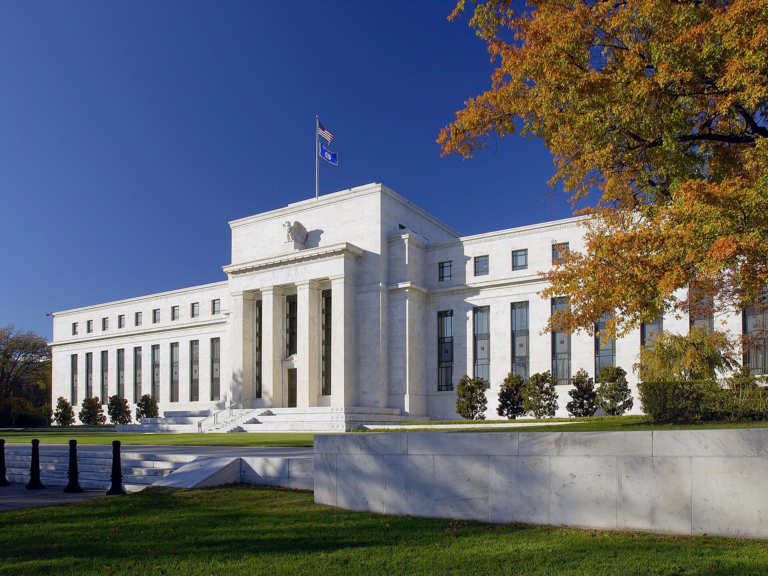
For the Federal Reserve, the combination is broadly reassuring. The central bank held its target range at 3.50 to 3.75 percent at its meeting on 17 June, the first chaired by Kevin Warsh, and its projections leaned toward keeping policy restrictive while inflation risks remained tilted upward. A services survey showing continued growth, easing price pressure and firmer hiring supports the case for patience rather than urgency: it neither forces the Fed toward cuts by signalling weakness, nor demands tightening by showing runaway costs. The softer Prices Index in particular gives the Fed a little more comfort that the disinflation process, though slow, is still intact.
For the Middle East and North Africa, the read across runs through familiar channels. A US economy that keeps expanding at a moderate pace supports global demand and trade, which matters for Gulf exporters and for the wider region’s growth. The path of US interest rates shapes dollar strength and Treasury yields, which transmit to the Gulf through the dollar pegs and influence regional liquidity, borrowing costs and investor risk appetite. And the easing in services price pressure, linked in part to lower oil prices, is a reminder of how tightly the region’s most important export is woven into the inflation story of its largest customer economy.
Why it matters: The ISM Services survey is the timeliest read on the largest part of the US economy, and June’s report told a constructive story beneath a softer headline: growth continued, hiring returned to expansion, and the key inflation gauge fell to its lowest in four months. For a Federal Reserve trying to bring inflation down without breaking the economy, that mix of steady demand and cooling prices is close to what a soft landing looks like, and it keeps the central bank on a patient path that shapes dollar and rate conditions felt across the Gulf.
Outlook: The next markers are the June consumer and producer price reports, the Fed’s late-July meeting, and the July ISM Services release due on 5 August. If prices keep cooling while activity holds up, expectations for eventual rate relief could firm; a reacceleration in costs, particularly if tariffs feed through more strongly, would push in the other direction and keep the dollar and US yields supported.
Sources: Institute for Supply Management; CNBC; Federal Reserve; US Bureau of Labor Statistics.